The Places of Pyre: The Warriors’ District

This is part of my “Pyre” world.

The Warriors’ District

Common Enemies: Ghosts and Zombies

Pyre needed its defenders. These warriors trained in many fighting styles, favoring hand-to-hand combat (since shamans could handle ranged fighting). Their halls contain many holograms endlessly re-enacting their stances and strikes.

Children who were not chosen as shamans were also considered for warriors. Because of the shamans’ criteria, the warriors tended to get more stubborn meatheads than the shamans. As a result, the warriors evolved a very strict and rigid culture of rigorous physical exercise and discipline.

Warriors prized inner strength, physical ability, and shrewdness in battle. Because Pyre was de facto ruler of the world for as long as it stood, warriors rarely concerned themselves with large-scale war strategies. They preferred to analyze specific battle tactics. They were most impressed by clever maneuvers on the battlefield.

Warriors also tended to look down on the shamans for relying on external rituals instead of inner strength.

Warriors all wore uniforms of various cool blues with white trim. The classic warrior uniform was a loose sleeveless shirt and loose pants, tied with a sash.

This district is crisscrossed with dozens of simple trenches and fortifications, besides its many (now ruined) training halls and barracks. The warriors depended on themselves, not traps, to hold back the invaders.

This had an interesting side effect. Humanoid constructs were rare in the warriors’ district, and offensive constructs were absolutely forbidden. So, roving constructs have never visited the warriors’ district. As a result, the many undead who arose here from the corpses of the warriors, wizards, and shifters have remained unmolested for centuries.

The Demonstration Halls

Most halls were built along the same lines: A long hallway, lined with statues and holograms, leads to a central training room that takes up most of the hall’s space. There are a number of small rooms off the main chamber, storing weapons, equipment, and training dummies. Huge windows, high on the walls, combine with skylights to bathe the rooms in light.

The Training Halls

These long, low buildings were used—surprisingly enough—as training grounds for the warriors. Different halls were used for different ages and types of warriors.

They consisted of two primary designs: a circular arena surrounded by high seats, and a long hallway, sometimes in a shape that wrapped around on itself.

In the arena design, warriors were pitted against each other, or simple but incredibly deadly constructs. Teenagers, for example, often fought spinning cylinders studded with long blades.

The hallways were designed as extended gauntlets. Spears shot from cubbyholes, blades of all kinds would appear out of tiny slots, and in general, dangers could attack from anywhere. Some of them even simulated urban combat, leading trainees into faux cellars and sewers.

The Gauntlet of Chains

This is a simple, room-by-room training hall. Upon entering, the door slams behind you, and the door on the opposite site does not open until you have defeated the room’s challenge.

Room One: Frenzy

Gauntlet of Chains Room 1

Gauntlet of Chains Room 1

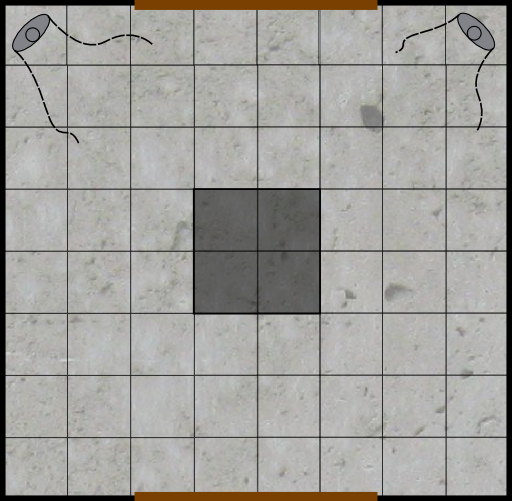
The first room is a simple square affair of stone block. In each corner floats a stone cylinder with a spherical red eye. In the center of the room is a three-meter-square raised stone platform, about two feet from the ground. Over the platform hang half a dozen chains that disappear into tiny holes in the ceiling. The exit door is adorned with carvings of three criss-crossed chains.

As soon as the entrance door closes, the cylinders come to life and fire bolts of force at the intruders. The cylinders cannot float onto the platform in the center of the room. The cylinders will avoid attacking any intruder that is already being attacked by another cylinder.

If three adventurers all pull on the chains during the same combat round, the cylinders cease fire and retreat to their corners, and the exit door opens.

Room Two: The Pit

Gauntlet of Chains Room 2

Gauntlet of Chains Room 2

In the center of this room is a pit three meters deep. On either side of the entrance door is a stone statue of a gargoyle-like humanoid holding long chains.

There are four silver keys scattered around the room, and each side wall holds two keyholes.

When the entrance door closes, the statues come alive and attack the intruders. The chains wrap around an individual (damaging them) and whip them into the pit (whereupon the intruder takes falling damage).

The adventurers must place all four keys into the keyholes. Once that’s done, the statues retreat to their original positions and the exit door opens.

For an optional extra challenge, each key is made of a different metal, and each lock is made of a corresponding metal, so the keys must be matched to their appropriate locks.

Room Three: Lightning Strikes
Gauntlet of Chains Room 3

Gauntlet of Chains Room 3

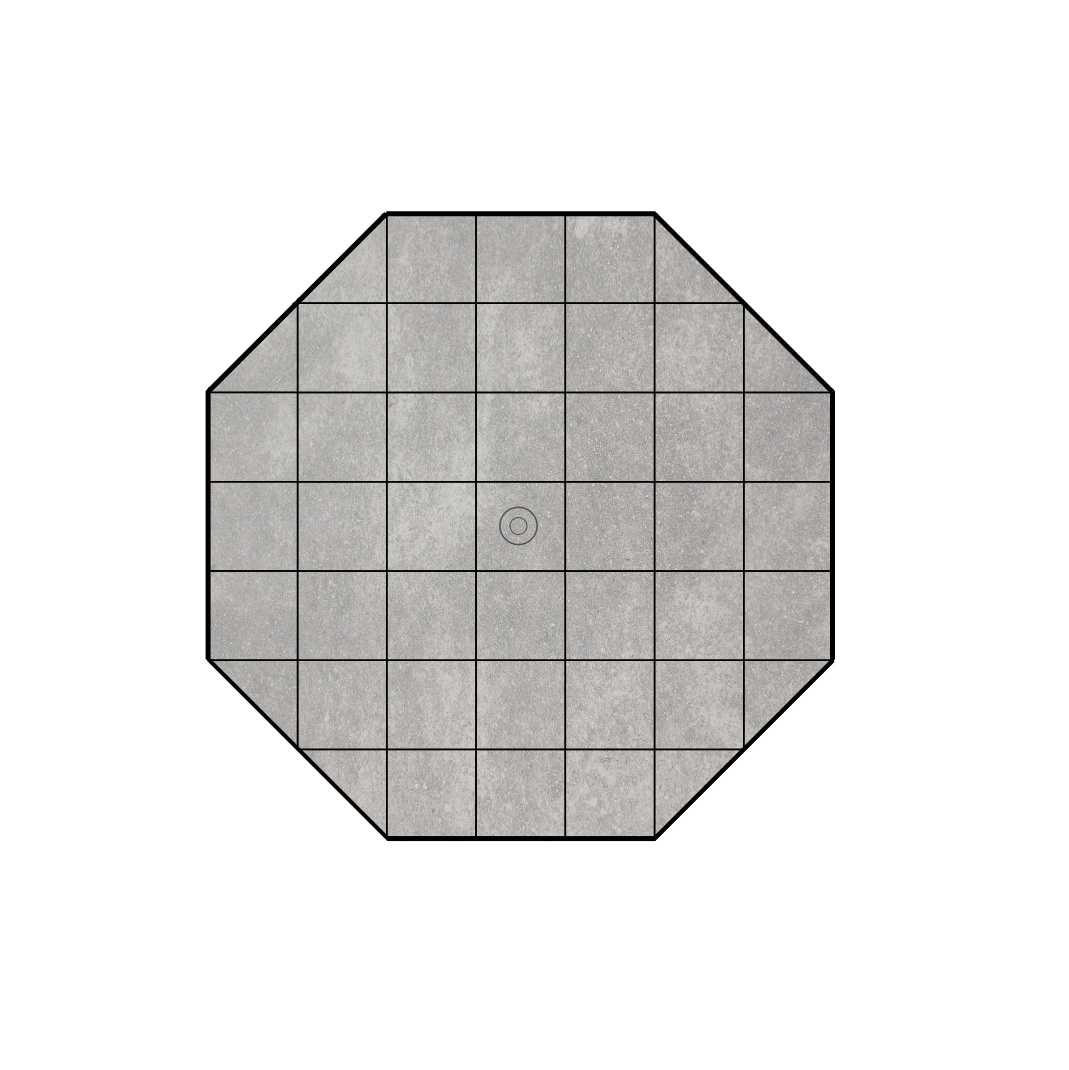
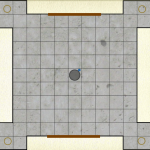
There are cubbyholes in each corner of this room. Each contains a metal ring floating parallel to the floor, within which runs a set of chains that disappear into the ceiling and floor. The chains are studded with small gems.

In the center of the room floats a large metal cylinder, through which further chains descend from the ceiling through holes in the floor. A thin silver ring runs around the center of the cylinder, about two meters off the floor, and on the silver ring is a cold blue orb.

When the entrance door closes, all the chains in the room begin moving up and down. Every other turn, the gems on the chains in the four cubbyholes align, and lightning bursts out, covering the appropriate quarter of the room.

Meanwhile, the blue orb aims at the nearest intruder and strikes him or her with lightning. The blue orb can only attack one creature per turn.

Destroying the metal rings in a cubbyhole will disable the lightning attacks from it, and the cylinder in the center can be disabled or attacked until it is destroyed.


Categories: Pyre | Tags: | Leave a comment

The Places of Pyre: The Merchant’s District

This is part of my “Pyre” world.

The Merchants’ District

Common Enemies: Oriforged Constructs, Chewers, and Shockers

Pyre was a relatively industrial civilization, so it needed a lot of trade with nearby countries for raw resources. Thus the need for merchants, who were some of the best in the world at the time.

This district was the primary target for looting during Twilight. It’s now a burned-out shell, thoroughly picked over and haunted by the spirits of many of the innocent merchant families who died here.

Geyser Courtyard

Geyser Courtyard

A common trap area in the Merchant’s District is the acid geyser courtyard.

The Treasury

In the center of the merchants’ district sits the treasury. While this had the largest concentration of money in Pyre, there was actually more money in total secreted away in various vaults in the Depths. Nevertheless, the treasury is an impressive, almost impregnable fortress, and has the convenience of a large, straight underground passageway to the Depths.

Entering the treasury requires a long walk down a hallway. One wrong step and jets of fire leap out to attack you. Those traveling down the hallway must learn to avoid the lightest-colored squares.

Treasury Entry Hallway (Merchant's District)

Treasury Entry Hallway (Merchant’s District)

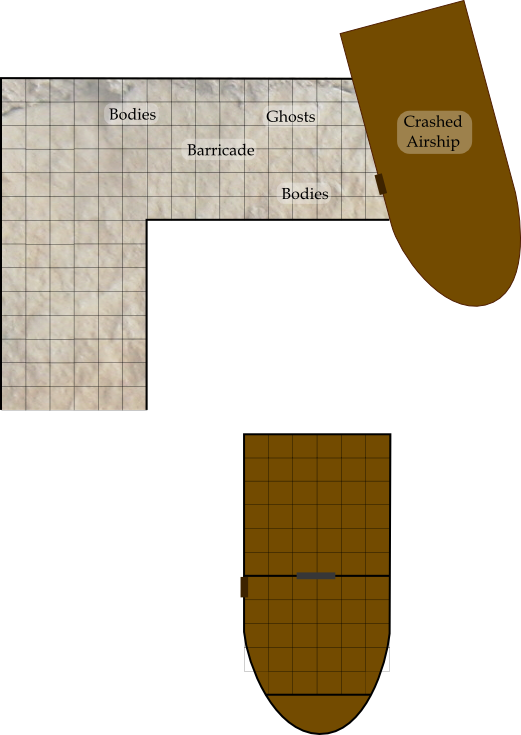
In one street in the Merchant’s District, an airship has crashed, and is filled with undead.

Crashed Ship Street

Crashed Ship Street

Categories: Pyre | Tags: | 1 Comment

The Places of Pyre: The Shaman’s District

This is part of my “Pyre” world.

The Shamans’ District

Common Enemies: Ghosts, Doms, Oriforged Constructs, and Chewers

Of course, the shaman were the holiest of people in Pyre. Older shamans lived in opulent apartments, but most lived relatively ascetic lives.

They could mount the best defenses, of course, so their district is now a complex series of bunkers, defensive trenches, temporary fortifications, and buried scrolls. Adventurers must face co-ordinated attacks from well-designed automated defenses, and for little reward except that found in the Crystal Academy.

The Crystal Academy

Crystal Academy Tower Level (Shaman's District)

Crystal Academy Tower Level (Shaman’s District)

This is where all young shamans train, and receive their first marks. It is made of five crystalline towers in a “Y” shape, the center taller than the others.

Children were usually brought in to the academy at the age of six, after several senior shamans applied a large set of rules and standards. The program mostly looked for very healthy and obedient children. Children entering the academy went through a ritual that turns them into acolytes; this created a triangular tattoo on the back of their right hands.

Acolytes actually did comparatively little magic; they mostly studied and worked as servants for the rest of the shamans in the Academy. Once a child reached adolescence (at about 13 years of age), he or she went through a ritual to become an Attendant, who could perform minor rituals and generally assist with full shamanic duties. The Attendant ritual added a secondary triangular tattoo around the Acolyte triangle. At the age of about 17, Attendants went through a rigorous ritual to become full shamans; this added a third triangle.
Shaman magic worked differently for men than for women, so boys were trained by male shamans and girls by women.

Entering the Crystal Academy, one must pass through a hallway. Human statues spit streams of acid above one’s head, into basins opposite. If unexpected people enter, the statues will turn and spit acid at them. Levers at the other end of the hallway switch off the statues.

The Academy’s towers are made up of many circular levels.

The Grand Auditorium

Near the Academy lies the Grand Auditorium, where shamans would demonstrate their skills in construction. Many constructs were first demonstrated here. Its large, half-dome shape is now cracked and partly fallen.

Beneath the auditorium is a warren of dressing rooms and cages for animals and constructs that would be lifted onto the stage through trap doors. These trap doors are now weak, of course, so any travel across the auditorium stage is dangerous. Worse, giant centipedes have built a nest beneath the stage.

Behind the Auditorium (across from the Academy) are many dead formal gardens. The spirits of the garden may be found here, unhappy at the death of their beautiful patron trees.

Shadow Town

Before a construct could be presented at the Grand Auditorium, it had to be tested, as were many rituals created by the highest orders of shamans over the centuries. So, the Unmentionables toiled for years to build Shadown Town, an empty neighborhood of streets and buildings. It was a perfect place to unleash a newly built ritual.

Many younger shamans fled here during the last desperate days of Twilight, so the streets are full of unsprung traps and skeletons.

The Stone Pits

The rituals of the shamans required huge supplies of raw materials; they transmuted tons of stone and metal every day. These pits and mounds were created to house these raw materials. Despite the popular name of this place—the Stone Pits—the pits contain mounds of various precious and common metals as well as several kinds of stone.

They are now best avoided; mountains of ore and unstable rocks make for terrible footing. Moreover, a colony of rust beetles has taken up residence in the huge pile of iron.

The Journeymen’s Halls

Many shamans were assigned to roam the world, performing rituals for the public good. These journeymen (despite the name, many were female) often returned to Pyre for short periods, and they were housed in large halls built just for them.

The main floor was a public gathering place, full of tables and chairs (and, sometimes, a stage), where a plate of food and a sympathetic ear could always be found. Upstairs, the journeymen stayed in comfortable apartments, never opulent but always tasteful and relaxing.

Of course, these are all ruins now. However, many journeymen left personal belongings here in the rush to defend Pyre, so a curious person could find crystals and other personal effects that could go a long way towards explaining the mysteries of Pyre.

A few of the larger apartments were meant for visiting delegations, and these each held a yard-square block Projector.

The Animal Pens

The Academy required a lot of food. Animals were kept in pens in the southwest of the district, the smelliest ones near the Merchants’ District.

Categories: Pyre | Tags: | 1 Comment

How to Run an Online RPG Convention


'Magnum, P.I.' by Mira Hartford on Flickr

‘Magnum, P.I.’ by Mira Hartford on Flickr

Indie+, an online RPG convention on Google+, finished today. I was one of the four sponsors who co-ordinated and ran the whole thing: 21 games and  7 panels scheduled for all hours of the week, including integration with YouTube, Google+, and a wiki.

A few weeks ago, we put out a call for potential hosts, asking them to add potential games or panels to our wiki. Once the new Event functionality appeared on Google+, we switched to that: we asked hosts to create an Event for their game or panel, then share it with our Indie+ page on Google+. We then re-shared those Events with our followers, and updated a Google Calendar and a schedule on the wiki.

Why did we have both a Google Calendar and a schedule on the wiki? Because we didn’t think about having a GCalendar initially, then someone set it up for us. We couldn’t integrate the GCalendar into the wiki, and folks had been told to fill out the wiki. So we ended up maintaining both.

Then we discovered some misleading terminology and unfortunate functionality within Events. An “Event On Air” couldn’t be streamed live, for example, and starting a Hangout (live video chat) from within an Event blocked it from live streaming, too. So we had to ask hosts to manage the Hangout separately from the Event.

Each sponsor took responsibility for one major element of the con: panels for one person, games for another, etc. This turned out to be a mistake, as we had games spanning a fairly wide range of time zones, so the Game Guy (me) couldn’t always be around to help.

So we leapt over stumbling blocks, and stumbled plenty ourselves. The result? 13 games and 7 panels happened, which was recorded into a total of 36 hours’ worth of indie RPG games and discussions.

Because we went ahead and did it. FILDI.

Categories: Uncategorized | 1 Comment

50 Games in 50 Weeks: Shadowrun 4E

Shadowrun on My Mind by John McKenna

Shadowrun on My Mind by John McKenna

I’d heard bad things about Shadowrun, that the world was much more fun than the system.

Fortunately, I played 4th Edition, which made complete sense. Character sheets were heavy-laden with skills and stats, but easy to understand.

The system features a straightforward core mechanic: assemble a die pool out of your abilities and roll it against a target number. If you roll a lot of 1s, something really bad happens.

The system benefits from many years of evolution. I felt like the system started with a heavy emphasis on crunch, then over time the more complex parts were re-factored out and storytelling elements were worked in. The current incarnation can handle crunch-heavy and crunch-light games with ease.

I also had the good fortune to play under an awesome GM. He knew the system, he knew the adventure, and he was completely open to player actions. He listened.

We finished in about two hours, which was half of our four-hour slot at Origins. The GM apologized, and offered to throw other stuff into the adventure; we players thanked him and politely declined. We were happy to have some extra time at the con, especially after a fantastic, memorable session. Much better to play a great two-hour session than a four-hour slog.

I don’t actually remember much of the system; I mostly remember having a great time. Isn’t that awesome?

Categories: 50 Games in 50 Weeks | 5 Comments

The Places of Pyre: The Nobles’ District

This is part of my “Pyre” world.

The Nobles’ District

Common Enemies: Shockers, Oriforged Constructs, Entrapment Orbs, and Doms

This district once housed the nobles who co-ordinated life in Pyre.

They went craziest during Twilight. They mounted elaborate death traps that quickly broke down, and stationed—all told—thousands of Constructs to guard their property. As a result, the Nobles’ District is the most confused wreck of the city, as it contains many well-guarded mansions. However, great wealth can often be found within those mansions.

Near the north end of the Nobles’ District is the Hall of Statecraft. This is a long, low building with a tall center tower that now leans badly to the side. That tower holds a huge array of communications equipment, which an enterprising adventurer may be able to decipher and get working again.

A good example of the sorts of dangers in the Nobles’ District is a lightning hallway: flame jets erupt from spaces in the walls at intervals: on, on, off (but they start at different points in the cycle). At the other end of the hallway, a damaged orb fires blasts of lightning at anything that nears.

The Design of the Houses

Most manor houses were designed more for entertaining than for habitation. As such, most are an “eclectic” jumble of rooms 10 to 20 yards on each side, occasionally connected by long hallways.

The nobles were badly looted during Twilight, so little furniture remains. However, quite a few treasure chests were hidden beneath floors and behind paintings.

There are plenty of traps, though. The nobles loved traps with the following triggers:

  • Pressure plates on the floor
  • Sensors indicating movement
  • Sensors indicating the presence of a living creature

These traps usually cause:

  • Poison darts
  • Jets of fire
  • Clouds of poison
Categories: Pyre | Tags: | Leave a comment

Quick Promotion

Indie+ LogoI’m helping to run an online game convention, Indie+. It’s a con run as a set of independently-run games and panels, all organized centrally and run as Google+ Hangouts. It’s running this week.

I volunteered to shepherd the gaming side of things. There are quite a few moving parts, including several different schedules to sync. I figured it’d be no big deal, as we were running this for the first time, so I wouldn’t have too many games to manage.

We have 20 games. Small by most con standards, but a heck of a lot for me to keep track of when it’s my first time and none of it’s automated.

Fortunately, all is going well so far. We’ve got a helpful team running the con, and plenty of interest.

So if you’re interested in RPGs, especially independent ones, head over to the schedule and look for a game or a discussion. Plenty are open for folks to watch. I hope you find something interesting.

Categories: Role-playing | Leave a comment

The Dangers of Pyre: Shockers

This is part of my “Pyre” world.

Shockers are man-sized metal cages with long, serpentine metal legs, which patrol a limited area for intruders. When an intruder is detected, the shocker wraps its tentacle-like legs around its enemy, drawing it towards the cage. Once the enemy is captured, the cage closes and is electrified, and the enemy is shocked into unconsciousness.

Shockers are particularly popular in the Nobles’ and Merchants’ Districts of Pyre.

Categories: Pyre | Tags: | Leave a comment

The Dangers of Pyre: Oriforged Constructs

This is part of my “Pyre” world.

A number of ancient sentinels wander the empty streets of Pyre. A common design involves a large humanoid about 10 feet tall, hunched over slightly, with large forearms, and made entirely of orichalcum. A tiger-like creature was another common design.

Oriforged Constructs are powerful at melee attacks only, and can only remember simple instructions, usually “Keep anyone from entering this area.” They have high hit points and do a lot of damage, and are very easy to hit.

Because of their programmed nature, certain crystals will deactivate a Construct when waved directly in front of it.

Categories: Pyre | Tags: | Leave a comment

Let’s Play an Interesting RPG, episode 11: Houses of the Blooded session 1, part 3 of 3

In our 30 June 2012 session, we played Houses of the Blooded, a storytelling game of intrigue and tragedy.

The Group: Let’s Play an Interesting RPG

The System: Houses of the Blooded

The Players

  • Brent P. Newhall, GM (@BrentNewhall, this site)
  • Brian Kelsay (@ripcrd)
  • Joe England
  • Larry Moore
  • Michael R.
  • Stacy Dellorfano
  • Thomas Caruso

Video (part 3 of 3)

[podcast format=”video”]http://rpg.brentnewhall.com/media/LetsPlay-0011-part3.m4v[/podcast]

Categories: Let's Play an Interesting RPG | 4 Comments