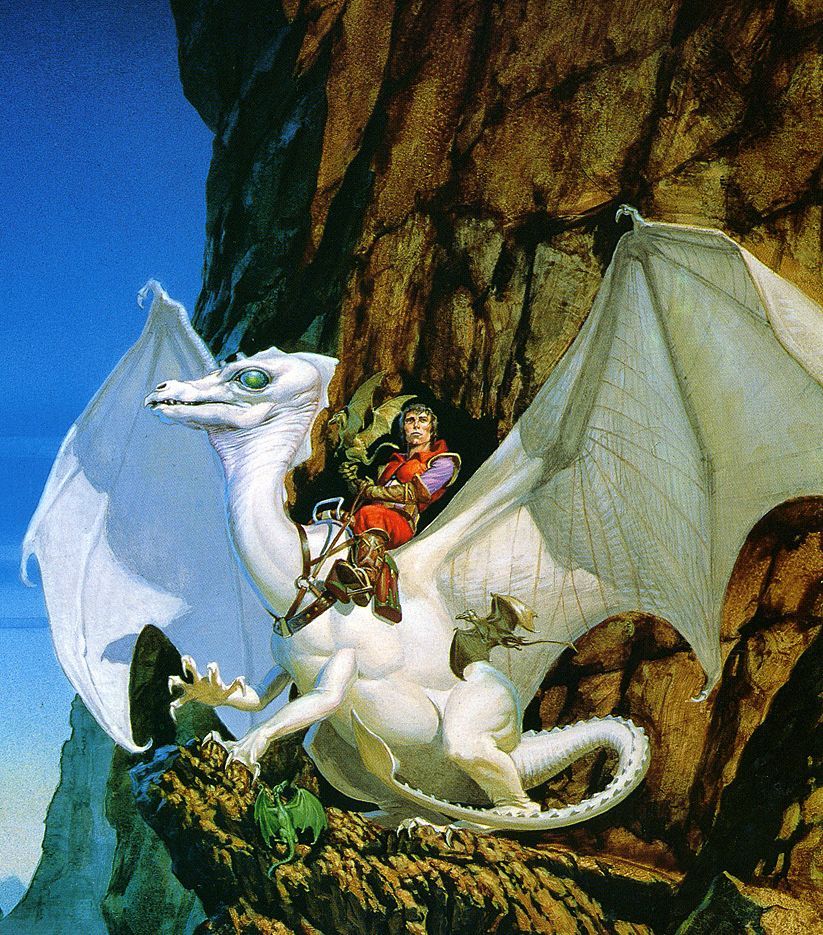
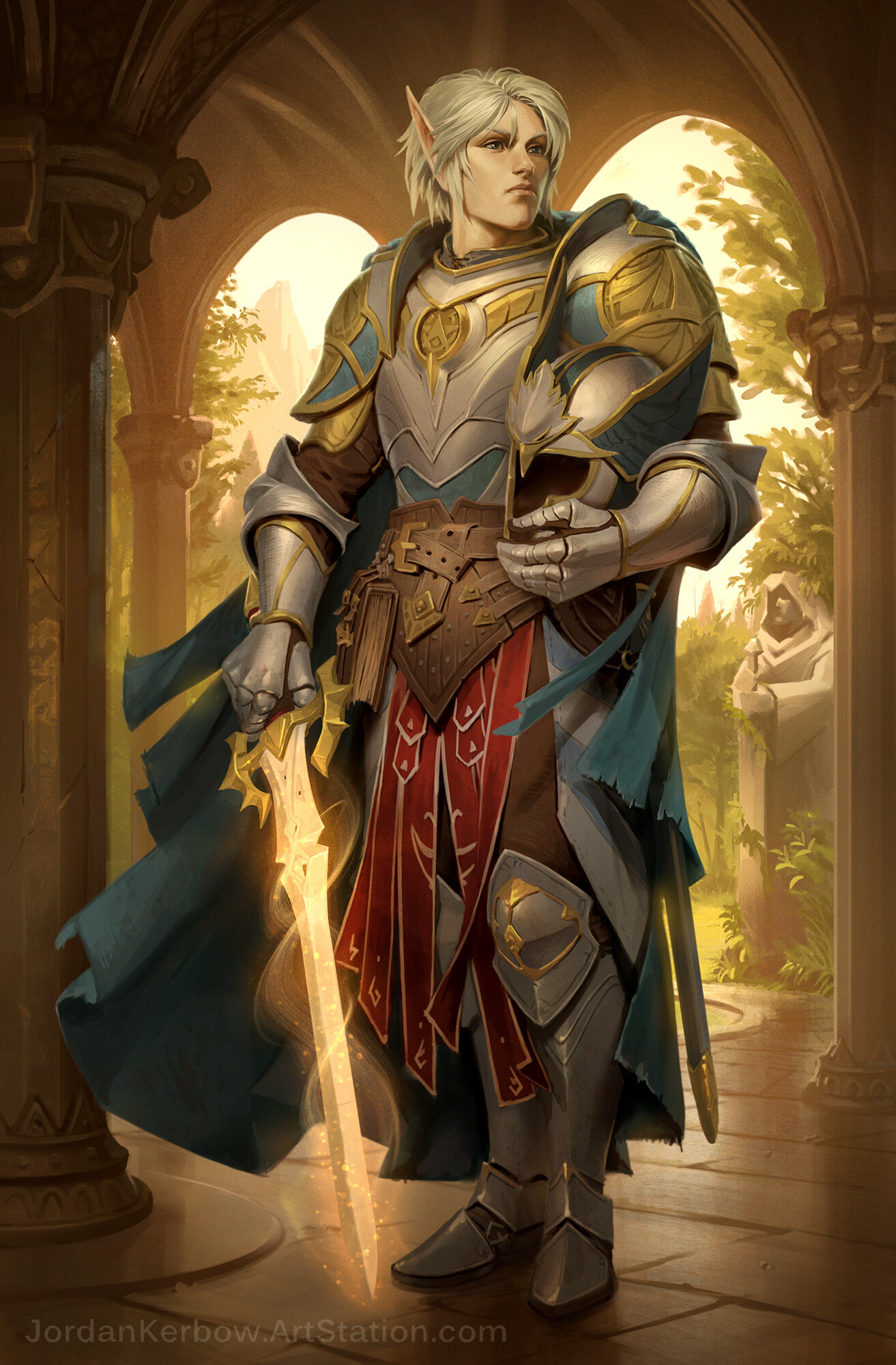
Cover of Anne McCaffrey’s The White Dragon by Michael Whelan
Caravans face enough dangers from the sides of remote roads without also having to watch the skies. As caravans troop along one stretch of the Old Road at the foot of a tall, craggy cliff, guards now crane their necks skywards and listen for whoops and cries from above.
A group of bandits flying on trained psuedodragons have been attacking caravans along this stretch of road for weeks now. They swoop down from the sky, throwing spears and firing arrows, causing guards to scatter and creating general mayhem. Once the caravan shows signs of surrender, the bandits land and their leader steps forward.
Their leader is a well-dressed, aristocratic female tiefling who calls herself Menace. She rifles through the caravan’s goods, always looking for something specific: a magic staff that a cabal of evil sorcerers is trying to smuggle to a nearby city.
The bandits are a particularly thorny threat, since they can retreat to the sky at any time, and they lair in a cave on the side of the cliff. Anyone attempting to attack their lair would either need flying mounts, flying magic, or the courage to rappel silently down dozens of feet of vertical rock.
As a friendly faction, Menace is actually a silver dragon named Moonstone. Moonstone doesn’t want to tip the cabal off about her knowledge of the staff, so she’s decided to disguise herself as a bandit.
When attacking a caravan, the bandits take a surprisingly small amount of loot, not enough to significantly cause trouble for the caravan, and when they arrive at their destination they inevitably find an “overlooked” bag of coins worth the same amount as the loot taken. Moonstone always makes sure the caravans she “robs” aren’t actually inconvenienced.
As a foe faction, Menace was once a member of the cabal of evil sorcerers, but split from the group and wants the staff for herself. It’s as simple as that. And if that staff were to fall into the PC’s hands, she would make for an easy recurring villain, since any time the PCs are in the open her bandits could swoop down from the sky.
As a foe, Menace’s bandits do actually rob each caravan they attack, taking as much plunder as their psuedodragons can carry.
Image of a fantasy caravan ethically generated with Shutterstock AI
Goods and messages need to be delivered reliably. That’s what the Silver Shields do.
The Silver Shields is a massive confederation of caravans that crisscross the continent, working every major and some minor trade routes. Some kids grow up thinking that goods only get delivered by the Silver Shields, they’re that ubiquitous.
Each wagon or carriage in a Silver Shields caravan sports an actual silver shield (though it’s often made of polished pewter) somewhere prominent. Each caravan is organized and lead by the Head, who sports a polished pewter shield badge. The Head manages the guards, each of whom have a simple shield emblem on an arm band, while the merchants elect a Caller who liases with the Head.
The relationship between the Head and the Caller varies. In about half of caravans, the Head calls the shots while the Caller obeys (at various levels of intensity), in about a third of them the Head and Caller collaborate equally, and in the rest the Caller effectively makes the decisions.
The Silver Shields used to stick to the largest routes, though they’ve recently pushed into smaller ones, angering some smaller caravans who feel squeezed out.
The Shields are run by the Council of Five, former caravan Heads elected to run the Shields after many years of excellent service.
A common Silver Shields caravan
Caravan 29 is lead by Samiel Irongut, a heavyset dwarven man who works as its Head. He’s grim, he’s seen it all, and he pushes his people hard, but he gets the job done and ensures everyone’s treated fairly. (Think Michael Ironside’s character in Starship Troopers.)
The caravan’s Caller is Senestra, an enigmatic tiefling woman who is always wrapped in expensive silks that hug her body. She seems to know everyone, and more importantly, knows dirt about everyone. She deliberately acts mysteriously and a little sensuously. She’s a very successful merchant of rare herbs and spices, which gets her into every noble’s kitchen and every apothecary’s back room, where rumors and secrets abound.
The caravan consists of 20 vehicles, from large enclosed carriages to simple wagons covered with a piece of canvas, about 50 merchants, and 20 guards (not including Samiel). 15 of the guards are trained with bows or crossbows, while the other 5 are melee fighters.
Friend or Foe?
As a friend faction, the Silver Shields are a perfect source of safe travel between points of civilization, rumors of adventure in the wilderness, messages, and quest givers. Every town and city probably contains a Silver Shields caravan somewhere, either unloading from its last trip or loading up for the next one.
As a foe faction, the Silver Shields are angling for a monopoly on trade. They’ve been secretly hiring monsters to attack smaller caravans. This corruption goes all the way to the Council of Five. The PCs might be hired by a smaller caravan group who suspects this; the PCs will have to catch Silver Shields agents negotiating with monsters, and eventually confront the Council of Five.
Image of ghosts in a cave ethically generated using Shutterstock AI
Note: This faction is intended more as an element of one adventure than a long-term ongoing faction.
Kids in the nearby village of Willowbrook often dare each other to enter the Caves of the Dead. The passages seem to twist and turn forever in a confusing maze. Here’s a good map.
The Caves of the Dead do actually contain the dead: several chambers contain simple sepulchers and stone tombs, installed by locals many decades ago. Modern residents use a nearby graveyard “like normal people,” so the Caves of the Dead are rarely visited, except by those kids on dares.
But things have changed recently. Those kids now claim to have seen ghosts appear and cry out, asking for help.
Little do they know, a necromancer secretly entered the area recently and has disturbed the spirits.
As a friendly faction, the spirits haunting the Caves of the Dead are trying to warn the residents of the necromancer, and can guide PCs in finding old weapons or preserved magical artifacts to defeat the necromancer, as well as point the PCs towards the necromancer’s location deep within the Caves.
As a foe faction, the ghosts in the Caves of the Dead are the necromancer’s unwilling pawns. He’s installed himself deep in the cave, and the PCs will have to fight the ghosts, plus raised skeletons and zombies, before confronting him. However, the ghosts will answer the PCs’ questions while fighting.
Use your RPG system’s stats for ghosts, skeletons, zombies, and necromancers.
Categories: Faction|Tags:adventure, faction|Comments Off on Faction Friday: The Caves of the Undead
Every year, the Springflower Caravan arrives at towns and villages in this part of the country. It’s staffed entirely by goblins who sell only minor magic artifacts.
As might be expected, people are suspicious of the goblins and the provenance of the caravan’s goods, but on the other hand, you can’t find artifacts like these just anywhere. Inevitably, at least a few locals end up buying an enchanted broom or anti-poison amulet.
During their stay at a settlement, half the goblins scatter into the wilderness nearby. If asked, they claim they’re just foraging for herbs and mushrooms. The locals are even more suspicious of this assertion.
As a friendly faction, the Springflower Caravan legitimately trades in minor magic artifacts, its members often looting minor dungeons to acquire them. The goblins are friendly and will happily sell a variety of useful minor magical items to the PCs. The goblins will even take requests and look out for them in their travels.
As a foe faction, the goblins of the Springflower Caravan are actually in the employ of an evil wizard. They scatter into the wilderness to hunt magical animals, which they slaughter, harvest, and bring back to the wizard, who provides them with the minor magical artifacts they sell as cover. Worse, they target creatures that protect the wilderness, like dryads and even unicorns; killing those animals is very bad news for the locals.
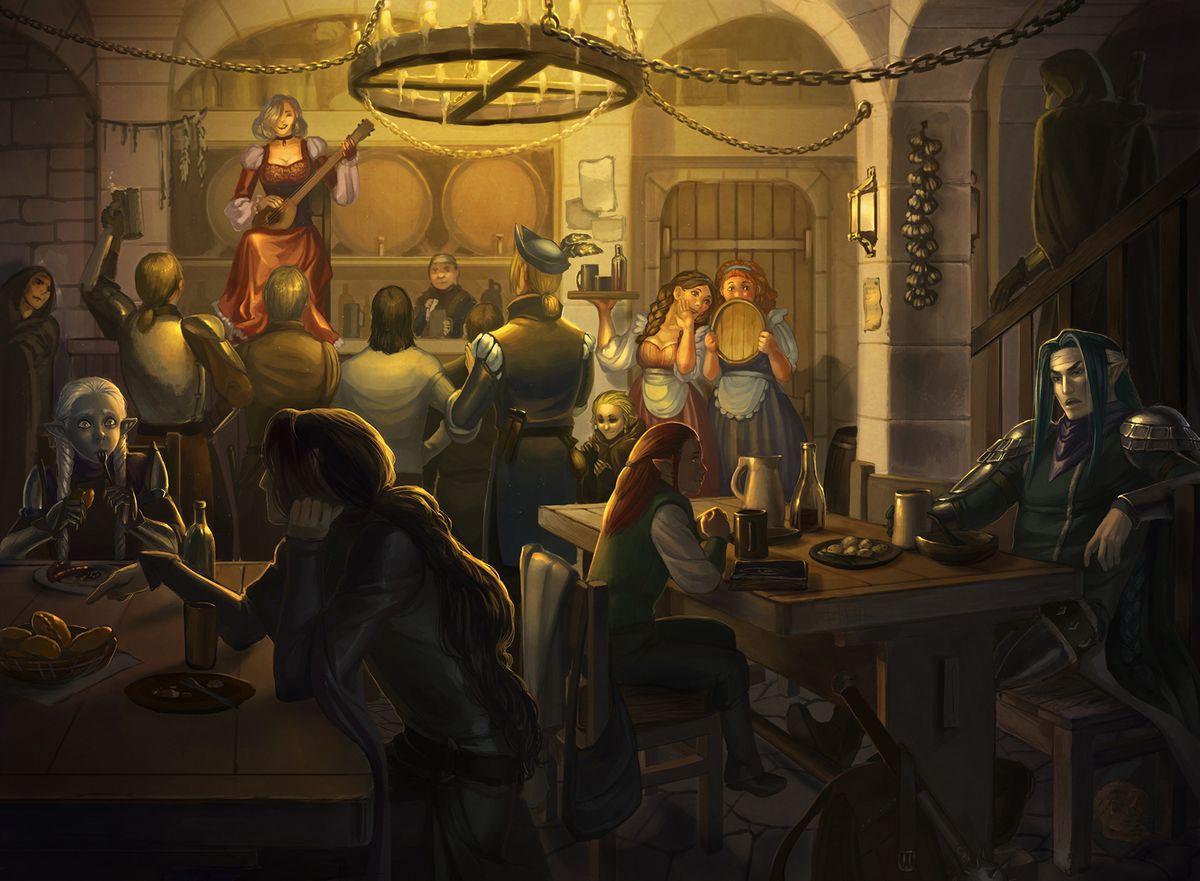
Art found floating around the internet without attribution, sadly
The PCs are approached by a dwarven woman named Baera, who asks them to investigate the Weeping Willow Tavern. It opened only a few months ago and is always full of people for no obvious reason. Baera runs a tavern on the same street and finds this suspicious.
The proprietor of the Weeping Willow Tavern, Tael Blackjaw, is actually a young dragon who’s using charm magic to attract customers to the tavern, but for a purpose well beyond ordinary commerce.
As a friendly faction, Tael is a silver dragon who’s tracked an aboleth (or similar mind-controlling creature) to this city. It appears to be after something belonging to a spellcaster named Tarin Silvertongue, but it’s thoroughly covering its tracks.
Every evening, Tael takes one or two charmed patrons downstairs to the basement, where he’s set up a zone of truth that will remain for the next 30 days. He then questions the patron about anything unusual or suspicious they’ve seen recently, looking for evidence of mind control. Afterwards, he harmlessly erases the patrons’ memories of their questioning and returns them to the taproom, none the worse for wear.
Tael has plenty of uses for a sympathetic party of PCs, and will gladly hire them to follow up on reports of suspicious activity.
As a foe faction, Tael is a black dragon whose real goal is to stock his swamp cave lair with stirges. He’s doing so in a remarkably evil way: He keeps a dozen stirges in a secret room in the tavern’s basement, and every evening takes one or two charmed patrons downstairs and has the stirges feed on them, just before the point where the victims’ blood loss would be obvious to others. He then magically erases the patrons’ memories and returns them upstairs.
The basement itself contains a teleportation circle that will last for the next 30 days, and magic runes on the floor, just barely visible if you’re keeping a keen eye out. Stepping on a rune magically alerts Tael of intruders.
If the PCs figure out what Tael’s doing and attempt to expose him, he’ll teleport the stirges back to his cave and retreat, periodically sending assassins after the PCs just out of spite.
This is an era of bandits and monsters. The roads are unsafe, villages burn, and the emperor holds lavish parties while ignoring the suffering of the people.
This hash reality planted the seeds of revolt. Rebels gather among the teeming masses in the Capital, plotting the overthrow of the emperor. This will not be easy, and so they make dangerous moves: assassinating guards and setting fire to weapon storehouses. They grow bolder with every step.
The emperor has finally been roused to action. He calls the most disciplined and loyal warriors in his empire to him and founds a new order of peacekeeper: the Emperor’s Wolves.
The Wolves are no ordinary guards or mercenaries. The emperor’s call attracted the best of the best, who honed their blades on some of the toughest monsters in the land.
Given complete impunity to root out the rebels by any means necessary, the Wolves got to work quickly. They have captured and…received confessions from dozens of revolutionaries and their sympathizers. They are ruthless in their single-minded purpose: wipe out the rebels. This is their strength, and it may be their downfall.
As a friendly faction, the Wolves are serious-minded peacekeepers fighting truly dangerous, radical revolutionaries. The rebels will sacrifice countless innocents in random acts of terror if they think that will overthrow the emperor. The Wolves just want the Capital at peace again, and they’ll do whatever it takes to make that happen, even if they have to get a little physical now and again. They’ll have plenty of tasks for a band of PCs — spy on a group of rebels, sneak into one of their camps, destroy their supplies, etc. — and they pay well.
As a foe faction, the Wolves have grown so focused on their mission at all costs, and so convinced of both the righteousness of their cause and their own martial mastery, that they’re now extremists themselves, hell-bent on tearing through the rebels no matter who gets trampled in the process. Worse, the rebels are not the terrorist organization the Wolves paint them as: they’re freedom fighters. If the Wolves find that rebels are holed up in a tavern, the Wolves might kill every staff member at the tavern as “sympathizers.” The Wolves terrorize the people more than the rebels do, and they have to be stopped.
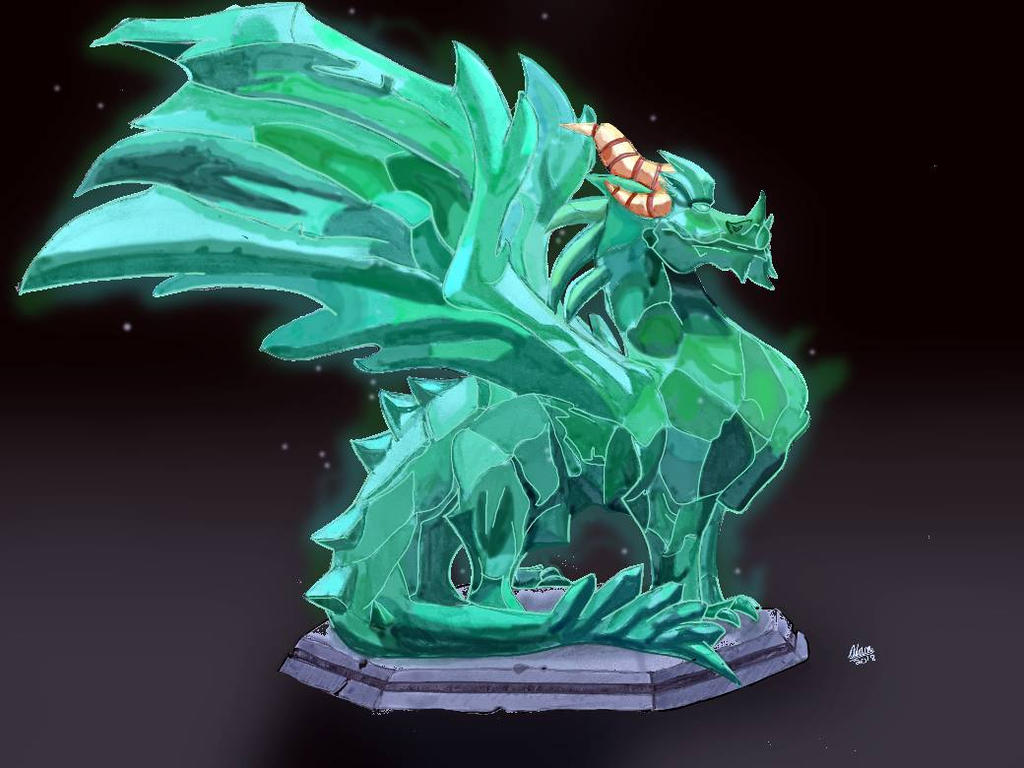
When the city’s sewers were last expanded, the workers accidentally broke into a vault and discovered a life-sized young dragon made of crystal sitting, ominously motionless, in the center of the vault. The workers immediately plugged the hole and told nobody of what they found (none of the workers wanted to deal with all the questions that would be asked and the likely interruption to their work).
But a few days ago, an old storm mage named Davin Thundergale reopened the vault, after overhearing one of the workers in a tavern talking drunkenly about the crystallized dragon they found. Davin believes that the statue is actually a real blue dragon named Kodax that was crystallized through magic, and seeks to free it in return for knowledge about storm spells.
Davin fancies himself a one-man adventuring party, though he brings with him about a dozen bodyguards, researchers, and cooks. Those are “just his attendants,” though, so they “don’t count.” One bodyguard is an animal tamer who uses several giant fire beetles as scouts.
As a friendly faction, Davin needs a variety of spell components to complete a ritual that will de-crystallize the dragon (an excellent task for the PCs). He’s confident that the ritual will also bind the dragon temporarily, long enough to negotiate with it and keep it from lashing out.
Once all the spell components have been acquired, Davin will welcome the PCs to watch the ritual as it’s performed. The actual outcome of the ritual is up to you. Perhaps it won’t go quite as well as Davin expects.
As a foe faction, Davin worships dragons, and wishes to free Kodax so Davin can serve as Kodax’s highest-ranking follower. His party is a group of rough-and-tumble ne’er-do-wells who follow him for the money, and don’t realize that Davin plans to offer them to Kodax as the dragon’s first meal.
Any city has its share of secrets. Those secrets are valuable, so there are organizations who find those secrets and sell them.
What better place to both learn secrets and sell them than a tavern?
The Nightbird Tavern is a watering hole that locals have been coming to for generations. Its staff have been serving those same locals for generations, with sons and daughters taking over for mothers and fathers for as long as anyone can remember. Given their high standards of service, this surprises some foreigners, but it’s like the little ones are born for it. Turns out, they are.
Unbeknownst to anyone, the entire extended family that runs the Nightbird Tavern also make up the Raven Society, a tight-knit crew of spies who slip into alleys and listen behind doorways throughout the city. Because who would be surprised to see a scullery maid out on an errand in an alley?
Highly adept in combat, they train their children from the earliest ages in both spycraft and martial arts.
The clan is led by Matreya Ravenclaw, a battleaxe of an old woman who can be annoyingly stubborn or laughingly easygoing, with little in-between. Her second-in-command, Nisha, is a tall, taciturn master of combat.
As a friendly faction, the Raven Society operates as a neutral information broker, passing tips about upcoming monster attacks or cults on the move to the city watch. They charge reasonable fees for their information, with a hefty discount to good adventurers who publicly protect their city.
The Ravenclaws would be willing to pay–in gold or information–an adventuring party who can create an armed distraction while one of their members performs a little skullduggery.
As a foe faction, the Raven Society sells their information to the highest bidder and don’t care who gets hurt in the process. Too many factions rely on their services for anyone to risk taking them out. If threatened, they can call in favors from both law enforcement and the city’s underbelly.
Worse, Nisha has begun consolidating the family’s power in ways that are far less neutral than the past, calling in favors to eliminate rival factions in the city. Nobody in the Raven Society gets their hands dirty, of course, but bodies are beginning to pile up. Matreya is uneasy about this; either she or Nisha could hire the PCs to wipe out the other.
There are two Gwelf books, beautifully illustrated, that are crying out for a tabletop RPG. So I thought I’d make one as a fan.
The world of Gwelf
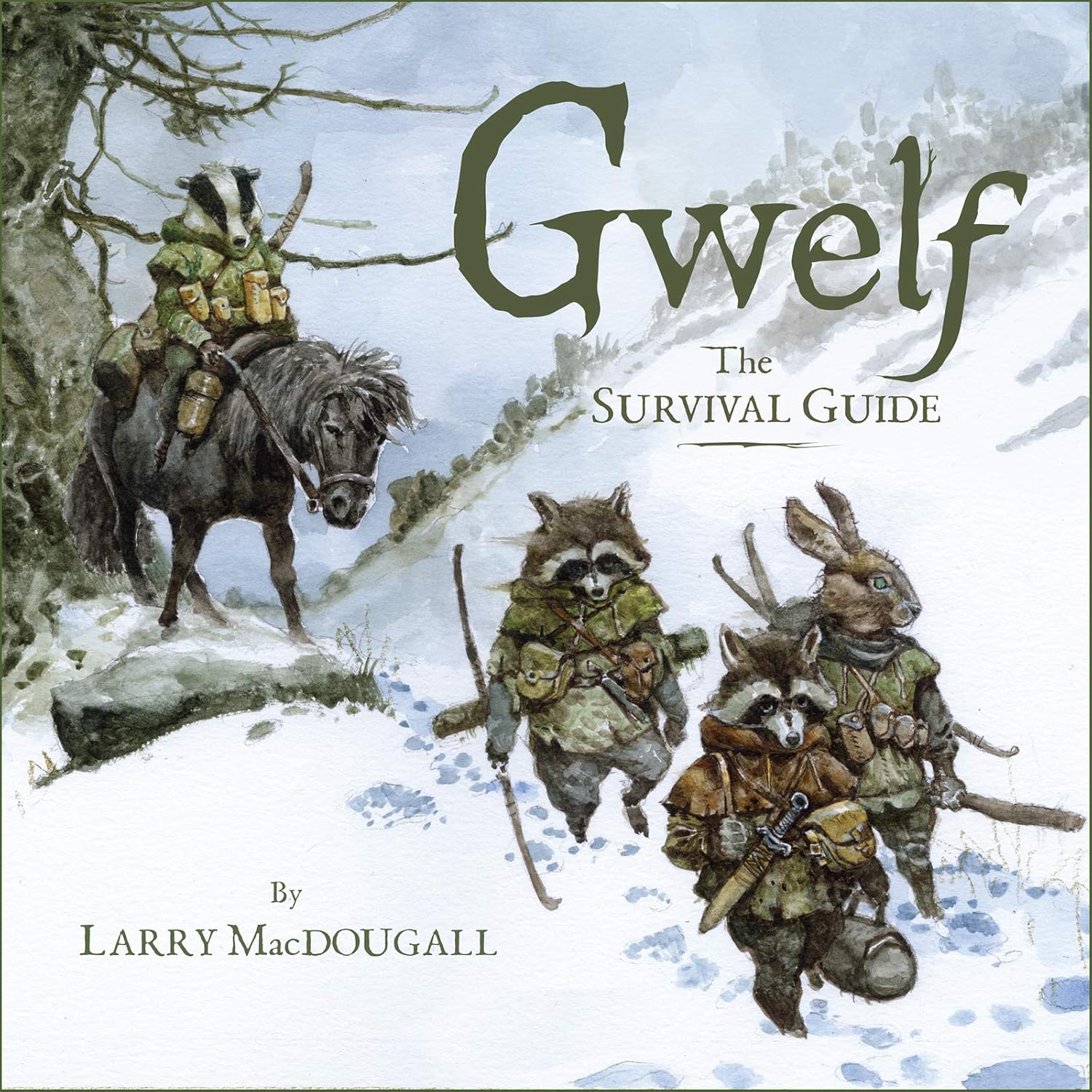
Source: Gwelf: The Survival Guide by Larry MacDougall
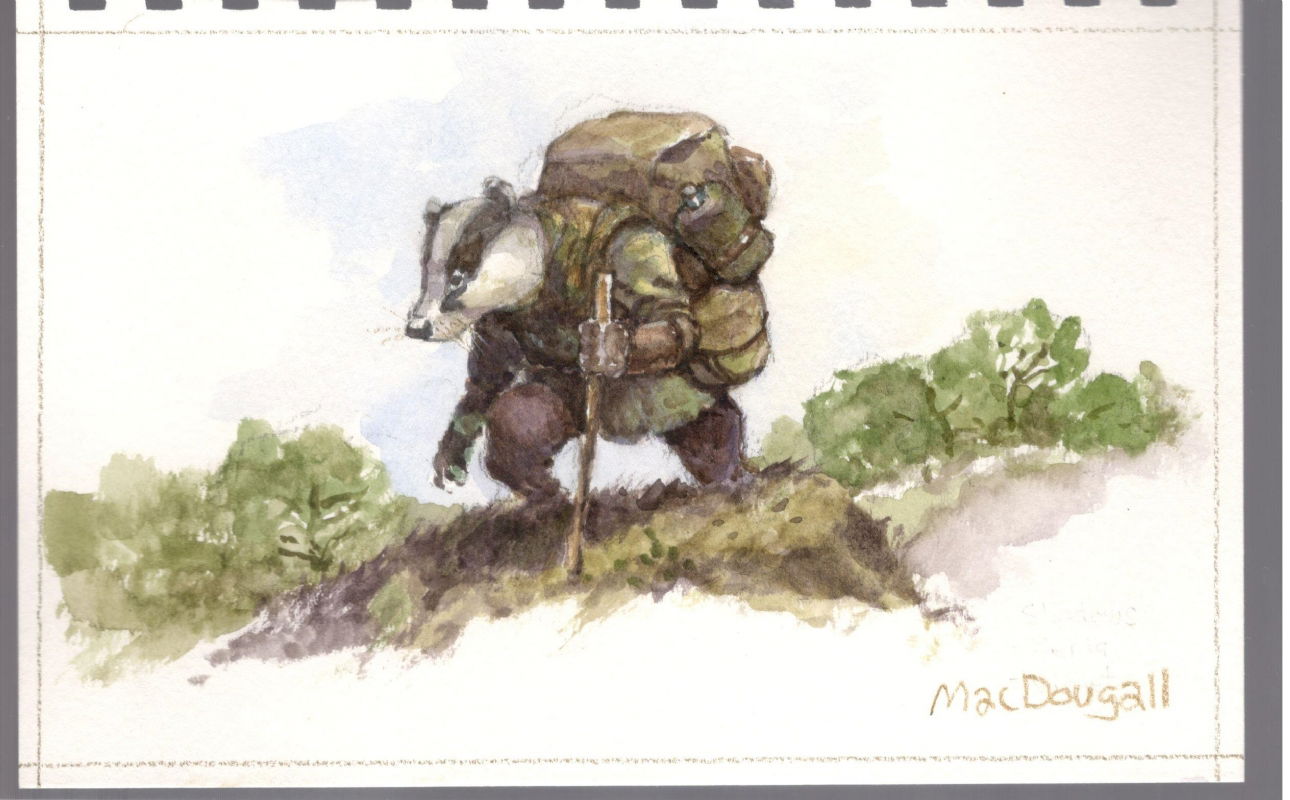
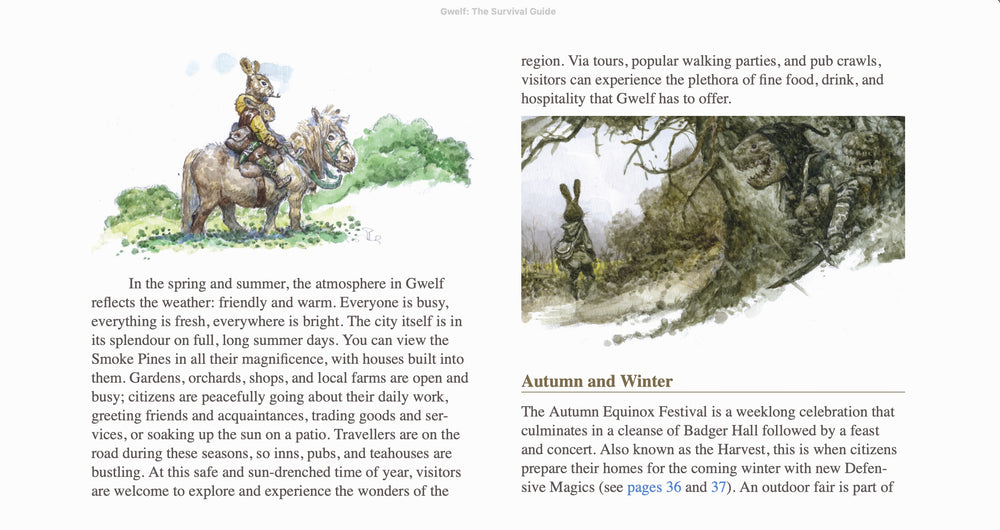
Gwelf initially presents itself as a bucolic world of anthropomorphic characters within the safe walls of civilization (the cozy City of Gwelf, the prosperous Farmlands, and the wilder Scrublands), where the Sparrows study white magic and direct the other denizens in safeguarding themselves from the dark forces of the Ravens in the distant Hinterlands. In contrast, trips out to study Raven-kind have a hard survival edge; many of those who venture into the Hinterlands and beyond never return.
The following is a fan-made tabletop RPG of Gwelf with no intent for profit.
Create your character
Choose your Discipline:
Guard: Trained in combat and defending other creatures
Exorcist: Expert at driving away Ravenkind
Medic: Trained in healing wounds
Scout: Skilled in exploration and survival
Choose your Species:
Badger: strong and resolute
Fox: clever and creative
Mouse: flexible and dependable
Otter: curious and cunning
Rabbit: peaceful and diplomatic
Raccoon: industrious and opportunistic
Sparrow: leader and researcher
Choose your Attributes:
Distribute 5 points between Mind and Body
You start with 0 Fatigue, 0 Wounds, and 10 inventory slots.
Go on your adventure
Your characters are called together by the Sparrows to investigate recent sightings of Raven-kind in a previously quiet area of the Hinterlands. (For the sample adventure below, Raven-kind have been seen hauling strangely-shaped objects in sacks out of a certain area.) The Sparrows want to find out what the Ravens are looking for. However, you’ll need to wait a few days in the City of Gwelf before setting out; the Sparrows need to send letters to the border forts letting them know you’ll be arriving, and they’re arranging for a scout to learn more about the Raven-kind sightings, who will meet you at the border with an update.
Start in the city of Gwelf, exploring shops and gathering supplies. No pressure. You can buy up to 10 inventory slots’ worth of goods.
Supplies available:
Particle candles of restoration and healing
Sleep inducing candles
Candles of warding
Defense amulet
Directional talisman
Climbing gloves
Sparrow quill
Pot of enchanted ink
Hammer and chisel
Scissors
Sling
Enchanted dagger (Witch Market)
Short sword
Bow and arrow
Crossbow and bolts
Stonk grenades
Shield
Flask of Pine Liquor
Satchel of tea
Satchel of coffee
Quiver of incense
Mortar and pestle
Embroidered handkerchief
Flute
Pan flute
Mandolin
Tambourine
Quill, ink, and parchment
Paint, brushes, and parchment
Book of poetry
From there, move out into the Farmlands, where you’ll stop at 2 locations. Choose or roll randomly:
The Pine Cone Inn
The Sparrow Feather Pub
Mrs. Tuffet’s B&B
The Tinker’s Meadow
The Ploughman
The Sparrow Feather Pub
The Mossy Kettle Pub
The Witch and Weaver
The Fox and Fiddle Tea Shop
The Floating Bridge at Albion Falls
Cherry Hill Gate and the Roadside Market
A Tinker Band
At one of these locations, you can spend an inventory item to learn a rumor about what’s going on in the Hinterlands:
The Ravens have found a place of great magic power.
The Ravens have unearthed an artifact and are studying it.
The Ravens are building a large fortification.
The Ravens are massing for war.
When you transition to the Scrublands, you can only carry 5 inventory slots’ worth of goods (the rest is made up of sufficient rations for the trip). If you have more than 5 inventory slots worth of goods, you must discard down to 5 now.
Here in the Scrublands, you will have 3 encounters (see below for rules on overcoming challenges). Roll randomly:
Dundurn Village (no challenges)
Rats (challenge)
Ragteeth (challenge)
Mange-creatures (challenge)
Then, you reach the border fort. Learn more from the scout, then venture into the Hinterlands. Here, you will encounter powerful Ravenkind.
Source: Gwelf: The Survival Guide by Larry MacDougall
Overcome challenges
When faced with a challenge, you may sacrifice one piece of appropriate equipment to automatically succeed. For example, a short sword can be sacrificed to defeat a Mange-creature, but a satchel of tea cannot.
Otherwise, determine the challenge’s Difficulty, as a die size, typically d8 to d12 (higher is harder).
Next, determine your Capability. This represents how much energy you can bring to this challenge. Start your as your most relevant attribute (Body or Mind). Add 1 to your Capability if you’re acting within your Discipline. If you have any points of Wounds (see below), subtract 1 from Capability. So, a Medic with 3 Body and 1 Wound attempting to skewer a Mange-creature would have a Capability of 2 (Body 3 – 1 for the Wound), while a fully-rested Guard with 4 Body would have a Capability of 5 (Body 4 + 1 for Discipline).
Capability effect
Modifier
Begin with…
Body or Mind
Discipline applies?
+1
Wounded?
-1
You and the GM each roll a Difficulty die (so, for an easy challenge, you each roll a d8). If the difference between the rolls is less than or equal to your Capability, you succeed; otherwise, you suffer a setback and take Strain.
Take Strain
Failure takes a lot out of you. The first time you fail at a challenge, you take 1 Fatigue. If you fail again, you take 1 more Fatigue. If you fail and have 2 Fatigue, you take 1 Wound. You can have at most 2 Fatigue and 2 Wounds.
If you have any points of Wounds, you take -1 on all challenges.
If you fail on a challenge and have 2 Wounds, you face a choice:
Retreat: You must remove yourself from the situation; you cannot take on any further challenges related to the current encounter. You may still be physically present.
Rage: You continue the encounter as usual, but after it is over, you will not be able to continue this adventure, and you gain a permanent scar.
Recover Strain
After an encounter, if you take a moment to acknowledge your victory or count the cost, reduce your Fatigue to 0.
At the start of the day, a Medic can remove 1 Wound on up to 3 creatures.
Source: Gwelf: The Survival Guide by Larry MacDougall
The Adventure in the Hinterlands
The following is a sample adventure for Gwelf.
Upon entering the Hinterlands, the party must first complete 1 to 3 survival challenges, representing hazards that they encounter during travel. The Hinterlands take a lot out of any who explore them.
Hinterland survival challenges:
A cold window buffets the party for hours.
The party must navigate a swamp.
The party cannot find a safe place to sleep and must camp in the open.
The party encounters a scouting party of rats.
The party encounters wandering Ragteeth.
The party sights a flying Raven and must hide.
For each survival challenge, each PC must succeed on a Body challenge. The first challenge has a Difficulty of 8, the next 10, and the final 12.
Then, the party comes across a weird landscape: many small hillocks suggesting underground tunnels, withered trees, and an unexplained chill in the air. At the center, trees surround an excavation that goes deep into the earth. Each tree surrounding the crater has a piece of paper nailed to it, and each paper contains strange jagged runes in some arcane Raven language.
The PCs can attempt to descend into the excavation, to a vertical shaft that has a ladder propped up against it, or they can search the area where they’ll find a side access tunnel. The vertical shaft will drop them right into a chamber, while the side tunnel will lead them to the same place but give them the element of surprise.
Below the shaft lies a huge chamber, much of which is taken up by a massive sleeping serpent. Its pale green scales glitter in the light of a wan lantern that’s been set down next to several rats that are silently pilfering items from a huge hoard of objects:
Smooth stones with strange symbols carved in them
Clay tablets with strange symbols carved in them
Oddly-colored crystals, some of which glow faintly.
The skulls of various burrowing creatures like moles and ground squirrels, some of them marked with strange patterns
Fossils of strange underwater creatures
Tree roots curved into fantastical shapes
The rats are prioritizing the stones and clay tablets. It’s now up to the PCs to figure out what to do. If they leave now and just report back, the rats might be able to clear out the entire hoard before any good creatures of Gwelf make it back here. But the rats will no doubt fight tooth and claw, and doing so might awaken the serpent.
If the PCs decide to leave quietly, have a patrol of rats discover them outside the chamber. Now they have to get past the patrol before reinforcements from the chamber arrive.
Design notes
I realize that acquiring items and sacrificing them to succeed in challenges feels a little wonky and too open to abuse during a session, especially with players more interested in winning the scenario than story logic or atmosphere. But the tone feels right, so I’m leaving it in.
A character’s Species currently has no mechanical benefit. If Species granted you another +1, that would be powerful enough to reward character optimization and “meta” in a game that’s not really about that. I haven’t figured out a better solution yet.
Suggestions welcome in the comments below! I do read them.
Systems and bloggers encourage GMs and players to beware frivolous die rolls. We are warned to avoid die rolls when the outcome would be obvious, or when one outcome would be uninteresting.
Okay, so when are die rolls actually interesting?
Simple failure is usually uninteresting (in RPGs, at least). Players want to jump across a chasm…and fail. So, what, they fall in and die? Not very heroic, and usually not very interesting.
Before we go any further: Yes, a great GM and great players can make that interesting. But it’s a high-level skill, not common in groups.
What if, instead of success/failure, you rolled to determine whether the PC faces a negative consequence?
In other words, if a PC wants to bash open a broken door, they don’t roll to see if they do it; they roll to see if that attracts the attention of nearby monsters. If you fail the roll to bribe the guard, he doesn’t just politely turn you down; the bribe is a crime and he tries to arrest you.
I’m sure there are systems that do this (I’m writing one). But imagine it accepted broadly. What if popular systems were built around the idea of dice rolls providing more than a binary answer of success or failure for the action itself?