50 Games in 50 Weeks: Everyone Is John

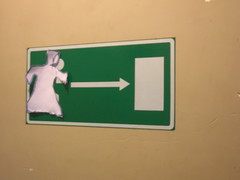
As part of DC Gameday, I volunteered to run a game of Everyone Is John.

System basics: Each player is a voice in the head of a totally insane man named John from Minneapolis. Each voice has a few skills, an obsession (something they really want to accomplish), and a pool of Willpower tokens. Whenever John is hurt, bored, or falls asleep, the voices all wager Willpower tokens to take control of John. The winner controls John until he’s hurt, bored, of falls asleep again.

The system perfectly simulates the competition among voices. The only potential issue is the absolute control of one voice and the lack of input from the other voices.

On the one hand, this system generates a very intense, one-on-one experience between the controlling voice and the GM. I’m sure it’s odd for a player to have the full attention of the GM for long stretches.

On the other hand, everyone else has nothing to do except observe. The player and DM have to be entertaining. I’d like to see a mechanic that allows non-controlling voices to give Willpower Points to the current voice, in exchange for accomplishing something the giver wants.

In our case, the system resulted in a very wacky story. Each voice had to deal with strange circumstances as they took over John–the players knew what had happened, but the voices didn’t–and had to cope.

That highlighted another difficulty: voices were often presented with situations that completely non-plussed them, because the voice has no context. I’d add a stipulation that voices remember only what’s happened since John’s most recent full night’s sleep. We may have been playing it wrong, though, by assuming that voices “lose consciousness” when they lose control.

Overall, the game itself was a lot of fun. The system provided a weird, strong, memorable experience that we learned quickly.

Categories: 50 Games in 50 Weeks | 1 Comment

Castles Were Decoration

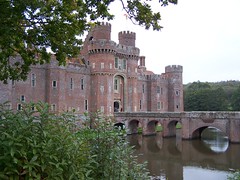
'Castle' by Dave Stokes on Flickr

'Castle' by Dave Stokes on Flickr

I’ve been listening to a series of lectures on historical castles, and it’s changed how I think about castles in an RPG setting.

Debate rages, naturally, so take all this with a grain of salt, but:

Castles were not just fortifications. Indeed, fortification was a relatively minor element of their function. Castles were homes and symbols of power. Many of them were indefensible but looked imposing.

Castles became symbols of power and stability. Not only did they say, “This noble is wealthy,” they said, “This noble can protect his peasants.”

Statistically, most castles were earth-and-timber affairs. Stone was just too expensive for most lords. In later centuries, many earth-and-timber castles were slowly converted section by section to stone. That conversion was, of course, messy and slow. So one might enter a “castle” that consisted of an earthen wall surrounding a stone keep.

Speaking of keeps: an important aspect of every castle was its relation to the noble who owned it. Each gate and wall added another layer between you and the noble, so the deeper you were allowed inside a castle, the more important you were. The inner keep was a special political place, because of what it said about anyone allowed to get inside it.

As the Middle Ages wore on, sieges grew increasingly popular, and two practices wore down the utility of castles: slash-and-burn tactics and cannons. As important as cannons were for wearing down a castle’s defenses, destroying all the surrounding property was arguably the larger problem. It does little good to lock oneself in a castle only to watch the destruction of your long-term food supply.

Implications for role-playing games:

  • If running a castle siege story line, why aren’t the besiegers destroying the surrounding countryside? What do the besiegers want out of that countryside?
  • How much food is in the castle’s stores? Many castles would keep months’ worth of food, but many had only a few weeks’ worth. What happens when the besieged run out of food?
  • What if the castle is in the middle of conversion to stone, or partly built? How easy is it to defend? Might the castle need human or monstrous protectors for its weak spots?
Categories: Role-playing | 1 Comment

Let’s Play an Interesting RPG, episode 5: Dungeon World, part 3 of 3

In our 17 December 2011 session, we played Dungeon World, a story-oriented game of fantasy adventure with a classic D&D feel.

The Group: Let\’s Play an Interesting RPG

The System: Dungeon World

The Players

Video (part 3 of 3)

[podcast format=\”video\”]http://rpg.brentnewhall.com/media/LetsPlay-0005-part3.m4v[/podcast]

Categories: Let's Play an Interesting RPG | Leave a comment

Let’s Play an Interesting RPG, episode 5: Dungeon World, part 2 of 3

In our 17 December 2011 session, we played Dungeon World, a story-oriented game of fantasy adventure with a classic D&D feel.

The Group: Let\’s Play an Interesting RPG

The System: Dungeon World

The Players

Video (part 2 of 3)

[podcast format=\”video\”]http://rpg.brentnewhall.com/media/LetsPlay-0005-part2.m4v[/podcast]

Categories: Let's Play an Interesting RPG | 1 Comment

Let’s Play an Interesting RPG, episode 5: Dungeon World

In our 17 December 2011 session, we played Dungeon World, a story-oriented game of fantasy adventure with a classic D&D feel.

The Group: Let’s Play an Interesting RPG

The System: Dungeon World

The Players

Video (part 1 of 3)

[podcast format=”video”]http://rpg.brentnewhall.com/media/LetsPlay-0005-part1.m4v[/podcast]

Audio Only (entire episode)

[podcast]http://rpg.brentnewhall.com/media/LetsPlay-0005.mp3[/podcast]

Post-Game Comments

I received some great feedback from an experienced Dungeon World player, who pointed out that the GM shouldn’t roll in Dungeon World, so I was doing that incorrectly. Also, we weren’t using Lore the way it was intended. So, FYI!

Categories: Let's Play an Interesting RPG | 1 Comment

One Little Tweak

\""Paxil

I ran a game of Searchers of the Unknown, a simplified and free original D&D rule set, at RyvenCon a while ago. \’Twas fun, and the system worked well, but we agreed that it could use one little tweak.

This way, madness lies. It\’s so tempting to house-rule a system because it\’s \”not perfect.\” Soon, a rules-light system grows into a rules-moderate system.

Well, this is a minor issue, but a significant one. There are four kinds of weapons in Searchers:

  • Ranged weapons, worth 1d6 damage
  • Small melee weapons, like daggers, worth 1d4 damage
  • Medium melee weapons, like swords, worth 1d8 damage
  • Large melee weapons, like polearms and two-handed swords, worth 1d10 damage.

(The actual terms are a little different, but these are more clear for my purposes.)

Those are all of the stats for weapons. Thus, there\’s no mechanical reason to wield a dagger instead of a polearm.

There\’s a good reason for this: space. Searchers of the Unknown is supposed to fit on one page. Complicated weapon rules would take up space and, well, complicate the system.

However, Ryven came up with an ingenious rock-paper-scissors solution: what if medium weapons give you +1 on your attack roll against enemies carrying small weapons, large weapons give you +1 against enemies carrying medium weapons, and small weapons give you a +1 against enemies carrying large weapons (simulating the ability to duck around the large weapon)?

It\’s an elegant solution, and though it does introduce a slightly more complicated attack roll, I think it\’s worth the tweak to balance out the game.

Hope this helps!

Categories: Uncategorized | 1 Comment

How Does Magic Work?

Rules of Magic for 21 Different WorldsMagic is weird. By definition.

As role-players, this creates problems. We exercise one magic system, become comfortable with it, then move to another world and struggle to understand its ways.

This blastr post includes a chart (shown at right) of the “rules of magic” for 51 different worlds/universes. It answers six questions about each:

  1. Where does magic come from?
  2. How do you wield it?
  3. Is there good and evil magic?
  4. Is magical ability hereditary, or can anyone learn?
  5. What’s the secret to defeating magic?
  6. Is magic a secret from a primarily non-magic world?

It’s fascinating to compare how magic “works” in different contexts and for different reasons.

Plus, if you’re playing and a spell’s effects seem illogical, these are good questions to ask: why does magic work this way? What was the designer’s intent?

Categories: Role-playing | 3 Comments

Let’s Play an Interesting RPG, episode 4: Hangout playtest, part 2 of 2

The Let\’s Play group plays a different RPG every week.

In our 9 December 2011 session, we played Hangout, an experimental system that Brent is still developing. The system is explained over the course of the session. The session was set in the world of TRON.

The Group: Let\’s Play an Interesting RPG

The System: Hangout

  • Rules complexity: Light (9-page PDF)
  • Availability: Still in private development
  • Website: None yet

The Players

  • Brent P. Newhall, GM (@BrentNewhall, this site)
  • Brian (@ripcrd)
  • Josh Roehm (debhaal)
  • Richard Ashley (owner of Dragon\’s Bay)

Video (part 2 of 2)

[podcast format=\”video\”]http://rpg.brentnewhall.com/media/LetsPlay-0004-part2.m4v[/podcast]

Categories: Let's Play an Interesting RPG | Leave a comment

Let’s Play an Interesting RPG, episode 4: Hangout playtest, part 1 of 2

In our 9 December 2011 session, we played Hangout, an experimental system that Brent is still developing. The system is explained over the course of the session. The session was set in the world of TRON.

The Group: Let\’s Play an Interesting RPG

The System: Hangout

  • Rules complexity: Light (9-page PDF)
  • Availability: Still in private development
  • Website: None yet

The Players

  • Brent P. Newhall, GM (@BrentNewhall, this site)
  • Brian (@ripcrd)
  • Josh Roehm (debhaal)
  • Richard Ashley (owner of Dragon\’s Bay)

Video (part 1 of 2)

[podcast format=\”video\”]http://rpg.brentnewhall.com/media/LetsPlay-0004-part1.m4v[/podcast]

Audio Only (entire episode)

[podcast]http://rpg.brentnewhall.com/media/LetsPlay-0004.mp3[/podcast]

Categories: Let's Play an Interesting RPG | Leave a comment

How To Play When It’s Just You

On the Gamer Assembly wiki FAQ, one of the questions is:

Are there any pre-made D&D 4E adventures designed for one player and one DM? Something to help teach rules (for both DM and player)?

This is what the Red Box was designed for. If you’ve paid for a D&D Insider account, you can download the solo adventure Dark Awakening (thanks to digitaldraco for the pointer).

However, the Red Box is an odd gaming aid, and doesn’t quite match the request. Many don’t have DDI accounts. I don’t know of any other adventures that serve as teaching aids, so here’s some general advice:

To begin, talk to each other about the sort of character that the player wants to play, and the genre of story that both player and DM are comfortable with. Do you want a combat-heavy story? An investigative mystery? A rousing adventure with lots of daring, athletic stunts?

Once you’ve determined this, start the player-character in a constrained environment. That is, start in a small village or a house out in the country, rather than a huge city.

Spend the first session focusing exploring the environment with appropriate skill checks. Get the user used to rolling a d20 and adding a modifier. Interact with local people.

Then give the PC a physical challenge. Rescue someone (or something) that’s in trouble. Require no combat; just skill checks.

This may take up the entire encounter. That’s fine.

'Beetle' by arenamontanus on Flickr

‘Beetle’ by arenamontanus on Flickr

Then, move on to the first fight. Start small. (Always start small.) Challenge the PC with one simple creature, like a dire rat or a fire beetle. Try to find a creature with only one melee or ranged attack power. Avoid surprise rounds, grappling, or charging. You want this to be a simple exchange of blows.

The point of the first fight is to get the player comfortable with the basic mechanics of fighting: pick a power, roll a d20 and add modifiers, and roll for damage.

As they become useful, introduce the following concepts:

  • Critical hits
  • Critical misses
  • Death saves (though I hope this is unnecessary in the first fight!)
  • Second wind

Once the PC wins the first fight, introduce further enemies and confrontations. In each fight, introduce one or two new rules, including:

  • Attacks of opportunity
  • Bursts
  • Blasts
  • Charging
  • Concealment
  • Conditions with save ends
  • Cover
  • Falling prone
  • Flanking and combat advantage
  • Grabbing
  • Huge creatures
  • Interrupts
  • Running
  • Shifting
  • Teleportation
  • Tiny creatures and swarms

If later enemies overwhelm the player-character, consider adding a player-controlled sidekick that has its own character sheet.

Hope this helps!

Categories: Prescriptions | 2 Comments