Let’s Play an Interesting RPG, episode 8: Dungeon Raiders

In our 17 March 2012 session, we played Dungeon Raiders, a retroclone of classic D&D.

The Group: Let’s Play an Interesting RPG

The System: Dungeon Raiders

  • Rules complexity: Light (10-page basic book)
  • Availability: Free PDF

The Players

Video (part 1 of 3)

Note that there is an echo in this episode.

[podcast format=”video”]http://rpg.brentnewhall.com/media/LetsPlay-0008-part1.m4v[/podcast]

Audio Only (entire episode)

[podcast]http://rpg.brentnewhall.com/media/LetsPlay-0008.mp3[/podcast]

Continue to part 2

Categories: Let's Play an Interesting RPG | 5 Comments

Let’s Play an Interesting RPG, episode 7: Marvel Heroic Roleplaying, part 4 of 4

In our 3 March 2012 session, we played Marvel Heroic Roleplaying, a story-oriented game of comic book characters, using the Cortex+ system.

The Group: Let’s Play an Interesting RPG

The System: Marvel Heroic Roleplaying

The Players

  • Brent P. Newhall, GM (@BrentNewhall, this site)
  • Brian Kelsay (@ripcrd)
  • Joe England
  • Jonathan Baldridge
  • Peter Robins
  • Seamus

Video (part 4 of 4)

[podcast format=”video”]http://rpg.brentnewhall.com/media/LetsPlay-0007-part4.m4v[/podcast]

Categories: Let's Play an Interesting RPG | 3 Comments

Let’s Play an Interesting RPG, episode 7: Marvel Heroic Roleplaying, part 3 of 4

In our 3 March 2012 session, we played Marvel Heroic Roleplaying, a story-oriented game of comic book characters, using the Cortex+ system.

The Group: Let’s Play an Interesting RPG

The System: Marvel Heroic Roleplaying

The Players

  • Brent P. Newhall, GM (@BrentNewhall, this site)
  • Brian Kelsay (@ripcrd)
  • Joe England
  • Jonathan Baldridge
  • Peter Robins
  • Seamus

Video (part 3 of 4)

[podcast format=”video”]http://rpg.brentnewhall.com/media/LetsPlay-0007-part3.m4v[/podcast]

Categories: Let's Play an Interesting RPG | 2 Comments

Let’s Play an Interesting RPG, episode 7: Marvel Heroic Roleplaying, part 2 of 4

In our 3 March 2012 session, we played Marvel Heroic Roleplaying, a story-oriented game of comic book characters, using the Cortex+ system.

The Group: Let’s Play an Interesting RPG

The System: Marvel Heroic Roleplaying

The Players

  • Brent P. Newhall, GM (@BrentNewhall, this site)
  • Brian Kelsay (@ripcrd)
  • Joe England
  • Jonathan Baldridge
  • Peter Robins
  • Seamus

Video (part 2 of 4)

[podcast format=”video”]http://rpg.brentnewhall.com/media/LetsPlay-0007-part2.m4v[/podcast]

Categories: Let's Play an Interesting RPG | 3 Comments

Let’s Play an Interesting RPG, episode 7: Marvel Heroic Roleplaying

In our 3 March 2012 session, we played Marvel Heroic Roleplaying, a story-oriented game of comic book characters, using the Cortex+ system.

The Group: Let’s Play an Interesting RPG

The System: Marvel Heroic Roleplaying

The Players

  • Brent P. Newhall, GM (@BrentNewhall, this site)
  • Brian Kelsay (@ripcrd)
  • Joe England
  • Jonathan Baldridge
  • Peter Robins
  • Seamus

Video (part 1 of 4)

Unfortunately, my capture tool didn’t grab the video for the first 20 minutes or so. :sigh:

[podcast format=”video”]http://rpg.brentnewhall.com/media/LetsPlay-0007-part1.m4v[/podcast]

Audio Only (entire episode)

[podcast]http://rpg.brentnewhall.com/media/LetsPlay-0007.mp3[/podcast]

Categories: Let's Play an Interesting RPG | 10 Comments

You know what you need? A classic D&D retroclone

\"Gray

Update: I\’ve added an EPUB version of Dungeon Raiders, so you can read it on your Kindle, Nook, or other eReader. Download below.

If you want a Dungeons & Dragons retroclone that explicitly mimics first-edition mechanics, you\’ve got Basic Fantasy, Dungeon Crawl Classics, Heroes Against Darkness, Labyrinth Lord, OSRIC, Searchers of the Unknown, and Swords & Wizardry. If you want a game that just tries to re-capture the flavor of early D&D, you\’ve got Dungeon Squad, Dungeon World, Expedition, Fantastic Adventures, Fudge Dungeon Crawl, Old School Hack, and Warrior, Rogue & Mage.

Why did I write another retroclone? To study the process. There are so many of these things that I wondered, Is there some inherent value in writing a retroclone? What does it teach?

I\’ll be posting a series of articles at Troll in the Corner about the decisions I made in designing this system.

In the mean time, here\’s Dungeon Raiders, a tabletop RPG system that goes all the way back to original D&D and \”first edition\” D&D, and simplifies them into a coherent, easy-to-use system.

Download Dungeon Raiders (free PDF and EPUB for Kindle/Nook/etc.)


Categories: Role-playing | 8 Comments

50 Games in 50 Weeks: Horrific, Terror in the Cards

Horrific: Terror in the CardsWhile browsing a local game store’s dusty bargain bin, my hands pulled out a couple decks of cards. Each was adorned with a tiny yellow price tag proclaiming, “$1.” The decks were part of a card game, Horrific: Terror in the Cards. According to the back of each deck, each player in the game plays a villain in a small town, trying to corrupt townspeople into minions, while turning the rest of the town’s inhabitants against the other players. It’s a terrific concept for a card game, so I bought the decks immediately.

Each player gets a deck of cards specific to the character being played: The Doktor, the Lord of Bones, etc. Each deck also comes with tokens for townspeople, who each have three stats.

The players begin by spreading out all their townspeople into one big sea of corruptible humans.

Play proceeds as follows: On your turn, draw 5 cards from your deck, place one card in your reserve (face-up, near you), and either play one card or place that card into your reserve as well. You can also play as many cards from your reserve as you want. When done, draw enough cards to have 5 in your hand, and adjust your trust.

Trust is the most important resource to manage, and is represented by a pile of coins, beads, or anything else that comes to hand (for my game of Horrific, we used paper clips). You need trust to perform certain actions (and, in some cases, to win the game), but when you corrupt townspeople or otherwise deal in nefarious dealings, you lose trust.

Each card lets you do something when played: turn a townsperson into a minion, turn a minion into undead, do good works in the town to gain trust, spread lies about another player to lower their trust, etc. Each player has a unique goal, which is visible to all other players.

And that’s about the entire game. Your goal may be to create a certain number of undead minions; another may just need to corrupt a certain number of townspeople.

Interestingly, you can accomplish your goal without screwing the other players. You don’t have to constantly plot against the other players. My game included stretches of straight playing towards our goals, and occasional “fights” where we were trying to bring each other down.

As a result, you can play the game as an intense competition full of backstabbing, or you can push hard towards your goal.

The mechanics are simple enough to grasp within half a game, but the different decks introduce variation; the Lord of Bones may be played by a devious genius in one game, and not appear at all in the next.

The artwork is creepy but not gory, appropriate for tweens and up. Indeed, this strikes me as an excellent game for teenagers, especially boys.

Categories: 50 Games in 50 Weeks | Leave a comment

Swing From the Chandelier

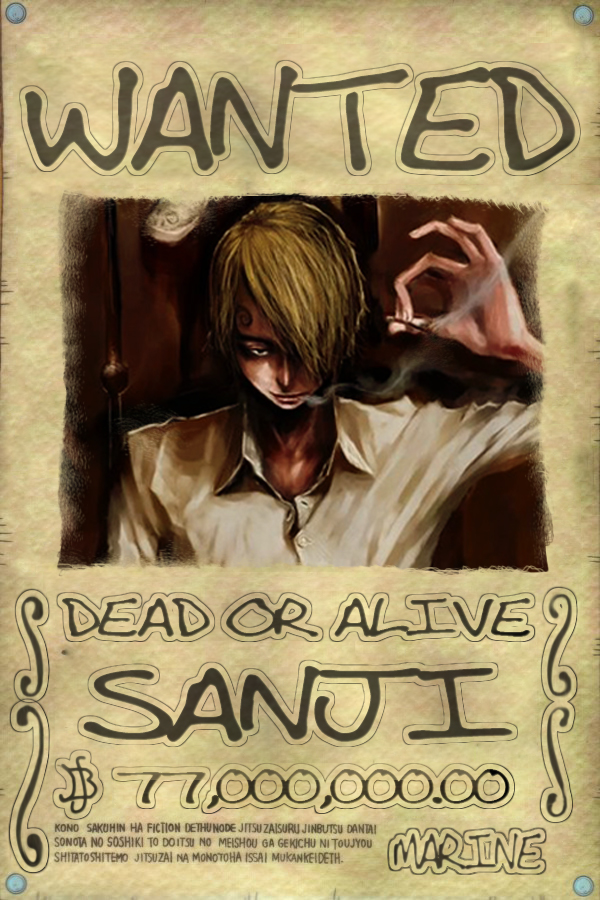
Sanji Wanted PosterIs this you?

As a player, do you try to avoid trouble?

When facing a dangerous situation, do you look for ways to make it less dangerous? To find the factors endangering your party and tamp them down, working around the problem?

In the real world, that’s commendable. If you’re playing an action-driven game, it’s not so commendable.

Because your’e playing a hero.

As a player-character, acting despite danger is your job. Minimizing danger isn’t nearly as much fun as rushing towards it, both guns blazing. Grab the princess. Swing from the chandelier.

Now, that should be your default reaction, not your only reaction. There are certainly times when you want to talk your way out of a situation.

Think of, say, Star Wars or Pirates of the Caribbean. The plot is motivated by the character’s actions. They certainly discuss options and converse with bad guys, but the player-characters all have a bias for action.

You can certainly play a diplomatic character. Just beware of defaulting to diplomacy. Instead, swing from a chandelier.

Categories: Role-playing | 1 Comment

50 Games in 50 Weeks: Paranoia

Paranoia RPGRPG players are conditioned to view PC conflict as an absolute bad. So how can I describe the fun of an RPG that assumes players will attempt to kill each other at every session?

Paranoia is set in a 1980’s dystopia where Friend Computer directs humanity with a scented iron fist. It’s 1984 crossed with Discworld.

The player-characters are all troubleshooters (“tasked to find trouble and shoot it”), given a job by Friend Computer to resolve some minor problem. Of course, failure to comply is treason and subject to immediate death. Your job is typically to track down commies, mutants, or traitors.

Unfortunately, you’re also secretly a commie, mutant, or traitor. Or all three.

Fortunately for you and unfortunately for your comrades, they’re all probably commies, mutants, and/or traitors, and you’ll get points with Friend Computer if you expose them and eliminate them before they do the same to you.

Your character gets a large array of interesting and goofy stats, and to use them, you roll a d20 in hopes of rolling at or under your stat’s score. There’s little in the way of damage; the weapons with which Friend Computer provides you rarely leave much residue.

Our group didn’t roll much; we were too busy dealing with an unfamiliar sewer transport, a surprise loyalty test, and of course, accusing each other of treason. The GM handled most of the rolls.

I had great fun playing Paranoia, but it was a very particular kind of fun. I felt “inside the action” more than I do in a typical beer-and-pretzels game, but I wasn’t taking any of it seriously.

It’s an odd game. A memorable, weird, hilarious, crazy, fun, odd game.

Categories: 50 Games in 50 Weeks | Leave a comment

50 Games in 50 Weeks: Space Hulk: Death Angel

Space Hulk: Death AngelYou are a space marine, a heavily armored and incredibly powerful warrior searching an abandoned ship for deadly, xenophobic aliens. Unfortunately, they will find you.

This is represented in a card game.

And that’s the yin and yang of Space Hulk: Death Angel. The basic idea–marines assaulted by aliens as they traverse a space ship–captures the imagination, but it’s complex and awkward to represent with cards.

The players each control a couple of marines, all of which are in the same squad. Other cards represent the ship corridors that the marines are exploring, and the aliens attacking them. Special dice are rolled when marines attack; each marine attacks in his own way.

Explaining the mechanics in detail would be dull and futile. It took me and a friend over an hour to understand the rules, and he’d played the game before. In particular, we scratched our heads over the rules for navigating through the ship and finishing the mission.

That said, Death Angel captures the claustrophobic terror of its premise. Several moments drew apprehensive groans from us both. I felt myself breathe stale air, smell fear, and feel the butt of my rifle jam into my shoulder.

I just wish I could figure out where I was on the damned ship.

Categories: 50 Games in 50 Weeks | Leave a comment