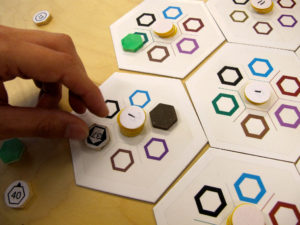
Game Design Hour: The Three Phases of Prototyping

by Kars Alfrink

by Kars Alfrink

This post continues a series of blog posts in which I provide recommendations about tabletop game design. This won’t necessarily teach you how to design a game, but it will help you along as you build it.

In this post, I’m going to talk about the prototyping.

The Crappy First Prototype

When I get an idea for a game, I rush to a Word document, a pack of index cards, or a physical notebook, and I write down everything that’s pouring out of my head. I document abstract ideas, specific mechanics, materials, and anything else that comes to mind.

Then I need to see what it looks like on the table, and I build my Crappy First Prototype.

I intentionally use scrap for the first prototype. I use torn-off bits of paper for counters, printer paper for boards, binder clips for pawns; anything that’s nearby.

I do this for a couple of reasons:

  1. Your game will change so much that any time or expense you put into any item probably won’t be worth it. You won’t use that item in the final product anyway.
  2. If you invest time and thought in “perfect” materials, your unconscious mind will favor the mechanics using them. It’ll be harder to change something that’s a poor fit for the game.
  3. Cheap materials will spur you to create a cooler game. Your mind will spawn all sorts of cool ideas for materials as you struggle with paper chits.

For an RPG, you may not need any materials. For a card game, I recommend blank (that is, unlined) index cards, which you can buy in huge, inexpensive quantities at any office supply store. For board games, use 8.5×11″ paper taped together for boards. I take a highlighter to a paper and tear off bits to create tokens, markers, and pawns. Coins and binder clips are great pawns.

The Early Play Test Prototype

Eventually, you’ll need to show the game to other people.

At this point, I replace the low-quality materials with something better, but still simple. For tokens, I’ll use plastic poker chips, for example. The point is to move away from scrap, but still avoid investing serious cost. Your game is still going to go through a lot of changes.

I’ll also format my rules into a form that’s easier to read, with headers and some form of organization. This isn’t anywhere near the final version with cool fonts and fancy art, but it’s at least formatted in a way that other people will understand, and I fill out any “(NEED TO FILL THIS OUT LATER)” sections.

Remember, you’re not showing this to everyone in the world; just a few friends who can give you an idea of whether the basic mechanics work.

The Reasonably Nice “Public” Prototype

Once you’ve run your game with a few friends, you can turn this into something closer to a final game.

Find materials closer to the final version. For a board game, The Game Crafter sells spare tokens, player pieces, etc. For a card game, you can also use The Game Crafter to order a cheap version of your cards. You’ll be showing your game to people who are less familiar with your aesthetics and expectations, so it’s important that the components suggest the game.

Now’s the time to really think about how to format your rules and make them look interesting and inviting. If we had large budgets, we’d plan for art ahead of time, but indie developers rarely have that luxury. Now you can look for art to slot into your rules and the actual presentation of your game.

Once you’ve gone through a few playtests with your “public” prototype, you can look into actually publishing your game. But that’s another post.
Categories: Game Design Hour | 1 Comment

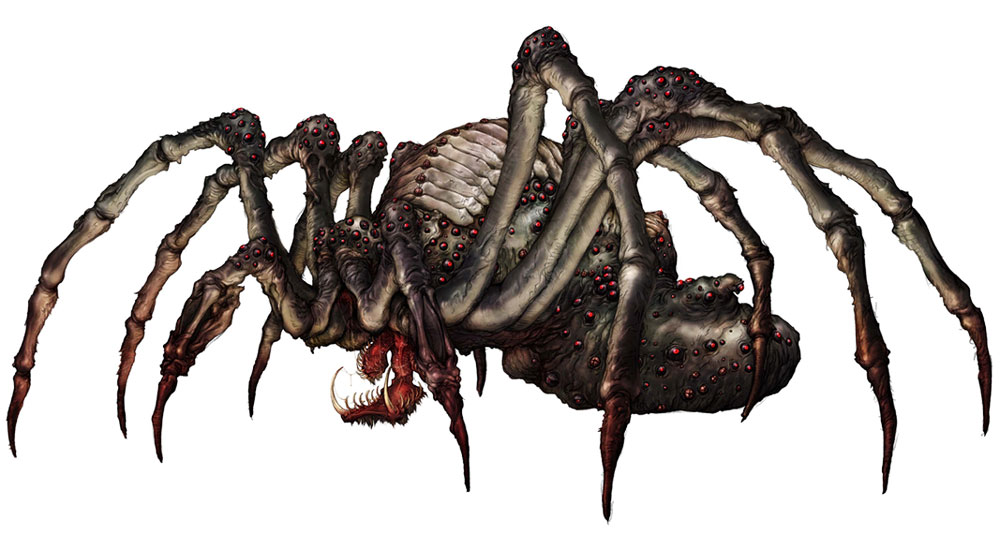
Monster Monday: Pupae-Disgorging Pregnant Armor Spider

How metal is that, huh?

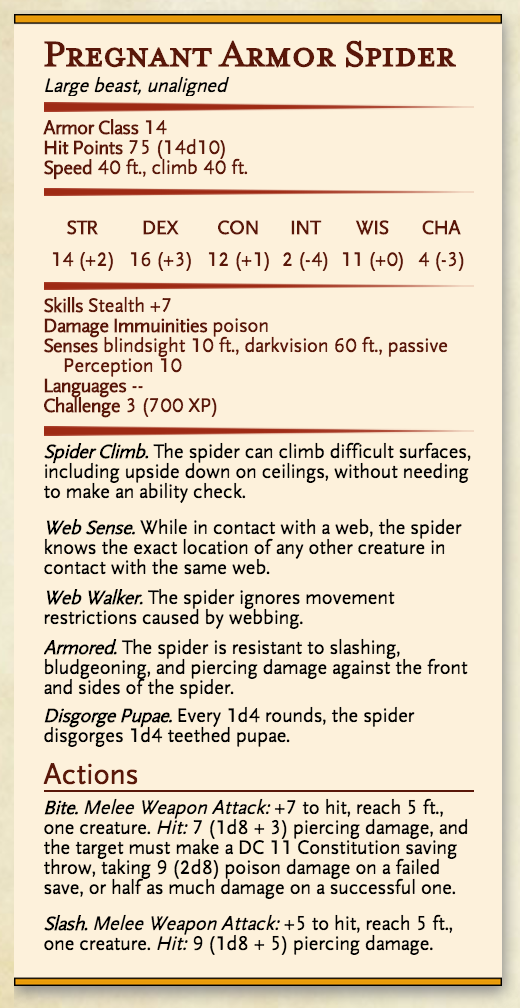
Inspired by the Egg Hunt encounter designed by Drunkens & Dragons, this giant armored spider has two particularly interesting elements:

Every 1d4 rounds, the spider spits out 1d4 teethed pupae, who quickly join the fray. The pupae are low on Armor Class and Hit Points but high on damage, which means PCs are likely to ignore them and focus on the spiders until the pupae get in one or two good hits. By that point there may be an overwhelming number of pupae, depending on how many spiders you include.

This monster introduces a facing mechanic. Due to its chitinous armor and steel-like blades of its forearms, normal weapon damage is halved if the attacks are made against the spider’s side and front. Its bulbous, pupae-filled, pregnant abdomen, however, will take damage like normal.

I ran two of these spiders against a 6th-level party and it was a pretty tough encounter; two of six PCs dropped below 0 Hit Points.

And here are the stat blocks:

___
> ## Pregnant Armor Spider
>*Large beast, unaligned*
> ___
> – **Armor Class** 14
> – **Hit Points** 75 (14d10)
> – **Speed** 40 ft., climb 40 ft.
>___
>|STR|DEX|CON|INT|WIS|CHA|
>|:—:|:—:|:—:|:—:|:—:|:—:|
>|14 (+2)|16 (+3)|12 (+1)|2 (-4)|11 (+0)|4 (-3)|
>___
> – **Skills** Stealth +7
> – **Damage Immuinities** poison
> – **Senses** blindsight 10 ft., darkvision 60 ft., passive Perception 10
> – **Languages** —
> – **Challenge** 3 (700 XP)
> ___
> ***Spider Climb.*** The spider can climb difficult surfaces, including upside down on ceilings, without needing to make an ability check.
>
> ***Web Sense.*** While in contact with a web, the spider knows the exact location of any other creature in contact with the same web.
>
> ***Web Walker.*** The spider ignores movement restrictions caused by webbing.
>
> ***Armored.*** The spider is resistant to slashing, bludgeoning, and piercing damage against the front and sides of the spider.
>
> ***Disgorge Pupae.*** Every 1d4 rounds, the spider disgorges 1d4 teethed pupae.
> ### Actions
> ***Bite.*** *Melee Weapon Attack:* +7 to hit, reach 5 ft., one creature. *Hit:* 7 (1d8 + 3) piercing damage, and the target must make a DC 11 Constitution saving throw, taking 9 (2d8) poison damage on a failed save, or half as much damage on a successful one.
>
> ***Slash.*** *Melee Weapon Attack:* +5 to hit, reach 5 ft., one creature. *Hit:* 9 (1d8 + 5) piercing damage.

___
> ## Teethed Pupae
>*Small beast, unaligned*
> ___
> – **Armor Class** 10
> – **Hit Points** 10 (1d10 + 5)
> – **Speed** 20 ft.
>___
>|STR|DEX|CON|INT|WIS|CHA|
>|:—:|:—:|:—:|:—:|:—:|:—:|
>|14 (+2)|10 (+0)|12 (+1)|2 (-4)|6 (-2)|4 (-3)|
>___
> – **Senses** blindsight 10 ft., darkvision 60 ft., passive Perception 10
> – **Damage Immuinities** poison
> – **Languages** —
> – **Challenge** 1/4 (50 XP)
> ___
> ### Actions
> ***Bite.*** *Melee Weapon Attack:* +7 to hit, reach 5 ft., one creature. *Hit:* 8 (2d6 + 2) piercing damage.

Categories: Monsters | Leave a comment

Faction Friday: The Necromancer’s Pits

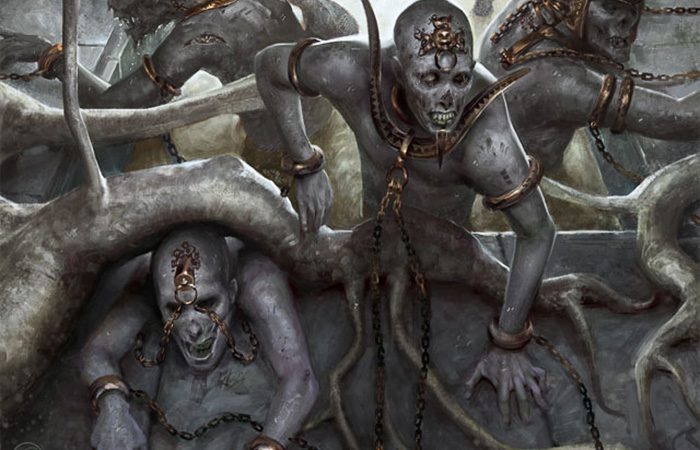
Magic: The Gathering art by Ryan Alexander Lee

Magic: The Gathering art by Ryan Alexander Lee

The Necromancer can be used either as a friendly faction that sends the PCs out on a mission, or as a foe that the PCs must overcome. Scarloth Vonidar studies necromancy in an old, haunted cave complex. He normally keeps to himself, but now he needs spell components to further his research.

As a friendly faction, Scarloth is a necromancer in name only; he’s a former druid who studies the arts of undeath to better understand the undead’s weaknesses, and maybe even find more powerful defenses against them. He found an out-of-the-way cave deep in the forest, not far from an old battleground that contains a mass grave, where he can raise and experiment on zombies in peace. The caves are further guarded by the ghosts of several dryads whom Scarloth befriended.

Plot hook: Scarloth needs poison sacs from gas spores as components in a spell that might weaken the undead. He’s located a cavern filled with fungi (and, unfortunately, a colony of ettercaps), travels in disguise to a nearby city, and hires the PCs to retrieve the sacs.

As a foe faction, Scarloth is no ordinary necromancer. Instead of just raising zombies to do his will, he seeks to understand the inner workings of undeath. To that end, he’s created a laboratory in a remote cave complex, where he raises and experiments on zombies. To guard the caves, he destroyed several nearby trees, and when dryads came to defend them, he killed them and turned them into ghosts that have no choice but to attack any except Scarloth who enter the caves.


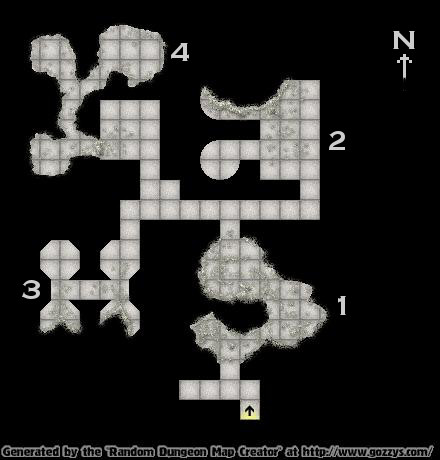
  1. The entrance leads to a natural cave haunted by 3 ghostly dryads. They have the stats of regular dryads, without spells but with the addition of a ghost’s ethereal sight, incorporeal movement, and etherealness abilities, and an AC of 12.
  2. Scarloth uses this chamber as his laboratory; it contains several tables filled with bubbling potions, and a zombie chained in the small holding area to the west. He’s currently enlarging it as he has time, but the new room to the north is unfinished.
  3. Pits in each of these rooms contain noxious liquids, into which Scarloth dips bodies, testing their effects when he raises them as zombies.
  4. Scarloth stores his supplies in the square chamber, and has left the rest of the caves untouched. Most of the supplies are mundane items, like food and tools, but the various magical reagants stored here would be very valuable to a spellcaster. If this adventure isn’t challenging enough for the party, these caves could be home to any number of predators, and could connect to a larger cave system.
Categories: Faction | Leave a comment

Game Design Hour: The 4 most useful RPG design things I know

'Right in the thick of it' by Nic McPhee

‘Right in the thick of it’ by Nic McPhee

Do you want to design a tabletop game?

I’ve designed a couple of indie tabletop RPG games and a couple of indie board games. I’m in the middle of developing one of those board games, so I’m going through the process I’ve cobbled together over the years.

This is part of a series of blog posts in which I provide recommendations about tabletop game design. This won’t necessarily teach you how to design a game, but it will help you along as you build it.

There are four things I’ve learned that dramatically improved my ability to design interesting games.

3 Unique Things

At the beginning of your game document, describe 3 things about your system that are different than almost every other game.

If it’s really not different, why would people play it?

Shape the Conversation

The fundamental activity of a tabletop RPG game is talking. Your players will talk whether they’re playing your game or not, and whether they’re playing your game “correctly” or not.

The goal of your rules is to direct that conversation towards specific topics and experiences.

You should know those topics and experiences as well as you know the inside of your car. You need to know exactly what you want players to be saying. (And here’s a bonus trade secret: they’re perfect for examples of play in your game document.)

Design the Game, Not the Mechanics

This is a corollary to the advice above, but it bears expansion.

Don’t apply dice rolls (or card pulls or whatever) to your game initially. Imagine people talking and playing the game, narrating their characters’ actions.

Write the game to push the players towards the conversations you imagine. Tell them how to create their characters and what kinds of adventures they’ll go on. Build mechanics where you see the conversation getting bogged down.

Conversation usually gets bogged down in conflict resolution, but conflicts in your game may be very different than in other games, so don’t rush to apply another game’s resolution mechanics to your game. Look at how conflicts are shaped in your game, and build mechanics appropriately.

Mechanics Emerge from Play

When designing, don’t create rules for every conceivable situation, and don’t spend a lot of time polishing each rule. Instead, get your game to the table and playtest it. Watch the experience of people with the game, and modify or invent rules to deal with the actual situations and frustrations that you encounter in play.

It’s better to start with a one-page game with only a few basic rules and shape the game as you playtest it, than to try to design it all in your head. Let the games you play make your rules for you.

Categories: Game Design Hour | 1 Comment

First-Class Role-Playing…for Players! Part 4: Creating an Interesting Character

by Magdalena Roeseler

by Magdalena Roeseler

In previous posts in this series, I provided basic advice on creating a character, table etiquette, and dealing with problems.

This post is all about going one step beyond and creating an interesting, deep character.

Any character is (simplistically) made of two things: nature and nurture.

The nature comes from the character’s inherent physical and mental makeup: their biology. Does the character have any unusual physical or mental attributes that would have changed his/her path through life, like poor eyesight, a bad leg, or shyness? In other words, what’s fundamentally different about this character, in a way that the character can’t easily change?

Also, importantly, how did the character react to that nature? Did the character with a bad leg exercise and become even stronger than an average person, or favor that leg and use it as an excuse to get out of physical activities?

The nurture comes from external circumstances in the character’s life: his or her backstory. What major events in the character’s life significantly affected him or her, and changed his/her mind? Did the character face a trauma that affected his or her ability to cope with something? Did the character have a particularly positive experience that bolstered his or her confidence, like a child who grew up in the theater and is thus more comfortable speaking in front of crowds? Personality is often driven by circumstance; a child surrounded by unstable personalities might grow up to be adept at talking to people without upsetting them.

Okay, so how do you put this into practice in a tabletop role-playing context?

First off, before play, invent 1 or 2 unusual physical or mental characteristics for your character. You may already have these. Importantly, these characteristics should be more or less beyond your character’s control, like an ugly face or an extremely analytical mind. Your character just can’t help it when it comes to these characteristics.

Then, define 2 or 3 major life events that affected your character’s outlook on life. They can be positive (a long stay with an old relative that made the character appreciate the contributions of the old or the sick) or negative (the character was constantly bullied, which gave him or her a very strong sense of justice).

Then, invent catchphrases that sum up the character’s reactions to those characteristics and events, like “I’m Just as the Gods Made Me,” “Sherlockian Mind,” “The Weak Deserve Respect,” and “Always Protect the Oppressed.”

Then write those catchphrases down and have them in front of you while you play. No matter the situation, consult that piece of paper like an oracle. Look at your catchphrases constantly as a guide to how your character should act, and act accordingly.

Hope this helps!

Categories: Player Advice | Leave a comment

Monster Monday: Lizardling Knight of Tarakona

Lizardling KnightThe savage continent of Tarakona, where draconic races battle for supremacy!

While the bureaucratic lizardling empire sends its well-trained units onto the battlefield in regimented rows and columns, the only wild cards on the field are the knights.

Knights are the smartest, most careful combatants in a lizardling army, carefully surveying their enemy for weak points and exploiting them. A knight will identify a dangerous enemy—particularly ranged spellcasters—and fire at it from range while closing, then switch to its sword and make two-handed attacks until its enemy drops to the ground.

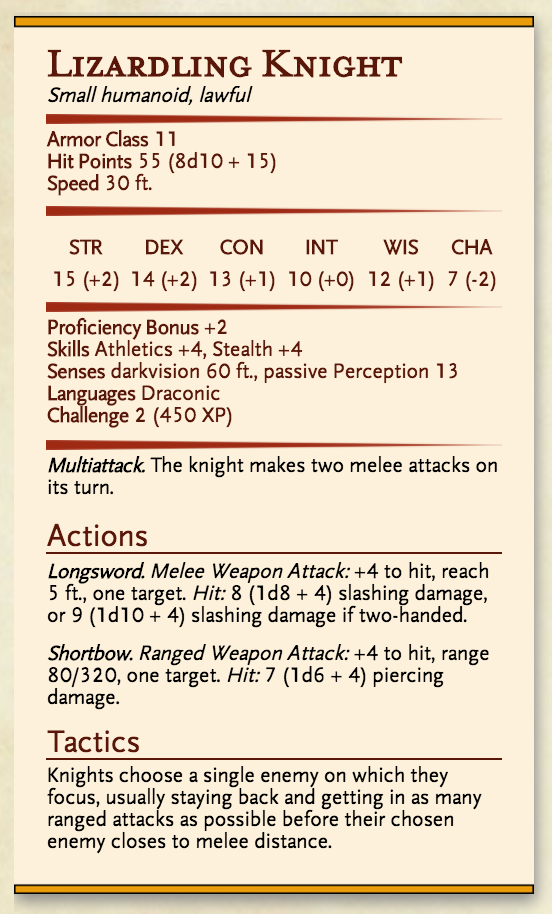
Lizardling Knight stat block


Text version of stat block, suitable for use in Homebrewery:


Lizardling Knight

Small humanoid, lawful


  • Armor Class 11
  • Hit Points 55 (8d10 + 15)
  • Speed 30 ft.

|STR|DEX|CON|INT|WIS|CHA|
|:—:|:—:|:—:|:—:|:—:|:—:|
|15 (+2)|14 (+2)|13 (+1)|10 (+0)|12 (+1)|7 (-2)|


  • Proficiency Bonus +2
  • Skills Athletics +4, Stealth +4
  • Senses darkvision 60 ft., passive Perception 13
  • Languages Draconic
  • Challenge 2 (450 XP)

Multiattack. The knight makes two melee attacks on its turn.

Actions

Longsword. Melee Weapon Attack: +4 to hit, reach 5 ft., one target. Hit: 8 (1d8 + 4) slashing damage, or 9 (1d10 + 4) slashing damage if two-handed.

Shortbow. Ranged Weapon Attack: +4 to hit, range 80/320, one target. Hit: 7 (1d6 + 4) piercing damage.

Tactics

Knights choose a single enemy on which they focus, usually staying back and getting in as many ranged attacks as possible before their chosen enemy closes to melee distance.

Categories: Monsters, Tarakona | Leave a comment

Faction Friday: Naomi’s Gnolls

Gnoll Defenders by benwootten

Gnoll Defenders by benwootten

Naomi’s Gnolls can be used either as a friendly faction that sends the PCs out on a mission, or as a foe that the PCs must overcome. This pack of gnolls is led by a charismatic human woman, Naomi Darvenel, who either restrains the gnolls into a force for good, or leads them on directed raids.

As a friendly faction, Naomi was a necromancer who repented of her vocation and wanted to make a grand gesture to bring good into the world. She used her powers to create a band of gnolls, but teaches them to do good instead of evil. This is a terribly difficult task, as the gnolls’ base nature constantly tempts them towards acts of carnage.

Plot hook: Naomi seeks the Amulet of Control, which should give her better control over the gnolls. She hires the adventurers to retrieve it from a ruined castle.

As a foe faction, Naomi is a necromancer who used her powers to create a band of gnolls. Necromancy is a lonely profession, and she considers the gnolls her (extremely fierce) pets. She occasionally uses them to hunt ruins for artifacts, but mostly keeps them in her lair. This last tactic is turning into a problem; the gnolls grow increasingly restless.

The PCs can encounter Naomi’s Gnolls in practically any dungeon environment, exploring it for treasure much like the PCs. Naomi’s protectiveness of her gnolls causes her to retreat as soon as one gnoll is defeated in combat, so the PCs may face Naomi many times.

Naomi’s Gnolls lair in an abandoned temple.

  1. The long entrance corridor contains two pit traps (DC 15 Wisdom (Perception) to detect). The first simply deals 1d8 falling damage; the other is a spiked pit trap, which also deals 1d6 poison damage.
  2. The entrance corridor was expanded into a small, time-wasting excursion that leads to room 2, in which an ochre jelly lies dormant until the PCs open either door (AC 8, HP 47, Attack +4, Damage 9 (2d6+2) bludgeoning + 3 (1d6) acid; splits if hit by lightning or slashing damage and HP >= 10).
  3. Naomi uses the large chamber in area 3 has her personal laboratory and study space. It contains a large table piled with books and artifacts and a bed. She magically summons food and water for herself and her gnolls.
  4. The gnolls sleep in this circular stone room, which looks like it may have once served as a ritual chamber of some kind.
  5. This small, oddly shaped room is now used to store Naomi’s supplies. Pushed against the walls are crates of clothes, sweets that Naomi can’t conjure, and some expensive plates and goblets Naomi has collected over the years (150 gp value in total).
Categories: Faction | Leave a comment

First-Class Role-Playing…for Players! Part 3: Troubleshooting and Summary

Welcome to the third part in a series about playing tabletop RPGs. The first post gave you some basic advice, while the second covered more advanced topics like improv. This post offers guidance on problems you may run into.

The Inflexible DM

'Running Deathwatch' by 8one6 on Flickr

‘Running Deathwatch’ by 8one6 on Flickr

Some DMs aren’t really running a role-playing game; they’re narrating their novel, within which the PCs happen to be characters. You’ll know this if the DM regularly denies or routes around reasonable character actions. In other words, if most of the things in the game happen no matter what the characters do, you’ve got an inflexible DM.

Action: Talk to your DM. Describe specific situations in which you weren’t allowed to do something for plot reasons, and how frustrating that is for you. Note that the DM might not change. In that case, if you want to keep playing, ask the DM how you can make your character better fit the campaign. If you’re at an impasse, offer to DM yourself, or find another DM to play with.

The Controlling Player

Some players dominate the game, insisting that everyone else follow their plan. Sometimes they’ll even move other players’ minis or insist that other players take specific actions.

Action: To address this in game, use a clear word like “Stop” when they do it. Then explain, calmly and politely, that you appreciate their advice but you’re going to do whatever action you chose instead. If the controlling player complains, say “It’s my character, not your character,” and continue. Be upbeat, totally polite, and firm.

If the controlling player continues, talk to him or her outside of the game. Describe their specific behaviors, and tell them that if they continue doing this, what you’ll do as a result (probably leave the game).

The Passive Player

Some players just aren’t interested in engaging with the story. They won’t react to your suggestions, and their actions in game almost always amount to “I attack.”

Good news: This isn’t your problem! Some players are naturally more passive. For them, D&D night is a time to relax and clear out a dungeon; they don’t want to get deep into a character.

Action: Let passive players be passive.

Summary

Here’s all the advice in this series, combined into one place.

When creating a character:

  • Look for a class, race, and other options that interest you.
  • Send your DM a message containing the following:
    • A description of your character, in as much detail as possible.
    • One family member, one knowledgeable friend to whom your character can go for information, and one influential acquaintance. Write down their names, classes, races, needs, fears, specific professions (guard, lord, dock worker, etc.), and physical locations in the world.
  • Ask for any unusual details about the setting, and for a list of house rules.

Once you’ve created your character, memorize your character’s attack-related stats and passive Perception, and as much of the rest of your character’s abilities as possible.

When you go to a face-to-face session, bring your character sheet, at least one pencil, extra paper, and snacks and/or drinks. If you’re hosting, clean.

Show up on time. If you truly can’t make it, communicate that to everyone as early as possible.

When the session starts, mute your phone.

During the game:

  • If the DM’s talking, be quiet and listen.
  • If you can’t decide what your character would do, choose one course of action and just do it. If the entire group is inactive, do something reasonable, but do something.
  • Choose courses of action that include other player-characters.
  • When a player introduces a new fact, accept it and add to it.
  • Don’t look at your phone.

Between sessions, ask each other player what you can do to help their character achieve his or her goals. Write these down and have them with you during the game.

Hope this helps!

Categories: Player Advice | Leave a comment

First-Class Role-Playing…for Players! Part 2: How To Be Awesome

'Deep in thought' by 8one6 on Flickr

‘Deep in thought’ by 8one6 on Flickr

This post is for players who have played enough sessions to have the game’s basic rules under their belts. If you’re completely new to role-playing, read this first post in the series.

Work With Your DM

Accept your DM’s house rules

Your DM has certain guidelines and parameters for the world, and house rules to play by. Accept them.

Seriously, part of the DM’s job is to figure out these things. Your DM probably has good reasons for using them.

That said, you can certainly ask questions about any special rules or restrictions. Your DM wants you to understand them, so if they don’t make sense to you, absolutely ask questions. Just don’t get into arguments about them. If you really dislike a particular restriction, it’s better to find a different group than to get into multiple arguments with this one.

Action: Ideally before the campaign begins, ask your DM for any unusual details about the setting, and for a list of house rules.

Don’t play against your DM

Some players think of the DM as their adversary, as an enemy to be outwitted. In fairness, some DMs think this, too.

While your DM is certainly inventing obstacles for your characters, he or she is running a game that he or she thinks will be the most fun for everyone at the table.

Don’t look for a way to avoid every plot hook, or to defeat every villain immediately, or to figure out what’s “really going on” and find a way around it.

Play the game.

Create Hooks For Your Character

Invent family members, friends, allies, contacts, and other people that your character knows in the world. Tell your DM about them.

These will create allies that your DM can bring into the game to help you. Don’t worry about whether your DM will use them against you or not (again, don’t play against your DM).

Action: Create one family member, one knowledgeable friend to whom your character can go for information, and one influential acquaintance. Write down their names, classes, races, needs, fears, specific professions (guard, lord, dock worker, etc.), and physical locations in the world. Send them to the DM and ask for feedback.

Collaborate With Other Players

You’re not the only player! Talk to the other players about their characters. Look for ways to support them in-game, not just statistically, but also by backing them up when their characters suggest courses of action, and proposing in-game things their characters can do (with your character’s help).

The game’s a lot more fun when player-characters are working together towards their goals.

That said, your players are also figuring out their characters in play. Watch for unexpected moments of character development during the game, and do your best to support them.

Action: Ask each other player what you can do to help their character achieve his or her goals. Write these down and have them with you during the game.

Improv and “Yes, and….”

Many gamers consider improv the Holy Grail of effective, in-character role-playing. While improv doesn’t map precisely onto tabletop role-playing, learning and practicing improv will certainly improve your role-playing skills.

Look up articles and books on improv (one of the best is Impro: Improvisation and the Theatre by Keith Johnstone). Look for ways to integrate that into your play.

One of the more useful rules of improv is “Yes, and….” When another player introduces anything, such as mentioning a side character or a bit of backstory, accept it as part of the story, then build on it. In other words, if a player says “Hey, remember that time we hunted goblins through the snow into Fardeep?” don’t say “No,” or “What are you talking about?” Instead, say “Oh yeah, I nearly lost an eye! I remember we let one of the goblins go; I wonder what happened to him?”

There are two main exceptions to this rule. First, if someone introduces a fact that contradicts already established history, step back out of character and ask the player to clarify. Second, if someone tries to act for another player in the moment (such as “Your character attacks me”), step out of character, point out that the other player doesn’t get to choose your character’s current actions, then move on.

If you don’t like what another player introduces, you can use “Yes, but…” to describe a complication to the fact. This is a way to take a problematic situation and turn it to your favor. Just don’t do it often.

Action: When a player introduces a new fact, accept it and add to it.

Don’t Dominate

If you’re actively doing things in the game, it’s easy for your character to become central and overshadow other characters. You can turn a group story, like The Avengers or Guardians of the Galaxy, into a solo-hero story like Indiana Jones. Some players are okay with that, but many aren’t.

Fortunately, this is relatively easy to fix: choose actions that include other characters. Invite another character to help you with your intended action. Don’t just wade into battle; ask another character to cover you.

Also, spend a session where you take a back seat. Let other players push the story forward. Certainly act and react, but if you’re consistently the one acting first, try being more passive and see what happens.

Action: Choose courses of action that include other player-characters.

That’s it! Stay tuned for some troubleshooting tips tomorrow.

Categories: Player Advice | Leave a comment

First-Class Role-Playing…for Players! Part 1: Help! I’ve Never Played Before!

Welcome to tabletop role-playing! We’re glad you’re here. You’re going to play an important character in a story, and you want to do the best you can. Good on you.

This blog post (and a few more coming later) provides advice to players of tabletop role-playing games, helping them to be better players. Each section will end with a specific action to take.

For simplicity’s sake, this paper will assume that you’re playing Dungeons & Dragons.

Help! I’ve Never Played Before!

'Hooligan' by 8one6 on Flickr

‘Hooligan’ by 8one6 on Flickr

Don’t panic!

The other players won’t expect you to memorize every rule. It’s like playing a board game; if you’re invited to play, you won’t be expected to have learned the rules ahead of time, but you will be expected to pay attention to them.

In other words, follow the advice in this blog post, and you’ll be fine.

Create the Character You Want to Play

Online, you’ll find advice about the “best” race, class, and abilities to choose to create a “balanced” party. But here’s the thing: that advice is usually aimed at experienced players who want to optimize their experience.

D&D is very tolerant of a variety of different characters, even several of the same characters. If your DM hasn’t given you specific parameters, create the character you want to play.

That said, a “lone wolf” character is very difficult to integrate into a group game like D&D. Avoid this trope if at all possible by giving your character in-world relationships.

Action: Look for a class, race, and other options that interest you.

…And Check With Your DM

The DM may be running a game in a very specific setting, where your character concept will have specific in-game consequences. For example, spellcasters or rogues may be seen with some level of suspicion by common folk. Some official races just won’t fit into the game world.

Also, the DM may suggest a particular race or class for you. That’s okay! Talk it over with your DM. If you really dislike the DM’s suggestion, suggest an alternative. Work it out until you find a character concept you like.

Action: Write down your character in as much detail as possible and send it to your DM, asking if it’s okay.

Know Your Character

Once you’ve built your character, spend some time memorizing as many of your character’s abilities as you can. In particular, pay attention to these stats:

  • Attack bonuses
  • Damage dice and bonuses
  • Passive Perception
  • Ability score bonuses
  • Unusual abilities, like a resistance to one type of damage

Focus particularly on combat abilities, since you’ll probably be under some time pressure when you need to use those.

Don’t worry about memorizing everything! Just learn as much as you can.

Action: Memorize your character’s attack-related stats and passive Perception.

Show Up

If you agree to attend on a particular day, show up on time. Only cancel if you’re physically ill or something really unexpected and serious comes up, and give your group as much advanced warning as possible. Your DM put a lot of time into preparing the game for you; don’t waste it.

Bring Supplies

If you’re playing face-to-face, you’ll be interacting with other players for several hours. This requires some social niceties.

Bring your character sheet, at least one pencil, and extra paper for notes. If you don’t have dice, download a dice-rolling app onto your phone.

If you’re hosting, clean the play area and the nearest bathroom. I’m not talking hospital-level antiseptic; just clear enough for people to get around.

If you’re not hosting, bring snacks and/or drinks.

Action: Bring the supplies listed above.

Pay Attention During the Game

You don’t want to miss a vital clue! Your DM will be giving you lots of information during the game, and if you’re chatting with somebody else, checking your phone, or otherwise distracted, you may not notice something important.

And by “clue” I mean anything in the game: an enemy who seems weak, a side character who knows something she shouldn’t, a pool of water; any of these might take only a few words of description, so they’re easy to miss.

Your DM isn’t the only player at the table, though. The other players are playing, too! Watch what they’re doing and what their characters are doing. React to them! Agree with their decisions, suggest other options, and generally push the story forward.

Action: Mute your phone when the session starts, and don’t look at it during the session. If the DM’s talking, be silent and listen. (This assumes your DM doesn’t talk over you; see part 3 of this series if that happens.)

Do Things

Be active! This is a role-playing game, not a role-listening game. It’s almost always better to do something than to sit back passively.

Remember that you’re playing a character, not a series of die rolls. Your character will have opinions and take action even if the rest of the world isn’t pushing for it.

A few caveats here: don’t constantly poke at anything nearby just because there’s a brief lull in the action. A hopelessly ADHD character will cause problems for most groups; lots of things in the game poke back, and constant activity can be very frustrating for your fellow players.

Also, this applies to your own character, not to everyone else. It can be a lot of fun to spend an hour planning a heist, debating many different options for what to do.

Action: If you can’t decide what your character would do, choose one reasonable course of action and just do it. If the entire group is inactive, do something reasonable, but do something.

That’s it! Stand by for more advanced advice tomorrow.

Categories: Player Advice | Leave a comment