Monster Monday: Lizardling Archer of Tarakona

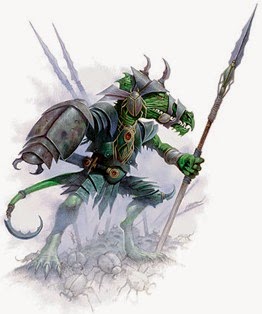
Kobold by V Shane

Kobold by V Shane

The savage continent of Tarakona, where draconic races battle for supremacy!

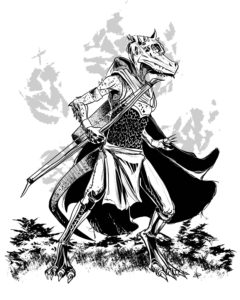
What the lizardling empire lacks in creativity it makes up for in training. Its archers can do terrible damage with their short bows. This is important, as they’re trained to maneuver around the rear of the battlefield and do damage from afar. A single good hit can take out an archer, but it can do considerable damage before that.

Archers always remain organized into a unit under a Commander (statted out separately), who strides into combat and calls orders back to its unit.
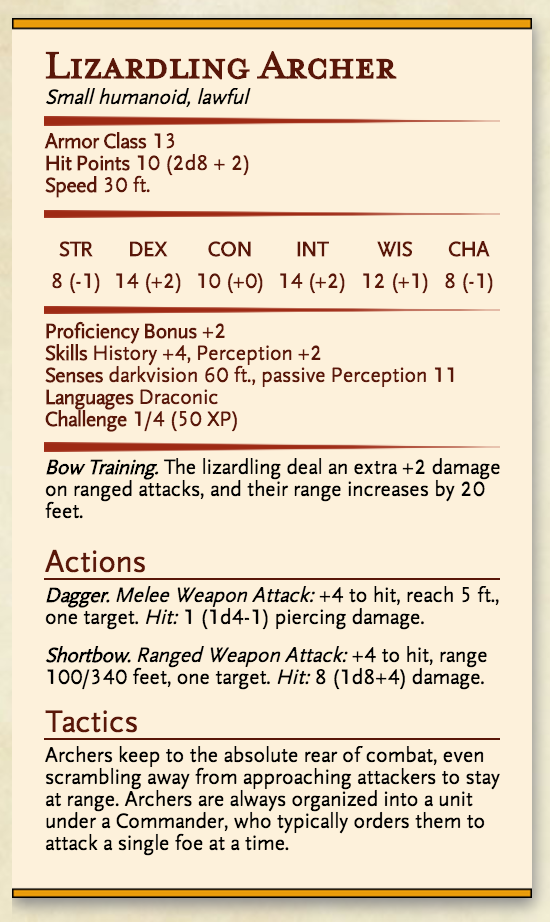
Text version of stat block, suitable for use in Homebrewery:


Lizardling Archer

Small humanoid, lawful


  • Armor Class 13
  • Hit Points 10 (2d8 + 2)
  • Speed 30 ft.

|STR|DEX|CON|INT|WIS|CHA|
|:—:|:—:|:—:|:—:|:—:|:—:|
|8 (-1)|14 (+2)|10 (+0)|14 (+2)|12 (+1)|8 (-1)|


  • Proficiency Bonus +2
  • Skills History +4, Perception +2
  • Senses darkvision 60 ft., passive Perception 11
  • Languages Draconic
  • Challenge 1/4 (50 XP)

Bow Training. The lizardling deal an extra +2 damage on ranged attacks, and their range increases by 20 feet.

Actions

Dagger. Melee Weapon Attack: +4 to hit, reach 5 ft., one target. Hit: 1 (1d4-1) piercing damage.

Shortbow. Ranged Weapon Attack: +4 to hit, range 100/340 feet, one target. Hit: 8 (1d8+4) damage.

Tactics

Archers keep to the absolute rear of combat, even scrambling away from approaching attackers to stay at range. Archers are always organized into a unit under a Commander, who typically orders them to attack a single foe at a time.

Categories: Monsters, Tarakona | Leave a comment

Faction Friday: The Dragon Slavers

Mialorn Manor

Original photo by Dwight Burdette

A wealthy halfling, Harran Mialorn, has been cowed by a young dragon named Mezvorax into kidnapping people to be the dragon’s slaves. He and his followers (also slaves of the dragon) live in a bat-filled mansion. Each follower wears an amulet that keeps them dominated by Mezvorax. About a quarter of those kidnapped become working members of the slaver ring, while the rest are delivered to the dragon.

The amulet gives each member of the slaver ring the ability to cast a psychic blast cantrip (range 50 feet, attack +4, 6 (1d8+2) damage).

As a friendly faction, Harran’s unusually strong will occasionally pushes back Mezvorax’s mental control, and he’s horrified at the situation he’s in. In one of his more lucid periods, he hires the PCs to infiltrate the group and kill the dragon. He’s procured amulets that look similar to those that dominate the group, and gives them to the PCs. If the PCs do kill the dragon, Harran becomes a grateful benefactor to the group, providing them with money and items as needed, as well as access to the city’s higher society.

As a foe faction, Mezvorax completely dominates Harran, as well as the other members of the group. The city Watch hires the PCs because the slavers made a mistake: a group of three street girls they snatched a few days ago included the daughter of a noble family who was “slumming.” The Watch has received several reports of strange goings-on around Harran’s manor, so they suspect he’s responsible (he’s been acting strangely, he’s become very reclusive in recent months, odd people are seen coming and going, etc.).

If your players are of an investigative bent, feel free to build this into a complete mystery, with clues, witnesses, and such that the PCs can follow up on before approaching the manor directly.

Mialorn Manor
The upper floors of Mialorn Manor consist of bedrooms, parlors, and other mundane rooms of no particular interest to an adventuring party. Harran keeps no clues to his draconic ties in the upper floors of the house.
Main Floor Basement Secret Caves
A large entrance hall leads to a grand staircase leading upstairs. A dining room, sitting room, and other functional rooms for entertaining stand just off the entrance hall.

At the door, guests are greeted by Nessa, a girl of about 19 dressed as a maid. If the PCs grow hostile, she will attack with psychic blasts and call in another servant, the chef, who attacks with knives and psychic blasts.

Foe: Nessa was one of the girls kidnapped a few days ago, an important clue that the PCs have come to the right place.

This dank basement consists of a wine cellar, root cellar, and two storage rooms. The first storage room is crammed full of crates and boxes, as the other has been cleared for use by the slavers.

The second storage room contains several chairs, a table, and ropes. Victims are kept here temporarily. A number of bats roost in this room, and attack any intruders who enter (normally vermin who only roost here overnight, Mezvorax’s spells have turned them into guards).

A section of the wall in the second storage room has been knocked out, then disguised by a major image spell to look like the wall is whole. This exit leads to the caves.

Magical runes cover the floor of the first, small room of the cavern, which Harran uses to attune victims to their amulets. Several cultists stand ready to attack the PCs when they enter, getting a surprise round and defending the deeper caves with their lives.

Further down the caves lies Mezvorax’s lair, where he employs the remainder of the slaves to expand the cave complex into a full lair. These slaves do not fight back (the most mentally docile are chosen for this work), but Mezvorax should be plenty of challenge.

Categories: Faction | Leave a comment

How to Run a Heist in D&D

'Hope Diamond by Julian Fong on Flickr

‘Hope Diamond’ by Julian Fong on Flickr

Let’s say your players need to retrieve a heavily guarded item in a fantasy RPG scenario. How should you go about running that?

First thing: establish the location. You’ll need a detailed map of the place where the item is kept; find a map online or create it yourself. Place the item deep within that location.

Then, populate the location with traps. The item itself may have spells on it, or the room may have spells, or you may have mundane mechanical traps around the room (pressure plates that trigger poison darts, pit traps, etc.).

Finally, add guards. Make sure the item is guarded by intelligent enemies.

Let the PCs learn about all this, then let the PCs plan.

Note: You may need to limit their planning. I’ve used a kitchen timer, set to 30 minutes, and told the playersthat something bad will happen if they don’t commit to a plan before the timer goes off. The “something bad” depends on what’s going on in your plot; perhaps the PCs are discovered, or another enemy makes its move, or the item in question is moved, or security is beefed up.

Then, when the heist goes off, ensure that enemies react intelligently. The guards should be alert. They should call for help. They shouldn’t just stand there and attack the PCs until death; they should retreat for backup if possible. The guards should also have their own options for locking down the location and otherwise preventing the PCs from getting away.

Have you run a heist before? Please post your experiences in the comments!

Categories: Role-playing | Leave a comment

Semi-Monthly Map: The Abandoned Temple of Arazhuul

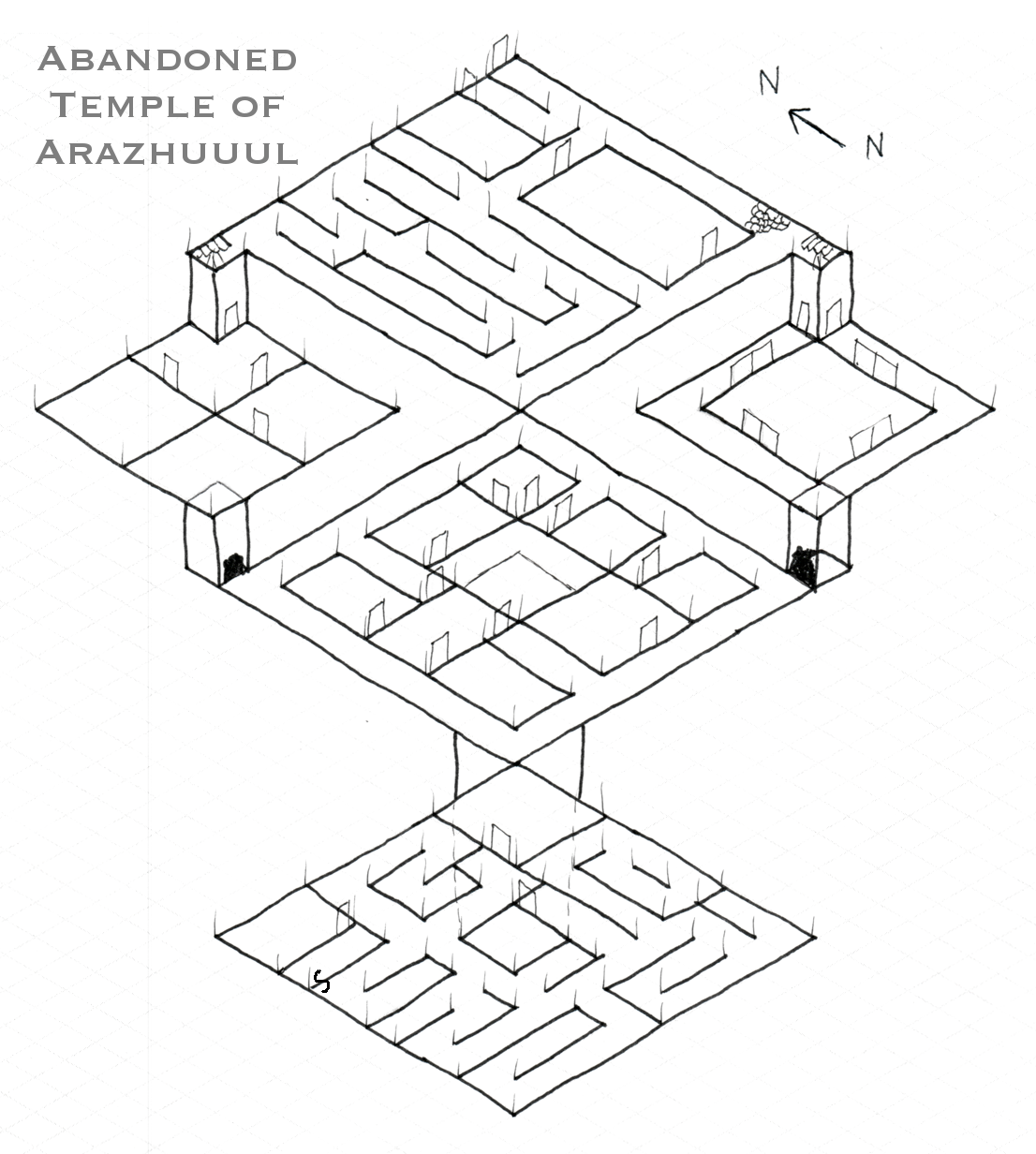
The Abandoned Temple of Arazhuul is a large dungeon complex that was taken over by several forces. As the PCs delve deeper, they will find themselves in several very different environments.

Arazhuul is a goddess of order and civilized pleasure, and the symmetrical design of underground complex exemplified this aspect of the goddess.

A few years ago, a group of goblinoids discovered the upper entrance and established the upper level as their lair. Originally a set of waiting rooms for visitors to the temple, the goblinoids converted the rooms for their own purposes. The small room closest to the entrance contains supplies–crates and barrels from recent raids–while they use the large room as their sleeping quarters. They converted the rest of the floor into a maze into which they can lure intruders and attack them at range from around corners.

The stairs in the northwest corner lead down to what were once storage rooms, but are now the lair of a giant spider who crawls in and out through a crack in the ceiling. The goblinoids avoid this area.

The stairs in the southeast corner lead down to what was once a large, shared sleeping chamber for guests of the temple. The goblinoids keep any slaves and valuables (the latter locked securely in a large, trapped chest) here.

The middle level remains more or less as it was in the temple’s heyday, primarily because of the animated constructs that guard it. The stairwells leading down to this level used to contain wooden stairs, but these were destroyed at some point, so the goblinoids do not descend to this area. Any creature who enters the stairwells activate gargoyles (placed randomly to begin with), which move at a speed of 15 feet per round inexorably towards the party. If the party splits, the gargoyles split up, as well.

The rooms in this middle level used to be the temple’s storehouse. Now, its rooms contain a few basic traps–pits, poison needles, etc.–and a few old treasures in the form of statuettes and goblets. The danger in this level is getting trapped by the gargoyles, which can both take and dish out large amounts of punishment.

The lowest level, reached by the huge staircase in the center of the complex, was discovered by a group of mind flayers some time ago. The temple’s treasures are of no interest to them, but this level serves as a convenient outpost while traveling through their vast network of tunnels beneath the earth. They have rebuilt this level into a confusing maze of slick, wet passages leading to two rooms. The small room in the northwest (only accessible through a secret door) contains a small stash of half a dozen brains in a small vat, which are tended by several grimlocks. The large chamber in the northeast corner serves as the mind flayers’ outpost; when the PCs arrive, the only inhabitant is one mind flayer and its pet intellect devourer. If a mind flayer is too powerful for your party, have it be in the middle of extracting the brain of a victim when the PCs arrive, giving them a round or two while the mind flayer is catatonic in its euphoria.

Temple of Arazhuul

Categories: Maps | Leave a comment

Rules for Establishing Dangers Near a Town

Let’s say the PCs are headed towards a small town, out in the middle of nowhere, that’s surrounded by dangerous monsters and ruins. Let’s further say you haven’t fleshed anything out beyond that basic concept.

(Astute players will recognize this as the setup for a West Marches campaign.)

What if you could build these dangers collaboratively with your players?

Here are some rules for a quick, 1-hour “session zero” fleshing out the monsters and adventuring locations near a particular spot in your world. It’s inspired by Microscope, but it’s much quicker and simpler.

Preparation

By Phil Roeder on Flickr

By Phil Roeder on Flickr

The facilitator prepares ahead of time by writing several monster types (goblins, orcs, trolls, etc.) on index cards or sticky notes, as well as remote adventuring locations (mine, temple, dungeon, caves, etc.). Each card has one monster type or adventuring location. The facilitator also write the name of the base town on an index card.

Play

In play, the facilitator places the card with the base town in the center of the table, and off to the side the facilitators places the other cards (all face up and visible, not stacked), as well as blank index cards and pens. The facilitator then chooses one other player to go first.

On a player’s turn, the player may do one of the following:

  1. Choose an existing card and place it on the table near the town. Its placement relative to the other cards corresponds roughly to its location in the fantasy world.
  2. Write further details on an existing card (“orcs” becomes “orcs – large war camp with goblin slaves”). This can be written on a placed card or an unplaced card.
  3. Create a new card, which should contain only a monster type or basic adventuring location (in other words, avoid fleshing out a card on the same turn you create it). The player can duplicate an existing card (so there can be more than one dungeon site).

At the end of a player’s turn, the player chooses the next player to go, until everyone (including the facilitator) has had a turn. Play continues until the group is satisfied with the amount of content generated.

At the end of the game, photograph the cards on the table. This is your basic adventuring map.

Categories: Cool Utilities | Leave a comment

Monster Monday: Lizardling Trooper of Tarakona

Lizardling TrooperThe savage continent of Tarakona, where draconic races battle for supremacy!

What the lizardling empire lacks in creativity it makes up for in training. Its troopers train with long glaives for month after month until they can handle them as though born to them, despite the weapon’s large size. This gives the troopers up to a 10-foot reach on the battlefield.

Troopers also train in a powerful unit charge, where they move forward as a group and deal significant damage. This is important, as a single strike from a more powerful foe can take out an individual Trooper.

Troopers always remain organized into a unit under a Commander (statted out separately), who strides into combat and calls orders back to its unit. Each Trooper considers itself a member of its unit, even if it’s the only surviving member.

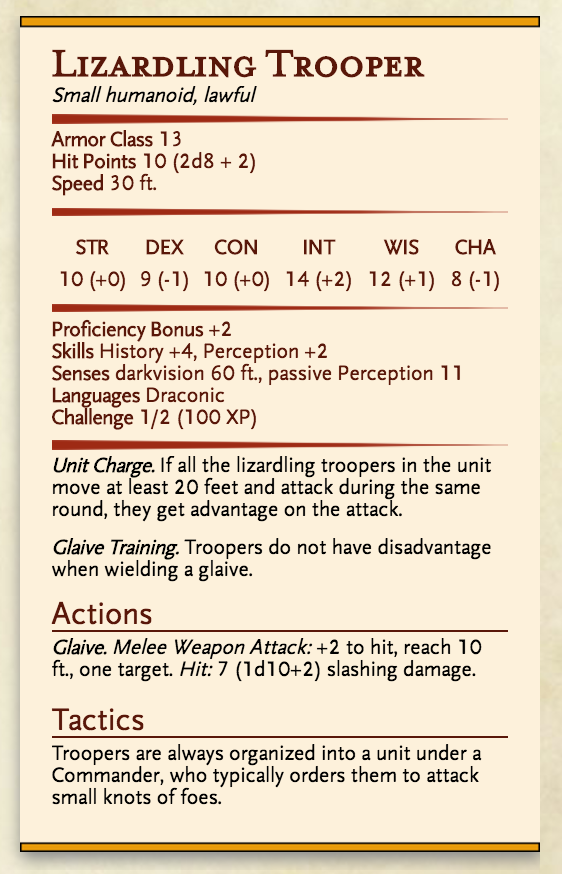
Lizardling Trooper stat block

Text version of stat block, suitable for use in Homebrewery:


Lizardling Trooper

Small humanoid, lawful


  • Armor Class 13
  • Hit Points 10 (2d8 + 2)
  • Speed 30 ft.

|STR|DEX|CON|INT|WIS|CHA|
|:—:|:—:|:—:|:—:|:—:|:—:|
|10 (+0)|9 (-1)|10 (+0)|14 (+2)|12 (+1)|8 (-1)|


  • Proficiency Bonus +2
  • Skills History +4, Perception +2
  • Senses darkvision 60 ft., passive Perception 11
  • Languages Draconic
  • Challenge 1/2 (100 XP)

Unit Charge. If all the lizardling troopers in the unit move at least 20 feet and attack during the same round, they get advantage on the attack.

Glaive Training. Troopers do not have disadvantage when wielding a glaive.

Actions

Glaive. Melee Weapon Attack: +2 to hit, reach 10 ft., one target. Hit: 7 (1d10+2) slashing damage.

Tactics

Troopers are always organized into a unit under a Commander, who typically orders them to attack small knots of foes.

Categories: Monsters, Tarakona | Leave a comment

Faction Friday: The Rat Cult

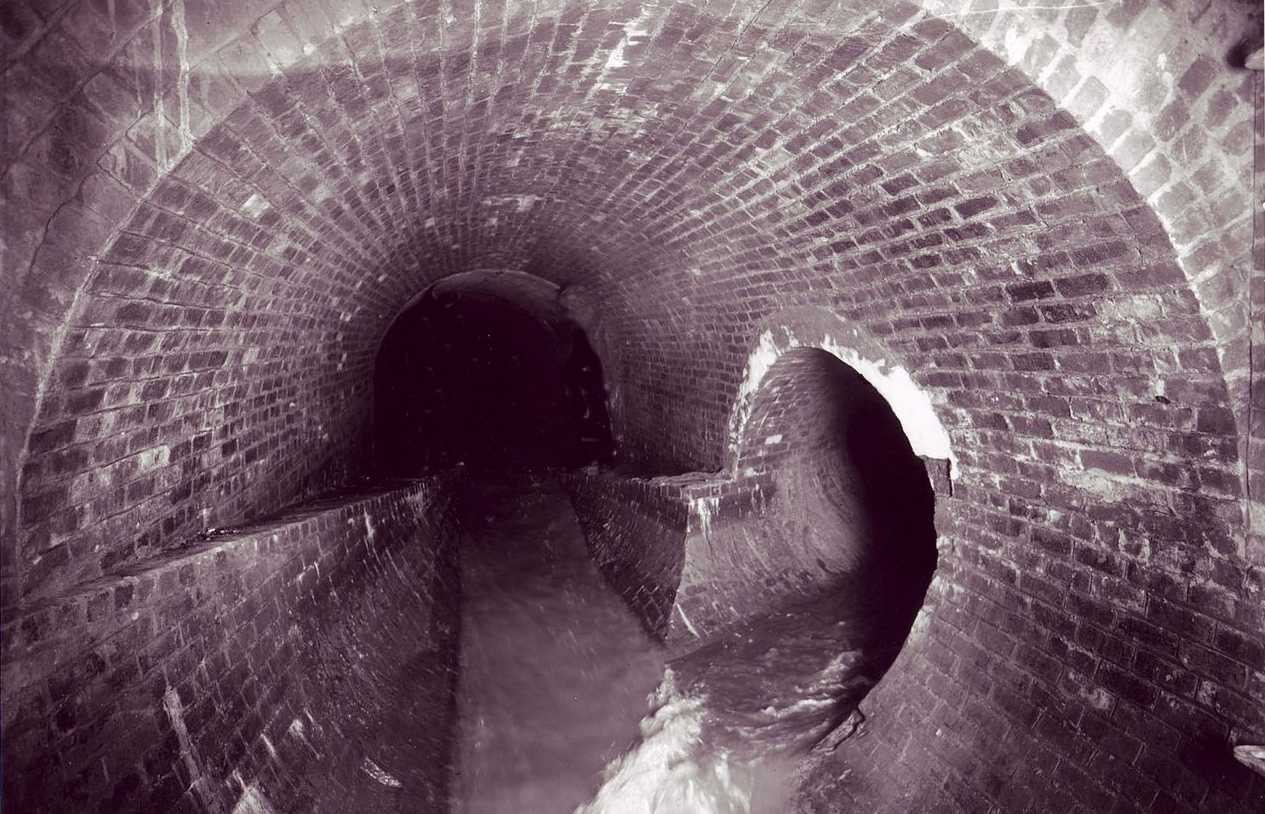
Sewer

The Rat Cult can be used either as a friendly faction that sends the PCs out on a mission, or as a foe that the PCs must overcome. The cult bases itself out of a hideout in the sewer system beneath the city. Edric, a young male wererat, leads the cult of a dozen disaffected youths.

As a friendly faction, the cult’s just a group of teenagers who meet most nights to go through strange (mostly made-up) rituals and dare each other to pull pranks. Edric’s the intense, obsessed leader who tries to corral them, mostly unsuccessfully.

Plot hook: Edric’s worried about the future of his proto-religion. He’s heard of a crystal ball buried in an abandoned temple that can be reached from the sewer system. He investigated it, but found it guarded by a natural predator too powerful for his group (oozes, giant centipedes, giant bats, etc.). He hires the PCs to retrieve the crystal ball for him.

As a foe faction, Edric leads an intense cult of a dozen teenagers who despise the regular folk of the city. In the past three months, they’ve successfully robbed four well-known businesses and destroyed three pieces of public art. The town Watch hires the PCs to find the cultists and stop them.

Rat Hideout
The cultists found a large, unused maintenance room which now serves as their hideout. It sits at the end of two corridors, which they have effectively trapped.
First Corridor Second Corridor Maintenance Room
The first corridor has been rigged with a tripwire (DC 12 Wisdom (Perception) to detect). If tripped, it jangles a set of old keys and nails, alerting those inside.

Foe: If the tripwire is tripped, a swarm of rats followed by a cultist appears and attacks the intruders. The cultist will retreat if reduced to less than half its Hit Points.


This wide corridor contains two rat swarms which immediately attack, and has been rigged with its own, much harder to detect tripwire (DC 17 Wisdom (Perception) to detect). If tripped, a metal plate falls over each end of the corridor and sewer water pours in from the sides. The rats swim with no particular effort, still attacking the intruders. If not stopped, the water will completely fill the corridor.

A panel containing four levers sits on the other side of the room. Two of them must be pulled to stop the water, then another must be pulled to open a drain in the floor, then a fourth must be pulled to open the doors. The third and fourth lever will have no effect until the first and second are pulled.

The cultists lounge in this large chamber that swarms with rats. It contains a few tables and chairs, plus half a dozen beds of straw.

A panel of levers just like those in the earlier chamber sit on this side of the wall, as well. Various pipes and levers line the walls.

Foe: Edric will order the cultists to attack any intruders and will turn into his wererat form and join the fray. If he is killed and at least half the cultists are dead or unconscious, the rest will surrender.

Categories: Faction | Leave a comment

How to Run a Large D&D Group (7+ Players)

by Capture the Uncapturable on Flickr

by Capture the Uncapturable on Flickr

/u/BoyScholar wrote in this post:

I’ll be attempting to DM a module with a group of roughly 7-8 players sometime next month and I’m looking for any advice to manage the player count.

First off: do it.

Some advise that you either turn some of the players away (at least temporarily), or run 2 groups. I disagree.

On the first score, think about it from the players’ perspective. You’re interested in a game, you know somebody who can show you the game, but he refuses to play with you because there are more players than he’s comfortable with? How discouraging for the prospective player! Not cool.

On running two groups: getting one group together is difficult enough these days. Trying to organize two groups is at least twice as hard, much harder than just running one session with a large group.

That said, there are some things you can do to make it easier.

Tell the players that the system’s designed for fewer players, and you’re totally going to play, but you will be looking for ways to mitigate that issue. Tell them it’s absolutely not a problem; just something the system’s not exactly designed for so you’ll all have to tweak the game a bit.

Then, minimize combat. Plan for one significant combat encounter each session. The players might skirmish with one or two monsters outside of that battle, but don’t plan on more than one battle. With that many players, combat will take so long that even one non-trivial fight will take up much of your session.

If you’re running a module, you’ll have more damage output on the players’ side, so scale the fights appropriately. Ignore less important fights, and add a few more monsters to the important ones. While this means you have more monsters to manage, that doesn’t introduce problems the way that increasing AC or damage output does.

With this many players, tell players when you’ll start, and start on time. You probably don’t start the game as soon as players arrive, so give them both times: When to arrive, and when you’re going to start playing. Then, stick to that schedule. If a couple of players haven’t arrived when play time rolls around, get started anyway. A few players are going to be late; don’t make that hurt the rest of the group.

Ask players for feedback after every session. Wth this many players, it’s easy for a few to slip through the cracks. You can do this both as a group, and you can communicate with any quiet players privately (some are uncomfortable providing feedback in a group).

I like to ask players for their favorite part of the session, their least favorite part of the session, and what they’d like to see happen in the future.

Then, after a few sessions, look for a natural division into two groups. Do a couple of players mesh well together? Suggest splitting the party so that they have their own campaign.

So, play with a large group! You can always split the group once you’ve got a feel for all of them, but for now, it’s always better to play.

Categories: Prescriptions | 1 Comment

What to put in your Unified GM Bag

In a previous post, I described the utility of having a Unified GM Bag: all your materials in one place.

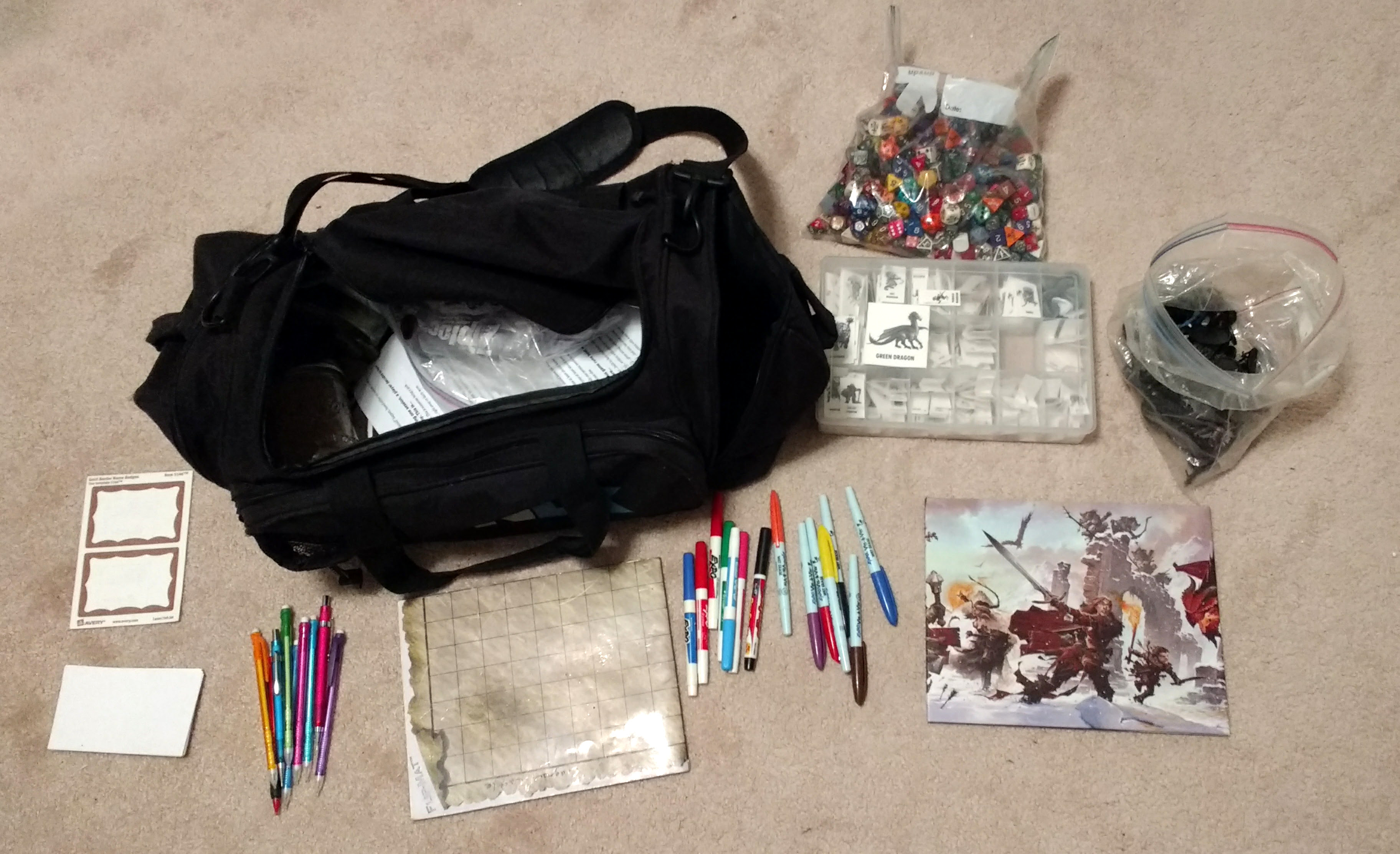
Here’s everything in my bag, with explanations:

GM Bag Detailed v2

A bag of dice. My players haven’t yet figured out that they can buy their own dice, and besides, folks sometimes lose dice and it’s handy to have spares.

At least half a dozen pencils. Players often forget to bring pencils, and even if they do, it’s useful to have spares in case one or two breaks.

Erasable battle maps, with a 1-inch grid on one side and hexes on the other. Even in games that don’t use miniatures, these are very useful for drawing out rough maps, marking down information, etc. Much as I love the theater of the mind, my players tell me that a 15-second sketch of a location can save many minutes of confusion. I keep two Pathfinder Flip-Mats in my bag.

Wet erase and dry erase markers. If I know what I’ll be running, I draw that onto the mat with wet-erase markers ahead of time, so they don’t smudge. I use dry-erase markers during the game for anything that can change positions (especially doors).

Glass beads. I use these clear red “stones” whenever I need Fate Points, tokens, or other counters. Their red color makes them very visible on a crowded table.

Paper miniatures with about 20 plastic stands. I printed several hundred minis from Paper Friends, with a wide variety of monsters, villagers, adventurers, etc. I actually 3D printed the plastic stands, but you can either make your own with binder clips, or use them as triangular, foldable minis.

A GM screen, in this case a D&D 4E screen into which I’ve pasted D&D 5E sheets. I don’t always use a GM screen, but it’s often useful.

Blank paper, 5-10 sheets. Great for impromptu handouts, as “fog of war” to cover a map, or as scribbling notes on.

Index cards, for notes that I can pass easily to players.

Name tags. This is incredibly useful for convention games, where you’re probably not going to remember every character name. Hand out name tags and ask each player to write his or her character name on the name tag, and put it on. Now you can address everyone by character name! I tried doing this with little stands on the table, but they’re never oriented so that everyone can see the stand, or they get blocked by other things on the table.

A 30-second sand timer (not pictured). I mostly use this with groups that are slow to make decisions; I give them each 30 seconds to decide what to do in combat.

One adventure (not pictured). I printed out a basic adventure that I can pull out if the PCs go completely off the reservation (an abandoned temple overrun with monsters).


In addition to all this, before each game, I place my binder of campaign notes and the core rule book into the bag. Now I’m ready for just about anything!

Categories: Cool Utilities | Leave a comment

Amazingly useful tools: a Unified GM Bag

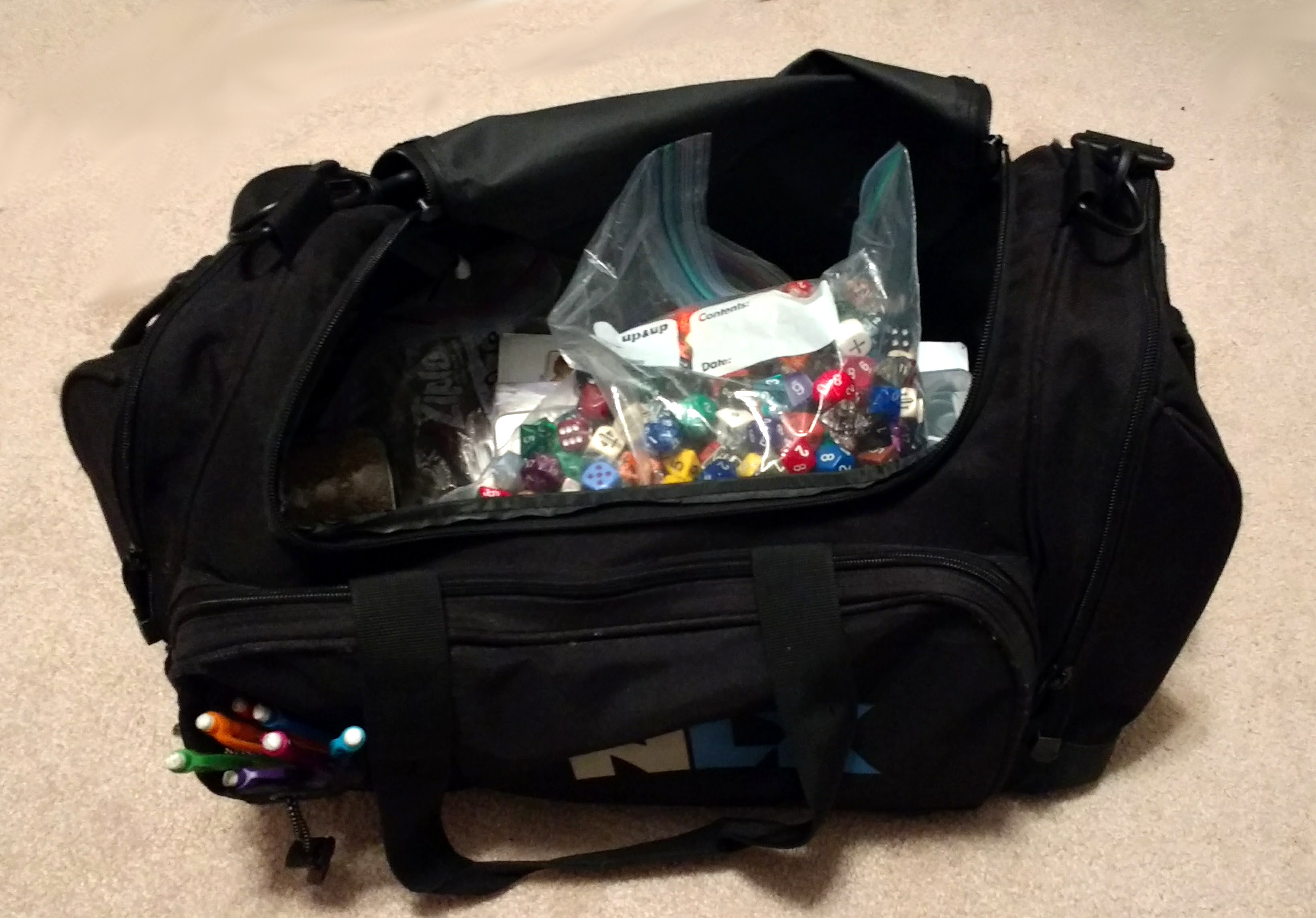
GM BagI have one big travel bag in which I store all my RPG materials (except for books and physical handouts like keys, rings, and pendants, since I have different handouts for different groups). It contains, among other things:

  • Dice
  • Pencils
  • Index cards
  • Counters
  • Blank paper
  • Folded paper minis

Why would you want to do this?

  • You may run for more than one group, now or later.
  • A friend may be curious about tabletop RPGs, and want to play a solo session to see how the game is run.
  • You may have to run a game at somebody else’s house.
  • You need all this stuff for RPGs anyway, so why not keep it in one place?

With a bag that contains all the essentials, you can run any time, anywhere.

Stay tuned for a post that details everything in my GM bag, but you don’t need that to make your own. Go for it!

Categories: Cool Utilities | Leave a comment