“Okay, How Do You Do That?”

'2012 Adventure Photography Competition' by FrontierOfficial

‘2012 Adventure Photography Competition’ by FrontierOfficial

Players often get caught up in the game mechanics of what their character is doing and don’t think through the fiction of what they’re doing.

A classic example is a rogue who says he “stealths” across a bare field in full sight of an enemy.

The GM can check this with a simple question: “Okay, how do you do that?”

Crucially, this question doesn’t punish the player. It asks the player to clarify the action in the fiction. The player may be perfectly justified in their action; they just didn’t explain it well.

It also helps the GM understand the player-character’s approach. A character who wants to intimidate a guard can do that in lots of different ways, each of which the guard can react to in different ways, which can further impact the story in different ways. Is this the sort of intimidation that the character won’t want to talk about, or will want to talk about?

Plus, this question encourages players to think in terms of the fiction rather than the rules. Which is what we’re all here for.

Categories: GM Advice | Leave a comment

The Treasure Table: This is What You Get?!?

About five months ago I signed up for The Treasure Table, a monthly subscription box aimed specifically at Dungeons & Dragons 5th Edition DMs. The first box was supposed to arrive in February.

No box.

I received an email from the guy behind this, explaining that he was having problems with his shipping company. Apparently he’d never used them before, and sure enough they were causing problems. This raised a red flag, that he went public with this process without testing out his shipping company, but such things happen.

Finally, yesterday, on May 1, the March box arrived (!). Oh boy!

Let’s open it up and see what’s inside.

…Oh. That’s not particularly exciting. Let’s fold it out and see….

There’s a welcome letter, four pre-gens, a “love letter,” a tiny d4, and four “cupids and cherubs.” And here’s the problem: I might not be as disappointed if this arrived in early February in time for a Valentine’s Day-themed game, but it’s now May.

Let’s look at the love letter. First off, it’s printed on a piece of paper that’s in that most Valentine’s of colors, orange. Second, you can’t even hand this to your players; it includes both text to the DM and to the player, and the letter begins with “My dearest (Player),” so you can’t just cut out the letter. Apparently, you’re supposed to re-type the letter from scratch.

Also, a minor but significant note: Shouldn’t this be addressed to “My dearest (Character)”? I shouldn’t actually address the love letter to the player him- or herself, right? I understand that kind of mistake in a quickly-written social media post, but in the only page of game content you wrote for the month?

Okay, what’s in the letter itself? Surely some interesting plot hooks! Surely some character nuggets! Nope, it’s just a long confession of love, with no information on the sender. Let’s read a sample!

Upon this canvas I shall spill my soul’s inner-most desires for you, and upon my chest I carve your name with the dagger of carnal desire, so the world may knoweth that only you lie within my heart.

Okay, first off, why use archaic “knoweth” when none of the other words use that formation?

Secondly, carving your lover’s name on your chest with the dagger of carnal desire is not only overwrought, it’s scary. Like, my PCs would burn this letter and avoid the sender at all costs. This would actively cause them to avoid any plot involving the sender.

It gets better! Or, rather, worse. The letter ends:

I live only to please your fiery carnal desires.

Not to harp on the grammar, but I’m going to harp on the grammar: desires don’t feel pleased. Desires don’t feel anything. Desires are satisfied.

But more importantly, this is even darker stuff that has a high chance of alienating players (and PCs). This isn’t just overwrought words of love, this is moving into deep D&S stuff.

Okay, moving on. How about those character sheets? Surely those are interesting…

…nope, it looks like the creator found an online D&D character builder, chose a few race and class options and clicked “Generate,” then paired them with a random fantasy name generator (don’t believe me? The four characters are named Izer Stuz, Sabis, Eldea Valora, and Sivet Longfall).

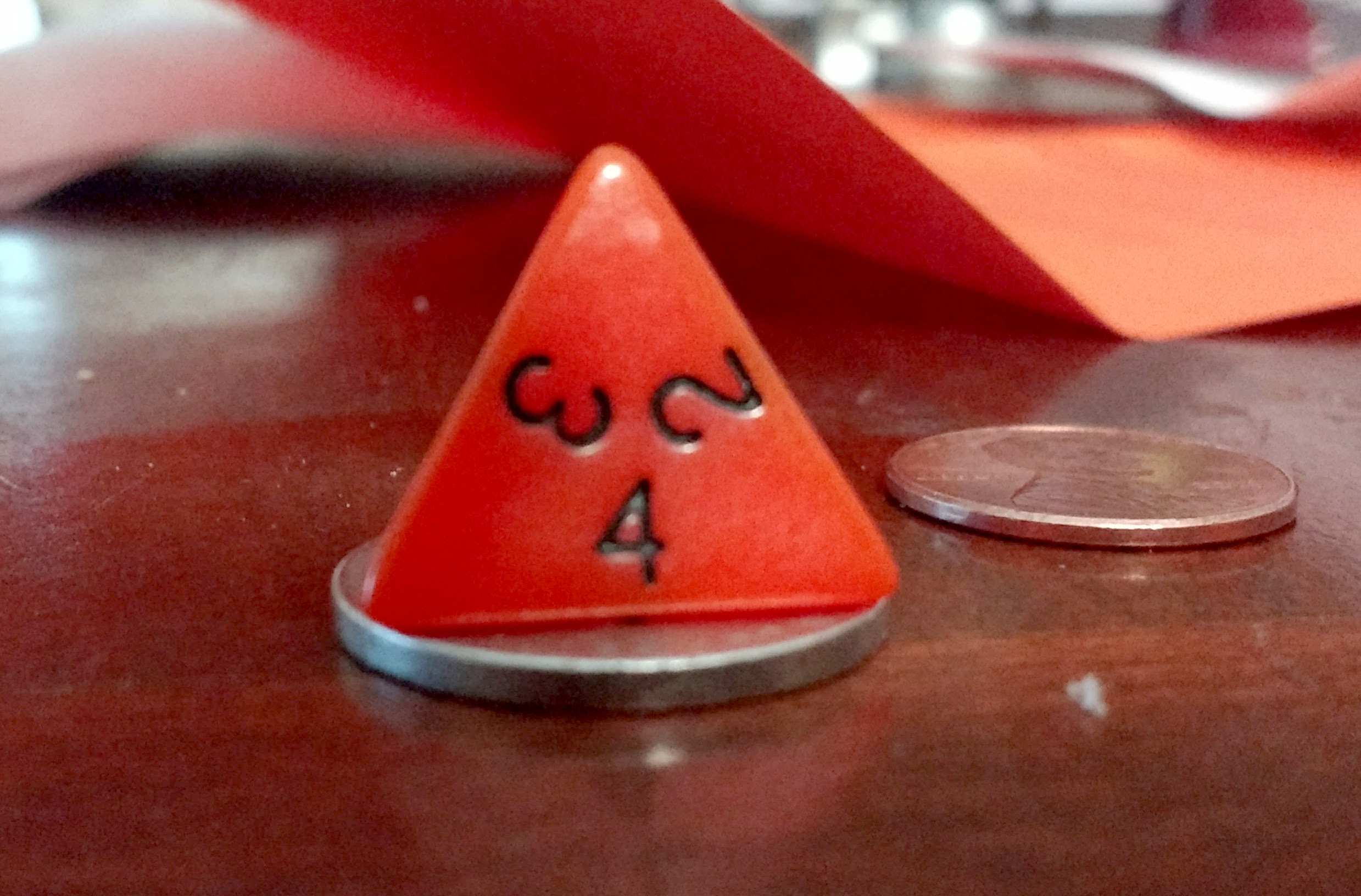
Besides the fact that the d4 is the second least-used of the standard dice array (that dishonor falling to the d12), this is also the smallest d4 I’ve seen. It’s literally the size of a nickel.

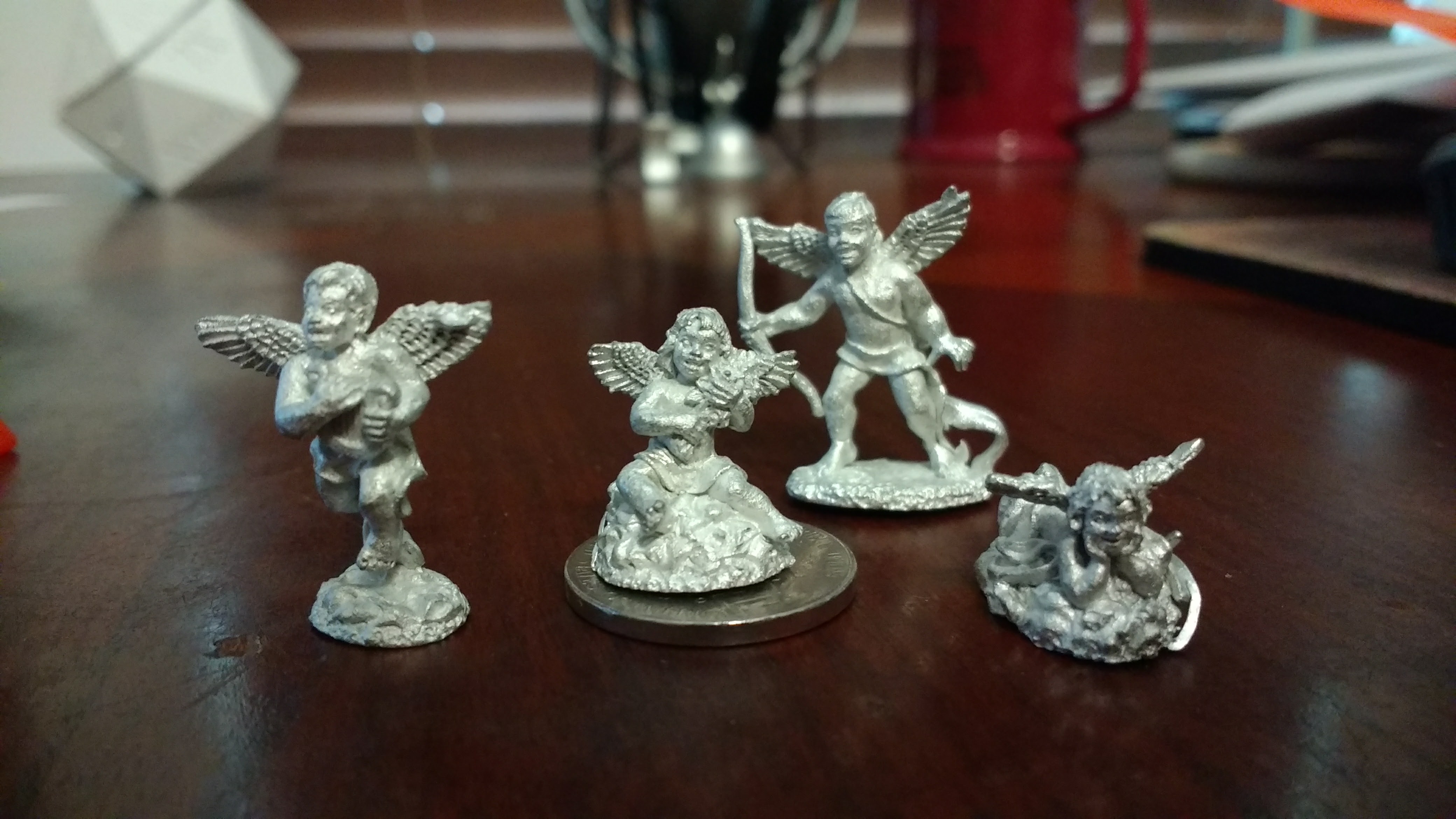
But you get miniatures, right? Yep, four cupids! Most of which are smaller than nickels. And again, yeah, I get it, February means Valentine’s which means cupids. But it’s not February, and even if it were, there aren’t any cupid monsters in D&D. What am I supposed to do with these in-game? Did the designer stat them out? No.

Okay, you may be saying, it’s slim pickings. But surely it’s not expensive.

I paid $35 for this box.

Now, granted, it normally comes with a t-shirt, and I opted out of that (I have too many t-shirts). But still, this isn’t worth $25. Heck, it’s hardly worth $10.

Categories: Uncategorized | 2 Comments

Monster Monday: Hunting Drake of Tarakona

T-Rex in the Storm by danimix1983-d34zbct

T-Rex in the Storm by danimix1983-d34zbct

The savage continent of Tarakona, where draconic races battle for supremacy!

The studious Komodos explore the ancient ruins that cover Tarakona in groups of 5 to 10, typically made up of rangers, investigators, and tamed hunting drakes, who then report back to a team of researchers in a Komodo stone city.

Drakes make for vicious predators: they’re basically miniature Tyrannosaurus Rexes with the personality of piranha. The komodos have managed to domesticate them to the point of using them as hunting animals, much like dogs.

However, hunting drakes have not lost their predatory natures. Indeed, komodo exploration parties like to bring 3-5 hunting drakes with them and unleash them all on one enemy, where they will knock said enemy to the ground and can tear it down to its skeleton in seconds.


Hunting drakes are typically released in packs, who will charge one creature and knock it prone so that the other drakes can gang up on it. If other enemies draw near, drakes will use their fire breath to keep them away while the drakes devour their prey. Drakes also do not move on from their prey once it drops to 0 HP; they will continue attacking until its flesh fills their bellies.

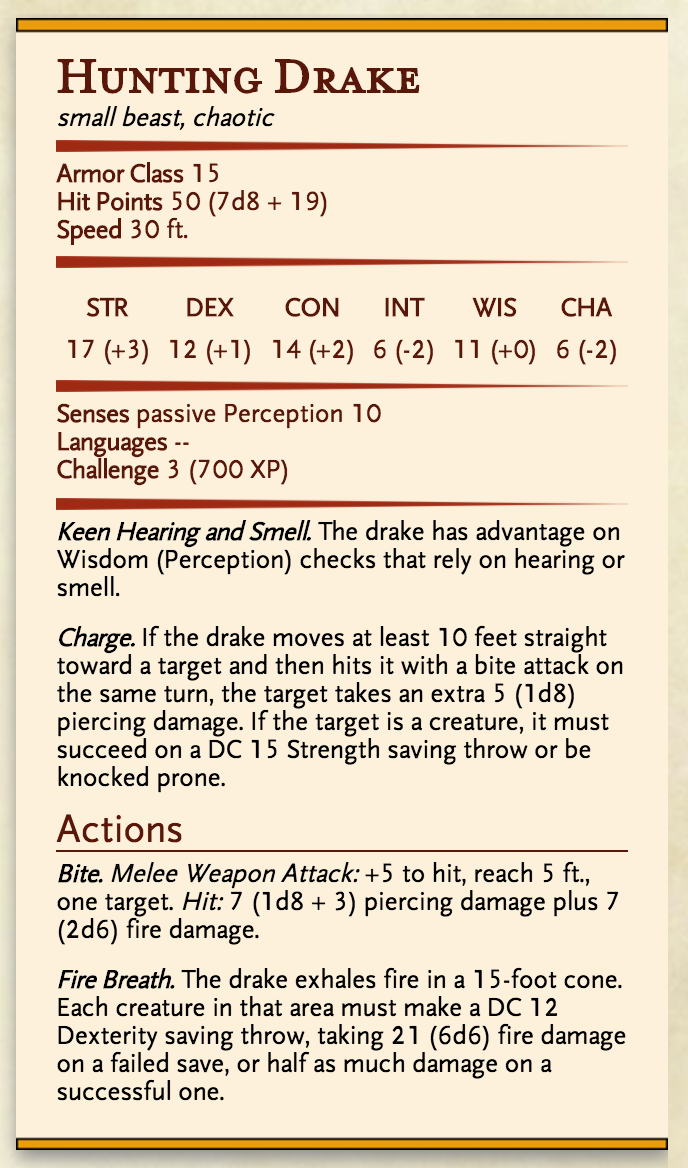
Text version of stat block, suitable for use in Homebrewery:

___
> ## Hunting Drake
>*small beast, chaotic*
> ___
> – **Armor Class** 15
> – **Hit Points** 50 (7d8 + 19)
> – **Speed** 30 ft.
>___
>|STR|DEX|CON|INT|WIS|CHA|
>|:—:|:—:|:—:|:—:|:—:|:—:|
>|17 (+3)|12 (+1)|14 (+2)|6 (-2)|11 (+0)|6 (-2)|
>___
> – **Senses** passive Perception 10
> – **Languages** —
> – **Challenge** 3 (700 XP)
> ___
> ***Keen Hearing and Smell.*** The drake has advantage on Wisdom (Perception) checks that rely on hearing or smell.
>
> ***Charge.*** If the drake moves at least 10 feet straight toward a target and then hits it with a bite attack on the same turn, the target takes an extra 5 (1d8) piercing damage. If the target is a creature, it must succeed on a DC 15 Strength saving throw or be knocked prone.
> ### Actions
> ***Bite.*** *Melee Weapon Attack:* +5 to hit, reach 5 ft., one target. *Hit:* 7 (1d8 + 3) piercing damage plus 7 (2d6) fire damage.

> ***Fire Breath.*** The drake exhales fire in a 15-foot cone. Each creature in that area must make a DC 12 Dexterity saving throw, taking 21 (6d6) fire damage on a failed save, or half as much damage on a successful one.

Categories: Monsters | Leave a comment

Faction Friday: The Desert Goblins

Goblins from D&D 4E; artist unknown

Goblins from D&D 4E; artist unknown

The Desert Goblins can be used either as a friendly faction that sends the PCs out on a mission, or as a foe that the PCs must overcome. This band of goblins was defeated by a dwarf adventurer, Balrin Darkhollow who decided to lead the group instead of destroy them.

As a friendly faction, a party of unsuccessful dwarf adventurers led by Balrin were attacked by a group of marauding goblins about a year ago. The dwarves did well in the fight, and once half the goblins died, the rest surrendered. In a moment of whimsy, Balrin ordered the goblins to work for the party as hirelings, and to his surprise, the goblins acquiesced. They’ve behaved as more or less faithful servants ever since.

The other dwarves grew increasingly uncomfortable with this arrangement and drifted away from the group, leaving Balrin as the goblins’ sole non-goblin leader. He now leads them in attacks on smaller bands of gnolls, orcs, and other monsters. He’s managed to avoid confrontations with other goblins so far.

Plot hook: The goblins are increasingly difficult to control, but Balrin has learned of a staff of charming in an abandoned temple that has magical traps. His group crosses paths with the PCs, and he approaches them, asking if they’d be willing to retrieve it for him, in exchange for some plunder. This is a good chance for some interesting role-play, as the PCs will probably detect goblins watching them, but the goblins won’t attack. And imagine an approaching dwarf surrounded by a dozen goblin guards!

As a foe faction, the story went about the same way, except that Balrin is a power-hungry dwarf who saw in the goblins the chance to build an army. Any dwarves or goblins who didn’t agree with him quickly met unfortunate ends, and now Balrin commands a serious fighting force through sheer force of will and strength of arms. They’ve been attacking caravans and nearby camps for months now.

Plot hook: The PCs are warned about a dangerous tribe of goblins led by an insane, battle-hungry dwarf. They then find themselves attacked by the Desert Goblins, which retreat after three of their number are killed. The PCs will find the goblins in their mansion.

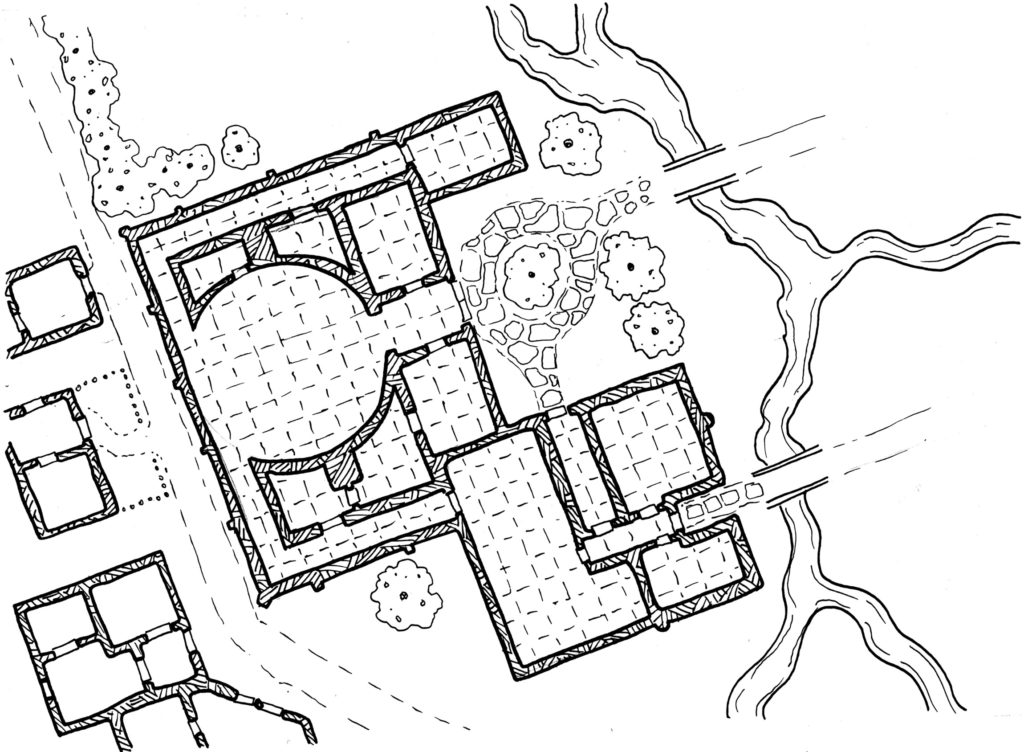
The following map of the mansion is “The House of Seven Wines” by Dyson Logos. The goblins will not stay in any one given room, and the mansion was abandoned and stripped of valuables long ago, so the map is not keyed. The PCs will simply encounter the goblins in whatever order you find most relevant given their approach. To spice up the encounter, stirges have nested in two rooms of your choice. A back room contains stolen weapons and supplies worth about 500 gp.

'House of Seven Wines' by Dyson Logos

‘House of Seven Wines’ by Dyson Logos

Categories: Faction | Leave a comment

Game Design Hour: How Polished Should My Play Test Materials Be?

by Emiliano García-Page Sánchez

by Emiliano García-Page Sánchez

So you’re writing a tabletop RPG, and you’re going to run a playtest with a couple of friends. What do your playtest materials need to look like?

I’ve already covered the three phases of prototyping, so let’s look at those recommendations and dig deeper.

At this point, I replace the low-quality materials with something better, but still simple. For tokens, I’ll use plastic poker chips, for example. The point is to move away from scrap, but still avoid investing serious cost. Your game is still going to go through a lot of changes.

I’ll also format my rules into a form that’s easier to read, with headers and some form of organization. This isn’t anywhere near the final version with cool fonts and fancy art, but it’s at least formatted in a way that other people will understand, and I fill out any “(NEED TO FILL THIS OUT LATER)” sections.

So, point #1: your playtest materials do not have to be final. Don’t worry about finding exactly the right tokens to represent health; coins will do fine.

Why not try to make the game look as good as possible? Two main reasons: 1) The playtest may well reveal that your entire mechanic is a bad fit for the game, requiring you to dump those perfect tokens you spent so much time finding. 2) Polished materials create the impression that those materials are final. Your playtesters will be much less likely to tell you that a mechanic doesn’t work if they see how much time and effort you put into its representation.

That said, you want materials that are easy to use in play. During your own personal testing, you probably used things like sticky notes and whatever was at hand to mark things, but those may be harder for your playtesters to use during a game than, say, blank cards or plastic poker chips. You want your playtest to move swiftly, so it’s worth upgrading from playtest materials that were convenient for you but won’t be as convenient for a handful of people around a table. In other words, you want materials that don’t distract your playtesters.

When it comes to your rules, of course it’s impossible to give you a single, clear rule that tells you when your rules are good enough for playtesters. Here are a few guidelines, though:

  1. Have you included all the rules needed just for the playtest? That is, are there any rules still in your head that need to be written down? Add them. On the other hand, don’t worry about a rule for every possible situation; just include the ones you’re likely to encounter in the playtest session.
  2. Are there any parts of the rules you intended to fill out at some point (often marked with “FILL THIS OUT LATER!!!!!”)? Fill those out now. Don’t worry about making them perfect, but either add them or remove them from this draft.
  3. Review the document thoroughly for spelling and grammar issues. One missed word in a rule can color a playtester’s perception of the game (because the playtester may think something’s possible when it’s not, or vice versa) and cause confusion that will unnecessarily eat up playtest time. You don’t have to write perfectly to publish a game, but unclear language will draw attention to itself, and away from the reasons you’re playtesting.
  4. Add page numbers. Your players will be flipping back and forth between pages during the test, asking where certain rules or explanations are, and without page numbers this will eat up time.

How do you run a playtest and gather useful feedback? I’ll explore those topics in the next few posts.

Categories: Game Design Hour | Leave a comment

My Go-To RPG for Any Genre

'Jump of Faith' by Abel Maestro Garcia

‘Jump of Faith’ by Abel Maestro Garcia

You come across a cool movie, TV show, or book, and you think, Man, I want to run a tabletop game in that world. But there’s no RPG designed specifically for it. What system do you use?

Unless another system fits particularly well, I always default to Risus.

Why? The entire Risus system can be described in one paragraph. In fact, I’ll do it now:

Write down clichés or catchphrases that describe your character. You have up to 10 points to distribute among those catchphrases; more points means they’re stronger. When your character tries to do something difficult, choose an appropriate catchphrase and roll as many d6’s as points in that catchphrase, add the results, and compare to a target difficulty number. In combat, you’ll roll against an enemy’s catchphrase; whoever rolls lower temporarily loses a die in their catchphrase. Lose all the dice in a catchphrase and you lose the conflict. Dice are restored at a rate appropriate to the genre (light superheroes: all dice restored at the end of every combat; gritty noir: one die restored per day).

So, all your players can grasp Risus in about 2 minutes.

More importantly, your players can create their characters in about 5 minutes. This lets you get a concept to the table and play it.

Risus isn’t ideal for every genre, of course; it’s better for pulpier concepts where characters tend to get into direct conflicts. If you want to run an investigation game, you’ll need a GUMSHOE-style approach to ensure PCs get the clues they need. If you’re running a Cthulhu-esque game, you may want to add a simple sanity mechanic (add 1d6 to Insanity every time a character encounters something Cthulhoid; above 10 they get jittery; above 20 they go insane).

But no system is ideal for every genre. Risus at least gives you a simple framework for making your characters, jumping into a scenario, and handling conflict.

Categories: Role-playing | 1 Comment

Game Design Hour: How to Schedule a Play Test

'Schedule' by pittaya

‘Schedule’ by pittaya

Let me introduce you to Sonja. Sonja wrote a cool little tabletop RPG. She wants to playtest it, running it with a few people to get a feel for the game, but her attempts to scheduled a game have so far met with failure.

She came up with a two-pronged, systematic approach.

First, she identified a handful of friends–face-to-face and online–who she thinks would be good playtesters. She messaged them directly, describing the game in a couple of sentences and asking if they’d be willing to playtest. No firm date yet; just a yes/no question. A couple of them responded affirmatively.

Then she wrote a broad, public post on her favorite social media platforms, asking if anyone would be interested in playtesting. This was a little different than the first message; she described the game in a little more detail, keeping an upbeat tone. After all, she didn’t know the people who’d read this as well, so she needed to provide more context. A few people commented expressing interest.

Note that she hadn’t scheduled anything yet. Instead, she focused on building a list of people who were eager to playtest.

Then she went to Doodle and created a scheduling poll. Doodle’s great because you can list a bunch of potential dates and times, and get folks to vote on which works for them, but you can use whatever alternative is easiest for you. She set up a bunch of time slots when she personally was free.

Then Sonja wrote a separate post, just for those who responded affirmatively to her first two posts, pointing them to the Doodle. About half of them actually filled it out, and she ended up with one time slot with three people.

Boom! She had enough people to run her playtest and a time slot.

Why do it this way? I’ve tried to start the process by scheduling the playtest session, but people didn’t get that interested, and I didn’t get enough responses to schedule anything. If you engage people about the game first, that smaller group is much more likely to work with you to schedule a session.

Categories: Game Design Hour | Leave a comment

Monster Monday: Komodo Ranger of Tarakona

The savage continent of Tarakona, where draconic races battle for supremacy!

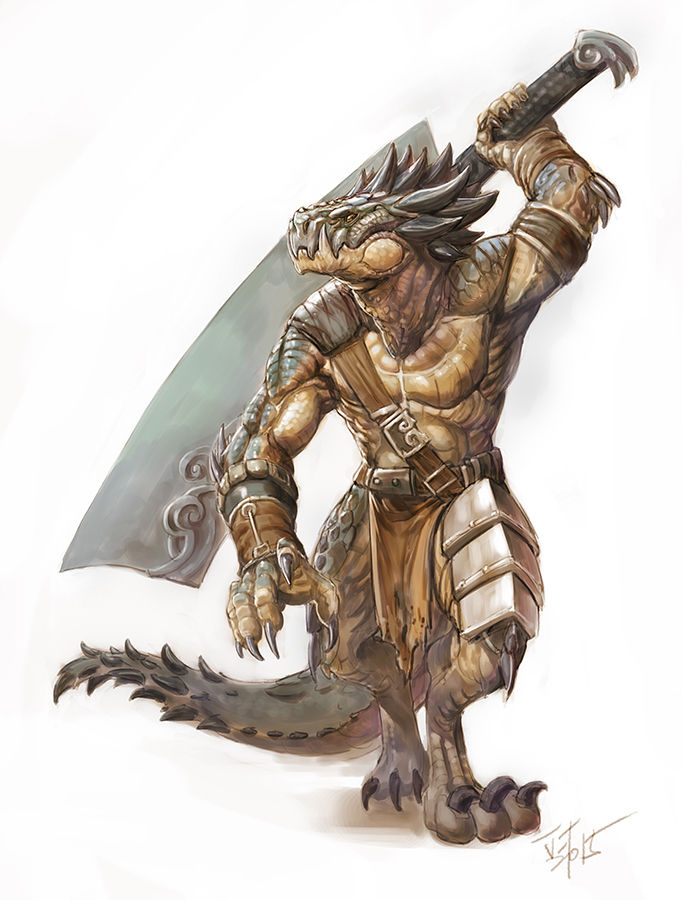
The studious Komodos explore the ancient ruins that cover Tarakona in groups of 5 to 10, typically made up of rangers, investigators, and tamed hunting drakes, who then report back to a team of researchers in a Komodo stone city.

The rangers scout ahead of the exploration party, keeping it safe and hunting for food. Every ranger spends a full year training in the wilderness before they are assigned to their first exploration party, and can live in the wilds on their own indefinitely.

Rangers have a reputation for short tempers and withdrawn personalities, seeing the investigators and researchers as weaklings who couldn’t survive a day without them. While this viewpoint holds some truth, it often generates friction between the members of any exploration group.

Rangers use their poisoned shortbows until attackers close, then engage in melee to protect the researchers.

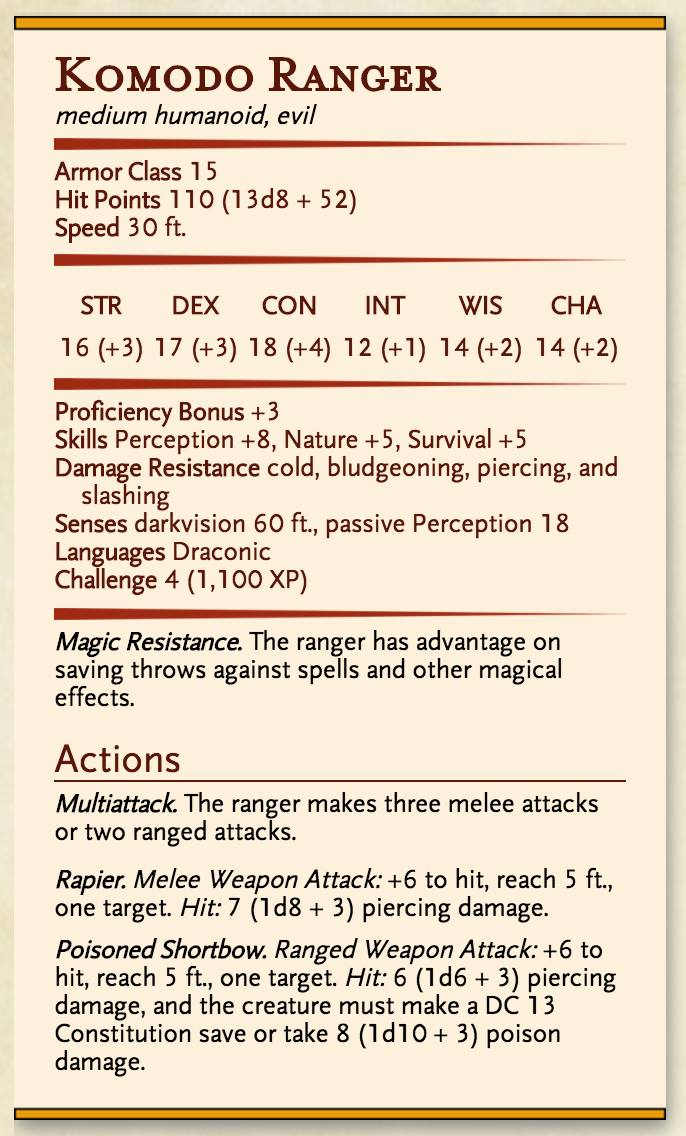
Text version of stat block, suitable for use in Homebrewery:

___
> ## Komodo Ranger
>*medium humanoid, evil*
> ___
> – **Armor Class** 15
> – **Hit Points** 110 (13d8 + 52)
> – **Speed** 30 ft.
>___
>|STR|DEX|CON|INT|WIS|CHA|
>|:—:|:—:|:—:|:—:|:—:|:—:|
>|16 (+3)|17 (+3)|18 (+4)|12 (+1)|14 (+2)|14 (+2)|
>___
> – **Proficiency Bonus** +3
> – **Skills** Perception +8, Nature +5, Survival +5
> – **Damage Resistance** cold, bludgeoning, piercing, and slashing
> – **Senses** darkvision 60 ft., passive Perception 18
> – **Languages** Draconic
> – **Challenge** 4 (1,100 XP)
> ___
> ***Magic Resistance.*** The ranger has advantage on saving throws against spells and other magical effects.
>
> ### Actions
> ***Multiattack.*** The ranger makes three melee attacks or two ranged attacks.

> ***Rapier.*** *Melee Weapon Attack:* +6 to hit, reach 5 ft., one target. *Hit:* 7 (1d8 + 3) piercing damage.
>
> ***Poisoned Shortbow.*** *Ranged Weapon Attack:* +6 to hit, reach 5 ft., one target. *Hit:* 6 (1d6 + 3) piercing damage, and the creature must make a DC 13 Constitution save or take 8 (1d10 + 3) poison damage.

Categories: Monsters | Leave a comment

Faction Friday: Raising a Dragon

'Young Dragon' by ejbeachy

‘Young Dragon’ by ejbeachy

Tobias Sinthalel can be used either as a friendly faction that sends the PCs out on a mission, or as a foe that the PCs must overcome. This wealthy noble has managed to procure and hatch a dragon in secret, which needs copious amounts of food, and needs a certain proportion of humanoids in its diet.

As a friendly faction, Tobias engages the PCs to attack various orc and goblin encampments in a nearby forest, and deliver the corpses to a particular spot where a female ranger in his employ, Vialora, pays them. They both keep up the pretense that they need the corpses to verify that the PCs accomplished their task, though the bodies are actually used to feed a fledgling dragon that Tobias keeps in an abandoned dwarven mining complex nearby.

Plot hook: Eventually, the dragon escapes, and Tobias asks the PCs to recapture it without killing it. This can be a multi-session job, as the young dragon attacks small goblinoid encampments and humanoid villages far out in the wilderness and prefers to flee rather than fight. The PCs will have to figure out a way to corner it.

As a foe faction, the PCs hear of a hunter who was captured by a tribe of goblins and nearly fed to a young dragon they kept in their cave. He managed to escape, and the city watch offers a reward to anyone who can kill the goblins and the dragon. The PCs arrive to find a surprisingly well-supplied underground complex, which is also protected by a capable ranger–Vialora–who, if reduced to half Hit Points, surrenders and explains the situation. She’s not paid well enough to risk her life, has grown increasingly uncomfortable with her role, and will help the PCs clear out the rest of the goblins and kill the dragon.

Then, the PCs should probably track down Tobias in his mansion and confront him, but that’s a whole other session….

  1. Bats roost in the first room; the denizens have learned not to disturb them, but they will attack any noisy PCs. A cave-in has destroyed the southeast corner of the room, but from the remaining frescoes on the walls this appears to have once been a dwarven mining settlement.
  2. This room was once a guard room and resting spot for dwarves visiting the complex’s owners or just passing through. A large crack in the floor now splits the room in two. Two goblins crouch here, playing a dice game with a small pile of copper pieces. They’re supposed to be guarding the place and listening for disturbances, but they won’t even notice if the bats screech out. They are, however, attentive enough to notice the sounds of a pitched battle. If approached, the goblins will run down the hall and warn the others, but if the PCs can immediately engage them in melee the goblins will fight rather than flee.
  3. These chambers were badly damaged by whatever quake affected the first two rooms; now all that’s left are crumbled halls that six more goblins and Vialora use to fight intruders. They keep behind corners and fire at attackers from range, retreating to better vantage points rather than engaging in melee as much as possible. The corridor in the north end of the circle has collapsed into a pit; the goblins can swing from ropes across it as an action. PCs must make a DC 15 Dexterity (Acrobatics) check or fall and take 1d8 bludgeoning damage.
  4. The fledgling dragon lairs here, along with several goblins that attempt to entertain it. The dragon has the stats of a wyrmling, except 80 HP and the addition of one claw attack, multiattack (claw and bite), and an extra +2 damage on all attacks.
Categories: Faction | Leave a comment

Game Design Hour: How to Find Play Testers

'Talking on the offshore' by ePi.Longo

‘Talking on the offshore’ by ePi.Longo

This is part of a series of blog posts where I confront issues relating to tabletop RPG game design.

First off, you may be asking: Do I need play testers? Can’t I play my game with a few friends, then just post it online?

Of course, yes, you can just publish it. And if you’ve got a simple, quick game, that might be appropriate.

But the game won’t be as good as it can be. You’re not everyone. Your friends probably have similar interests to you. You need other perspectives to find holes in your design that you can’t even see.

So how do you find play testers?

There’s no magic bullet. But one way is to run games online for strangers.

Post on your favorite social media network, offering to run games. If you have a lot of followers, you might be able to ask for players for your in-development games. If not, offer to run popular games like D&D.

Then, once you’ve run a couple of sessions with these players, ask them if they’d be willing to play a session of a game you’re writing. Run a game with them.

Now, ideally, you can find a group that will run your game without you even being there. Unfortunately, very few people are willing to run a game that’s still in development. Try asking your players if one of them is willing to do so, but if they’re not, that’s just the reality of indie tabletop RPG development.

At least you’ve found playtesters and received their feedback!

How do you run a playtest and gather that feedback? I’ll be covering those topics in future posts.

Categories: Game Design Hour | Leave a comment