I Ran Tomb of Horrors, and It Was Awesome. Here’s How.

Recently, I ran the Tomb of Horrors for a handful of friends. They had a blast, and repeatedly said so. For what it’s worth, Tales from the Yawning Portal hadn’t come out yet, so I used a 5th Edition conversion I found online, combined with the original module.

In pitching the Tomb to the players, I explained that it was very deadly, and that the first characters they threw at the Tomb were unlikely to survive. I further told them that I’d provide pre-gens. I then went online and printed off 30 pre-generated level 10 D&D 5E character sheets from Digital Dungeon Master.

This was the secret: use a bundle of pre-generated characters.

The players arrived, grabbed random character sheets, and spent a minute glancing them over. Then I jumped into the module.

The players began investigating, and soon triggered a tunnel collapse. The first character death came as a surprise, then they grabbed another character sheet and I could see the realization dawn on their faces: I matter more than my character.

We spent two sessions getting through the Tomb, and to give you an idea of how much fun they were having, after the first session the players came to me to schedule the second. I skipped a couple of rooms for time, and one that was just a little too silly and complex for me to run (multiple secret doors in a row, for those familiar with the module).

The players turned into investigation machines. The character became a tool, a thing to inhabit because it’s useful and fun. Sure, you wanted your character to survive, but character death lost its horror.

And that, to me, is the biggest reason to run the Tomb. It teaches players that their characters don’t have to be carefully considered, multi-dimensional characters with complex backstories. It teaches them what it feels like to lose a character, in a context where doing so is expected. It allows their characters to die, and realize that’s okay, because it’s fiction and death happens. And death isn’t scary in a tabletop game because there’s always another character.


Categories: GM Advice | Leave a comment

In defense of the Tomb of Horrors

It’s become fashionable to decry the Tomb of Horrors as a paragon of bad design. It’s got things that will kill characters outright. It’s got things that will kill them without a saving throw, even. Surely that’s a sign of bad dungeon design, right?

No, it’s not, given the module’s parameters.

I’m going to give you two reasons why Tomb of Horrors is a usable dungeon. Not necessarily the kind of dungeon you want to run, but a viable one.

  1. This is the resting place of a demi-lich. It’s his Holy of Holies. If someone makes it far enough, they can destroy Acererak. He doesn’t want that to happen, so of course he’s going to make it deadly. But he’s crazy, so it’s a winnable dungeon. Acererak enjoys teasing adventurers with the realization that the Tomb is solvable.
  2. The module explicitly warns you that it’s deadly, and that if your adventurers are hack-and-slashers, you shouldn’t even run the module.

I suspect that much of the online complaints about the Tomb of Horrors comes from groups where the DM didn’t properly prepare the players for the Tomb. If you just spring the Tomb on your players, especially if they’re running beloved characters central to a long-running campaign, you’re not running it effectively.

Again, to be clear, you don’t have to run the Tomb of Horrors. But it can be run in a way that’s fun for all involved.

How best to run it? I’m writing a separate post about that, which also explains what my players learned. Here’s a hint: Use pre-gens.

Categories: GM Advice | Leave a comment

Monster Monday: Light Dragonrider Patrols

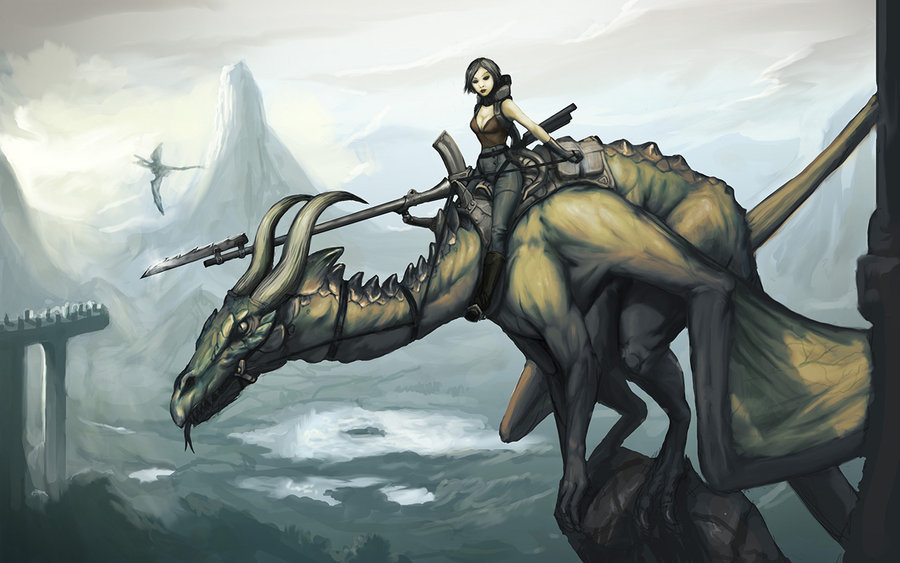
The feared dragonriders of Elyslanta patrol the skies of their domain, their riders searching for trouble and reporting back as necessary. The Royal Dragonriders maintain both light and heavy patrol units, using younger and older dragons, respectively, for each type.

Light dragonriders typically fly in pairs. They will deal with minor dangers, such as a few goblins attacking a caravan, but will simply observe and report back to the closest Watch Eyrie if they see something they can’t deal with themselves (at which point the Eyrie typically sends out a unit of heavy dragonriders).

If a province is under a serious, long-term threat, light dragonriders fly in units of four under orders to engage enemies directly unless hopelessly outclassed.

And here’s the stat block, ready for pasting into Homebrewery:

___
> ## Light Dragonrider
>*Large dragon, lawful*
> ___
> – **Armor Class** 17
> – **Hit Points** 75 (10d8 + 30)
> – **Speed** 30 ft., climb 30 ft., fly 60 ft.
>___
>|STR|DEX|CON|INT|WIS|CHA|
>|:—:|:—:|:—:|:—:|:—:|:—:|
>|19 (+4)|10 (+0)|17 (+3)|12 (+1)|11 (+0)|15 (+2)|
>___
> – **Saving Throws** Dex +2, Con +5, Wis +2, Cha +4
> – **Skills** Perception +4, Stealth +2
> – **Damage Immunities** fire
> – **Senses** blindsight 10ft., darkvision 60ft., passive Perception 14
> – **Languages** Draconic, Common
> – **Challenge** 4 (1,100 XP)
> ___
> ***Multiattack.*** The dragoon makes two attacks, one with its javelin and one with its breath or claws.
> ### Actions
> ***Javelin.*** *Ranged Weapon Attack:* +5 to hit, range 30/120, one target. *Hit* 7 (1d6 + 4) piercing damage.
>
> ***Claws.*** *Melee Weapon Attack:* +6 to hit, reach 5ft., one target. *Hit* 12 (1d10 + 7) slashing damage.
>
> ***Fire Breath (Recharge 5-6).*** The dragon exhales fire in a 15-foot cone. Each creature in that area must make a DC 13 Dexterity saving throw, taking 24 (7d6) fire damage on a failed save, or half as much damage on a sucessful one.
>
> ### Tactics
> The dragoon will typically keep its distance, the rider throwing ***javelins***, until a dangerous target presents itself. The dragoon will then close to ***fire breath*** distance, then if necessary engage in melee.

““
““

Categories: Monsters | Leave a comment

Faction Friday: The Cult of the Werecat

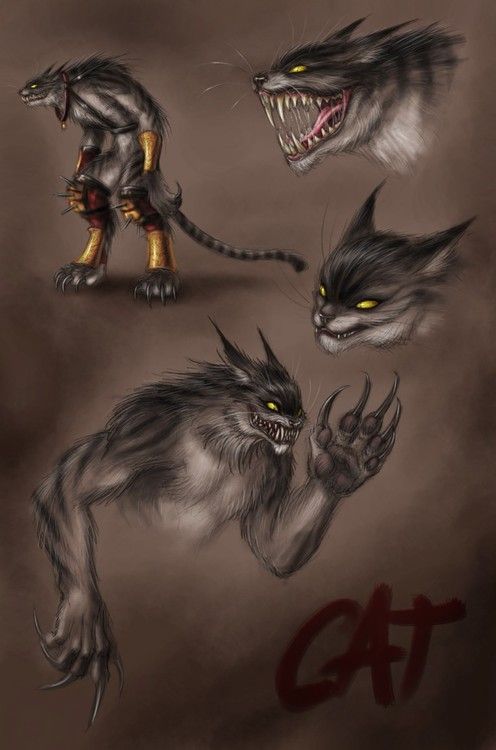
Werecat

Artist unknown, sadly

Tharren Ironshield really likes cats.

Granted, cats are excellent companions underground, hunting vermin and finding warm spots to nap. Several dwarf clans maintain large numbers of cats as companions and vermin control.

But something happened about ten years ago that made Tharren obsessed with cats. He was cursed by a jilted lover to become a werecat (same stats as a wererat, ironically). Instead of attempting to bury his lycanthropy or completely embrace it, he sought a third way: a meditative control. His studies and research attracted 12 other, similar-minded lycanthropes who now follow him in their attempts to control their urges.

Surprise, surprise: It hasn’t worked. In fact, it’s only driven the cult’s members further into frustration and, in Tharren’s case, near madness.

However, the cult recently learned of an artifact that might cure them: Bidala’s Ring. Enter the adventurers!

As a friendly faction, the cult’s obsession has made them eccentric as opposed to dangerously out of touch with reality. They’re desperate to control their condition, and fortunately several of them come from wealthy families.

Plot hook: Tharren contacts the PCs and asks them to hunt down Sid Majora, a famous warlock who recently recovered Bidala’s Ring from a dangerous dungeon. This can be as simple as confronting Sid in his apartment in a city, or a multi-stage operation where the PCs must learn of Sid’s various hiding places and visit each one for clues (diary entries, maps, talkative assistants) as to where he hid Bidala’s Ring.

As a foe faction, the cult’s members have been driven mad through their many ritualistic attempts to control their lycanthropy. Now they’re obsessed with Bidala’s Ring, and have taken to assaulting anyone even rumored to possess it (usually ending with the death of the victim).

Plot hook: Jade Thorn, the half-elf captain of the City Watch in this district of the city, contacts the PCs and asks them to investigate a string of attacks. Two people have been murdered; one assaulted but escaped. All were rumored to have owned Bidala’s Ring, though the Watch hasn’t made this connection yet. If the PCs take too long investigating, the cult will kill again.

Plot hook 2: The PCs are approached by Mara Mahatman, the second daughter of a merchant family and occasional adventurer. She was one of a party who went searching for Bidala’s Ring but never found it, and two other members of her party have been attacked and killed. She fears for her life and asks the PCs to investigate while she takes precautions.

The Crypt of the Werecats

The cult operates out of a crypt entered through catacombs beneath a grand cathedral in the city.

The werecats avoid the corridor between the Hold and the Cistern, as it is haunted by several vicious ghosts. Otherwise, the PCs will encounter the werecats here in various numbers.

Use stats for the wererats in the Monster Manual (AC 12, HP 33, Init +2; Attack +4). Tharren also uses those stats except he has an AC of 14, 45 HP, and deals an extra +2 damage on his attacks if he’s within 10 feet of at least one other cultist.


Categories: Faction | Leave a comment

Game Design Hour: How to Get Useful Playtest Feedback

By Linux Foundation

By Linux Foundation

Playtesting your game is thrilling. You’ve finally gotten your baby game in front of other players, you’re seeing what works and doesn’t work.

And then the session comes to a close. You say, “Okay, do you have any feedback?” and stare at your playtesters, waiting for them to fall over each other to give you a wealth of suggestions.

More often than not, instead, they just look at each other, look back at you, and say, “Not really.” They may point out one thing that went wrong so clearly people in the next room could see it, but that’s all the feedback you get.

And you end up feeling frustrated. How can you get useful feedback?

To understand that, you have to understand why people don’t easily give in-depth feedback in playtesting sessions. I think there are two main reasons: social pressure and asking the right questions.

Your playtesters are human, and they see that you’ve built a game you believe in. They don’t want you to believe your game is bad. They fear that you’ll take negative feedback personally. They also don’t want to be seen as the one person with criticisms if everyone else enjoyed the game. So, nobody goes first.

Also, “Do you have feedback?” is a vague question. It’s like a parent asking “How was school today?” or a boss asking “How’s the project going?” It’s easier to just answer “Fine.”

So. You can solve this with a couple of specific questions.

First, ask this: “What should definitely remain in the game?

This starts the feedback with a question that’s both positive and probably unexpected, and subtly introduces some danger. The players realize that this game might change drastically, and it’s up to them to save some parts of the game.

It also shows you what parts of the game work, and what parts of the game the players enjoyed. Of course, these parts may not be perfect, but at least you know not to chuck them out immediately.

Then, ask this: “What would you like to see changed?”

Now that players realize that the game might change, you want to focus them on the problems.

Feel free to give the players some time to think about this. If the table’s initially silent, let that silence stretch for a while. Give people time to think. Don’t rush.

Then, ask this: “Did anything confuse you, even briefly?”

This is incredibly important. Some rules and aspects of games aren’t necessarily bad, they were just badly understood in the playtest. Many times, a rule makes sense to you but is unclear to other people, either because they have less experience than you, or more experience than you (“Oh, that term always means this to people who play these other sorts of games”). You need to know those pain points so you can rewrite the appropriate rules to be more clear.

Now, how should you be acting in the midst of all this feedback? Four things:

Write down everything the players suggest. You won’t be able to get it down word-for-word, naturally, but get the gist of it on paper. Even if you think it’s dumb. Even if you never plan to implement it.

Why? That tells the player that you care about her or his feedback, which further tells the other players that you’ll care about their feedback, too.

Also, you may look at that feedback later and realize that it’s not so crazy after all.

Ask “Why?” if a playtester doesn’t explain his or her suggestion. Meaning, if a player says “You should drop the encumbrance system,” full stop, ask them why.

You need to understand the reasoning behind their feedback, because their specific piece of advice might not be perfect, but the reason for the advice will tell you what’s going wrong.

Don’t disagree with a playtester. Your job here is not to tell the playtesters if they’re right or wrong; it’s to gather feedback. So just smile, nod, and accept whatever feedback you get.

Again, remember, you don’t have to implement any of the feedback you receive. So it’s much better to take all of it graciously and positively, so that you’ll get all the feedback you can possibly get.

Don’t explain your design decisions unless specifically asked to. This is a very common mistake, and very easy for us designers. A player will suggest that you change a rule, and you’ll launch into an explanation of why you included that rule.

You might think you’re engaging the player with that rule, to better understand the best way to change it. But more often than not, it comes across like you’re defending the game. It will make other players less likely to share feedback, because they don’t want to get into a debate.

Again, your job is to collect feedback. Collect it.

What should you do with all that feedback? I’ll write about that in the next post.

Categories: Game Design Hour | 1 Comment

As the GM, I Split the Party…And It Went Great

by Gure Esku dago

by Gure Esku dago

My favorite RPG convention panel, “Improv DMing,” occurred at GenCon several years ago. It was mostly a Q&A session about how the panel’s host improvs games.

Someone asked what he does when the players ask to split the party. He explained that he tells the group that half of them will have to pack up and go home and schedule a separate session, because they’re asking him to run two games.

I considered that answer as basically gospel. Now, certainly, one or two members of a group can briefly scout ahead, or a party can be in two adjacent rooms during combat, but otherwise, no splitting the party.

Fast forward to a recent session of my D&D game. My players were planning a heist, and twice so far they’d mentioned wanting to play the game in separate rooms if the group split up.

The group spent most of a session figuring out how to approach the heist. Two players wanted to visit the heist location ahead of time and plant a triggered spell on an outside wall.

Assuming that this would be a short “scouting ahead” sort of situation, I took those two players into a separate room. One started the ritual (which needed about an hour in-game), while the other kept watch.

Then they proceeded to fail their rolls to keep hidden. A guard showed up. The PCs couldn’t stay hidden. The PC keeping watch tried to charm the guard, then distract the guard, and the dice were just against him.

The guard called for more guards. Worse, the player kept trying to distract them, coming up with increasingly desperate tactics, prolonging the encounter.

Thirty real-world minutes later, the players finally gave up on their ritual and retreated. We returned to the main room.

The other players were happily chatting away, holding mugs of tea in their hands. The two separated players talked excitedly (though with some disappointment) about their failed attempt to plant their spell.

We got back to the session. Nobody was bored.

During the post-game feedback session, players in both locations talked about how much they liked splitting the party. The ones in the other room felt special, while the ones “left behind” enjoyed wondering what was going on in the other room.

In fact, players in both rooms still talk about that session.

Would I split the party frequently? No. Would I split the party for hours? No. Would I split the party again? Absolutely.

Categories: GM Advice | 2 Comments

Game Design Hour: How to Run a Play Test

By greensefa

By greensefa

This is part of a multi-post series about the practicalities of designing a game. Today I’m going to look at the practical actions you need to take while actually running a playtest.

First, choose a classic scenario. Avoid the temptation to test an unusual setting for your system, like a James Bond action scenario using wushu rules. This will skew your playtesters’ feedback, and you won’t be able to separate problems with the game from problems with the game’s applicability to the scenario. Stay basic.

Second, run the game as if you were the DM, not the designer. As the designer, it’s easy to answer a question about a rule by explaining the reason why you designed that rule. This information will skew your playtest. It gives your playtesters more information than your audience will have. Other potential problems with the game won’t surface, because your playtesters will understand your reasoning behind them. Don’t give them more information than a DM who read your rules would know. That can be hard to do, but it’s important that you do your best.

Third, bring lots of paper and take copious notes. Many small moments occur during a playtest that you want to capture and will slip from your mind once the session’s over. You will notice a pause when a particular rule is introduced, or a conversation about a rule interaction that you will want to capture immediately.

Also: I know, you probably want to use your laptop or tablet to take notes. But people react differently to a person writing on a piece of paper compared to a person typing on a screen. The latter feels impersonal to people, and they’ll feel more like they’re in a doctor’s office than a playtest. It will shut them down emotionally a little bit, which you do not want in your playtest.

Fourth, run the game. Meaning, other than taking notes, run the game like a normal session. Ensure the players are having fun. A playtest involves play, and playtesters who’ve had a good time with your game will give you more feedback than players in a session where you paid less attention to the game itself.

How should you ask for feedback and incorporate it into your game? We’ll cover that next.

Categories: Game Design Hour | Leave a comment

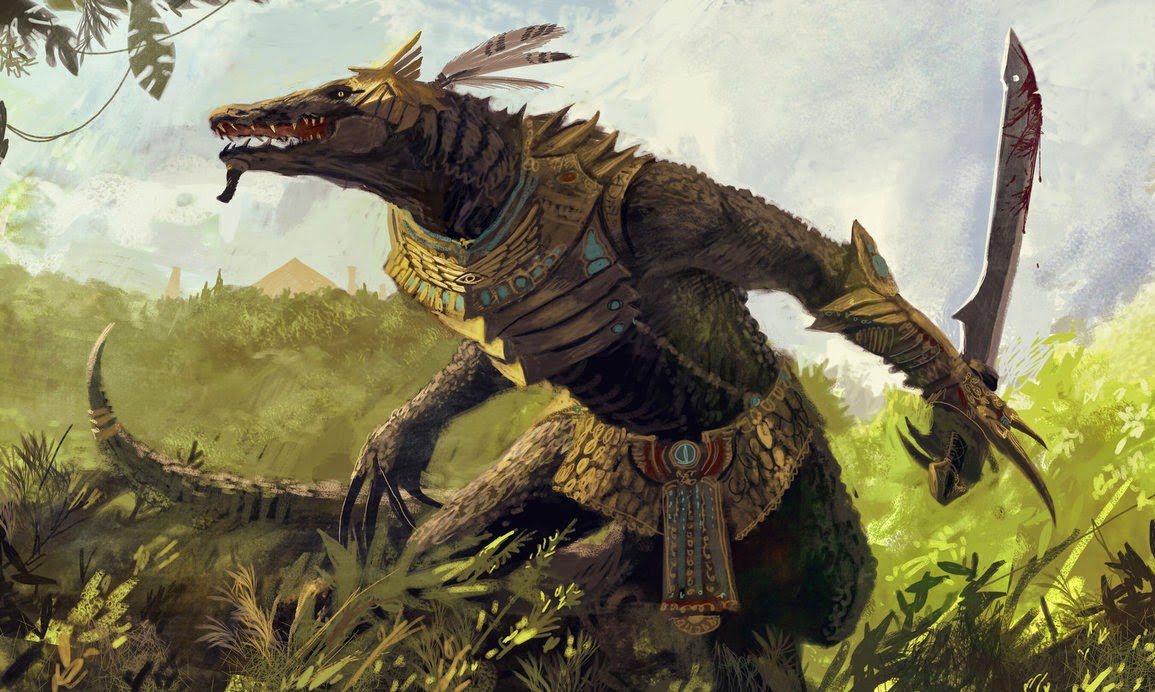
Monster Monday: Komodo Researcher of Tarakona

lizardman by obrotowy-d5xlij1

lizardman by obrotowy-d5xlij1

The savage continent of Tarakona, where draconic races battle for supremacy!

The studious komodos explore the ancient ruins that cover Tarakona in groups of 5 to 10, typically made up of rangers, investigators, and tamed hunting drakes, who then report back to a team of researchers in a komodo stone city.

Researchers are rarely encountered outside of a komodo city, but do occasionally accompany exploration parties on expeditions to particularly interesting ruins. They invariably lead the group.

If a komodo exploration party learns that they are being followed, the researchers and investigators will often use their disguise self and illusion powers to appear like a friendly, wandering group of kala (keeping rangers and hunting drakes hidden) and lure their enemies close before attacking.

Researchers wade to the front of combat attempting to intimidate enemies using Intimidation checks, charm person, and suggestion. They will also attack in an attempt to show they mean business.

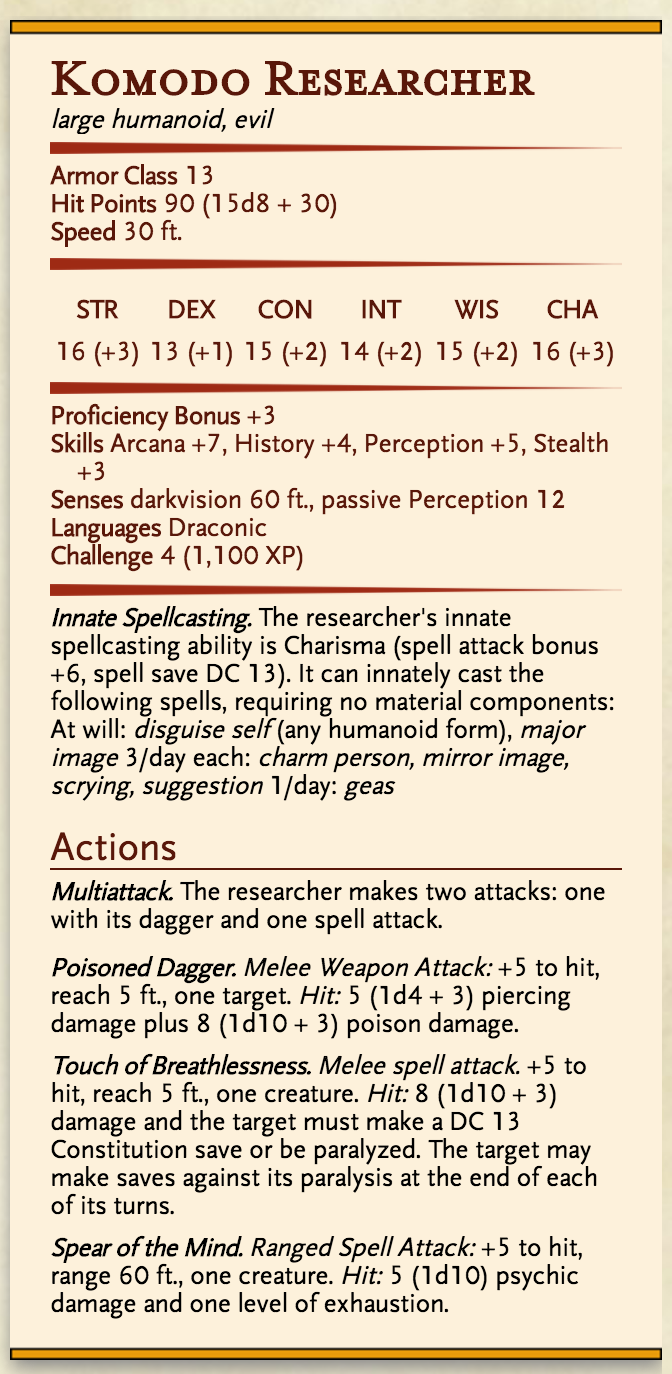
Text version of stat block, suitable for use in Homebrewery:

___
> ## Komodo Researcher
>*large humanoid, evil*
> ___
> – **Armor Class** 13
> – **Hit Points** 90 (15d8 + 30)
> – **Speed** 30 ft.
>___
>|STR|DEX|CON|INT|WIS|CHA|
>|:—:|:—:|:—:|:—:|:—:|:—:|
>|16 (+3)|13 (+1)|15 (+2)|14 (+2)|15 (+2)|16 (+3)|
>___
> – **Proficiency Bonus** +3
> – **Skills** Arcana +7, History +4, Perception +5, Stealth +3
> – **Senses** darkvision 60 ft., passive Perception 12
> – **Languages** Draconic
> – **Challenge** 4 (1,100 XP)
> ___
> ***Innate Spellcasting.*** The researcher’s innate spellcasting ability is Charisma (spell attack bonus +6, spell save DC 13). It can innately cast the following spells, requiring no material components: At will: *disguise self* (any humanoid form), *major image* 3/day each: *charm person, mirror image, scrying, suggestion* 1/day: *geas*
>
> ### Actions
> ***Multiattack.*** The researcher makes two attacks: one with its dagger and one spell attack.
>
> ***Poisoned Dagger.*** *Melee Weapon Attack:* +5 to hit, reach 5 ft., one target. *Hit:* 5 (1d4 + 3) piercing damage plus 8 (1d10 + 3) poison damage.
>
> ***Touch of Breathlessness.*** *Melee spell attack.* +5 to hit, reach 5 ft., one creature. *Hit:* 8 (1d10 + 3) damage and the target must make a DC 13 Constitution save or be paralyzed. The target may make saves against its paralysis at the end of each of its turns.
>
> ***Spear of the Mind.*** *Ranged Spell Attack:* +5 to hit, range 60 ft., one creature. *Hit:* 5 (1d10) psychic damage and one level of exhaustion.

Categories: Monsters | Leave a comment

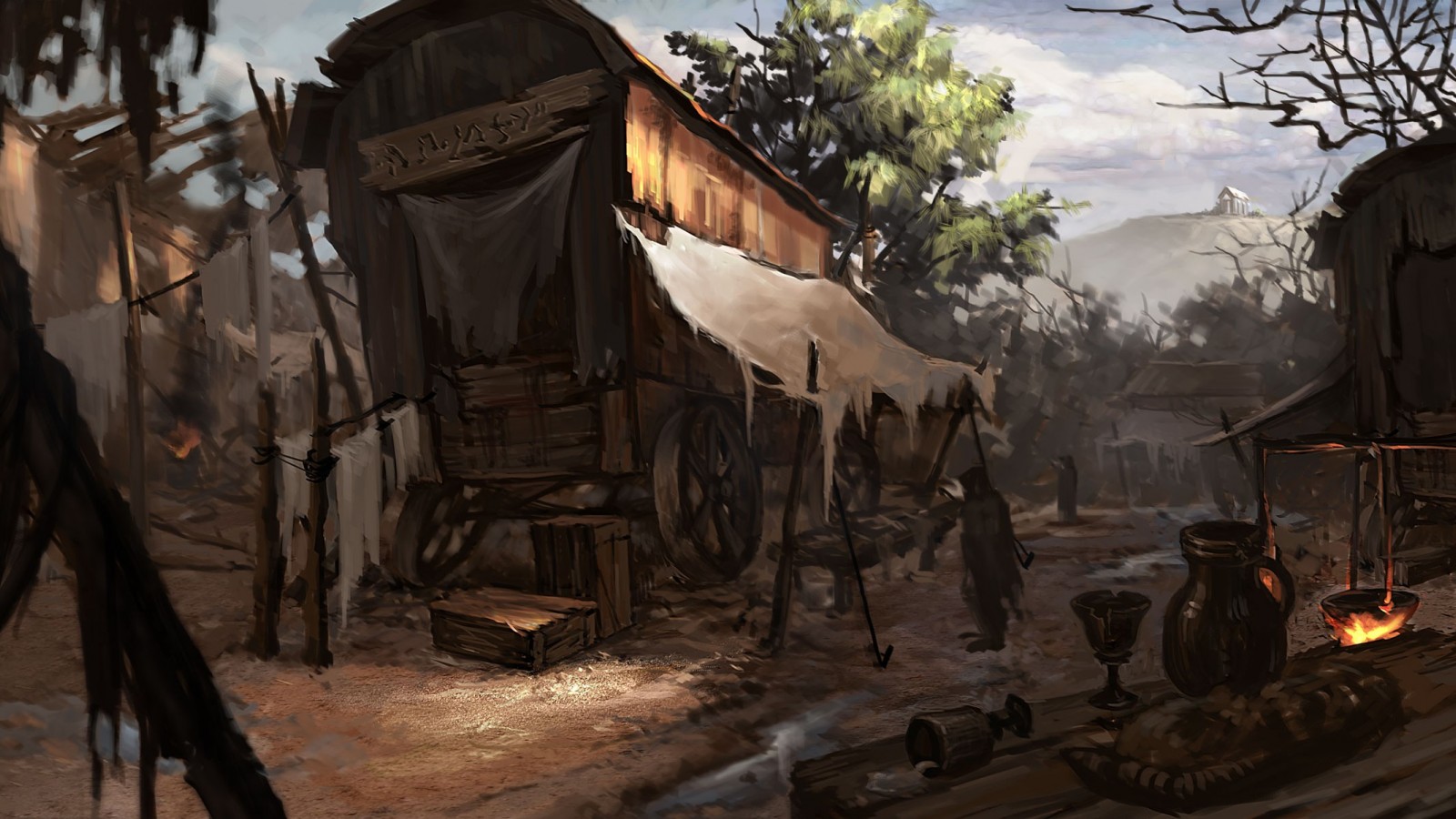
Faction Friday: The Caravan of Death

Art by tristram(?) for Diablo III

Art by tristram(?) for Diablo III

Pity Callahan’s Caravan. Pity, or fear it. Wherever these metal-working merchants go, somebody dies.

Callahan’s Caravan of Death is a faction that can be used either as a friendly ally and source of adventure, or as a foe to be fought. It consists of two dozen people (twelve adults and twelve children) spread across nine wagons. They spend the spring and summer traveling the trade routes, selling various metal objects such as pans, knives, files, and scythes, and the other half of the year in a quiet valley where they smith those objects.

As a friendly faction, the members of Callahan’s Caravan face a perplexing problem. Whenever they arrive in a town with their caravan of nine wagons and trade, within 24 hours, someone in that town dies. Sometimes it’s a grandmother on her death bed. Sometimes a person slips and cracks their head. Sometimes it’s more mysterious, like an unpopular council member dying in his sleep. Rumors have spread, and now when the caravan rolls into town few people come out to do business with its members.

Plot hook: The PCs are approached by Millicent Avernath, one of the more successful merchants and the de facto leader of the otherwise mostly democratic caravan. She asks the PCs to investigate and clear the caravan’s name. As it happens, another member of the caravan — Hossil Thrick, a haughty half-elf — angered a hag some months back by making her a shoddy kettle. The hag since cursed the caravan, causing this trouble.

As a foe, the same situation generally applies: within 24 hours of the caravan arriving in a settlement, somebody in town dies. However, the circumstances are usually somewhat suspicious. As it turns out, the caravan has been unable to compete with other, more successful merchants, and agreed to take on a disguised assassin for a hefty fee.

Plot hook: The PCs are approached by Dar Surefoot, the half-orc who organizes the (tiny) local watch, the day the caravan enters town. He’s heard about the deaths, and want the PCs to investigate.

Categories: Faction | Leave a comment

Semi-Monthly Map: Demons’ Tower

Long ago, a now-lost civilization carved several platforms on this natural upthrust tower of stone. Steep, straight ramps lead up to each oddly level platform. All traces of the past civilization’s activity are lost except for a perfectly circular depression on the top platform, in which faint runes can just be discerned.

Recently, a demon cult learned that the circle can be used to summon demons. They climbed Demons’ Tower and manned it with a dozen cultists and their minions: a small pack of gnolls.

When the PCs arrive, six cultists perform a ritual at the top of the tower (area 1). The party has a limited amount of time–say, 20 combat rounds, or two minutes–to reach the top and disrupt the cultists before the ritual is completed, a portal to the Nine Hells appears, and a new demon charges through it every round.

The next platform down (area 2) contains four cultists, all of whom will cast spells as soon as enemies enter the entrance zone at the bottom.

The platform below that (area 3) contains two more cultists and two gnolls armed with bows. All will used ranged attacks against enemies in the entrance zone (area 4).

The entrance zone (area 4) contains four gnolls armed with glaives; two will charge into melee and the others will stay behind the barricade and defend the first ramp. Thanks to the glaives’ reach, the defenders behind the barricade can still attack enemies who are on the other side of the barricade. A creature can climb over the barricade with a successful DC 15 Acrobatics (Dexterity) or Athletics (Strength) check.

Categories: Maps | Leave a comment