Player Rx: How to react when thrown a curveball

'The Sorcerer, 2012: Dawn of a New Age' by keoni101 on Flickr

'The Sorcerer, 2012: Dawn of a New Age' by keoni101 on Flickr

Your character’s fighting an evil sorcerer, and he turns to your character and reveals that he’s kidnapped your character’s sister. How do you respond?

As a player, you’re often given cues for your character to react to. It can be tough to decide exactly how to react. Does your character have an emotional scene? Will that slow down the game? We tie ourselves up in knots.

I say: this is a role-playing game. Your job is to play your character. If your character would scream in rage, or beg her friends to spare this guy so they can find the sister, that’s your character. Go with it.

If the scene does drag on, you’ll realize that as you play the scene. Best to at least dive into it.

Categories: Prescriptions | Leave a comment

Exploring The Lost Kingdoms

Michael Garcia’s The Lost Kingdoms is a GM aid, meant to provide a ready-to-use framework for a typical fantasy kingdom.

And that is its biggest problem.

On the one hand, The Lost Kingdoms may be useful for new GMs who want a generic fantasy town with the barest bones of backstory. The setting’s background–wild kingdoms locked away behind a gate, recently re-opened for adventurers–is a great idea. The document lists a few common locations–a tavern, a weapons shop, a general store, several temples, etc.–each with a paragraph or two of basic information.

On the other hand, who wants to adventure in a generic fantasy town?

However, there’s not enough detail in The Lost Kingdoms to raise any of its contents to life, and what does exist should be easily imagined by any GM. Do I need someone to tell me that my town has a weapons shop? If the players need one, I can just say “Yes, there’s a weapons shop.” The meager information provided in the shop’s description (that it’s run by “a very well-known pair of Dwarf brothers”) could just as easily be re-imagined.

Worse, the book’s naming hurt my brain. Most places in town have deliberately generic names, like Apothecary and Inn, but the town square is named Statdplatz. Areas of exploration are given names that sit uncomfortably between generic and specific, like Edge Mountains, Morning Mountains, Crystal Lake, and Wasted Sands.

And the emperor who unsealed the gate? Bob the Magnificent. It just jars.

To top it off, the last page refers to “the awesome random encounter chart which I also provide,” which I can’t find anywhere in the book.

Even at its current $0.99 price, I can’t recommend The Lost Kingdoms. What’s here is too generic and weirdly named to be useful.

Categories: Uncategorized | Leave a comment

A certain “D&D in Space” setting, converted for 4E: Voidjumpers of Space, First Release

'Spelljammer' by f_mafra on Flickr

'Spelljammer' by f_mafra on Flickr

There’s this legendary D&D setting: Spelljammer. D&D in space. Wizards and barbarians on wooden sailing ships, flying through space to plunder shattered worlds.

Unfortunately, TSR rushed the setting into production, so many of its components suffered from wonky mechanics. It was an imaginative setting that could be frustrating to play. And sadly, it wasn’t updated for either the 3rd or 4th editions of D&D.

I’m now attempting to fix that.

At the bottom of this post, you’ll find a link to the first release of Voidjumpers of Space, an attempt to solve all of those problems. It’s free (as in beer), with a donation button for you if you feel it’s worth your money.

A few goals here:

  • This is the “first release.” This is my first setting at this scale, and I don’t know what people need to see fleshed out. I plan to incorporate reader comments into another release, which will be closer to a professional release. I want this to be a community-driven setting.
  • I’m also noodling with the idea of a Kickstarter project to fund awesome art like this.
  • This is an attempt to re-capture the overall flavor of Spelljammer, with a new world. So, this is not an attempt to clone Spelljammer; it’s not Spelljammer with the serial  numbers filed off. That would both annoy Wizards of the Coast and be far less fun than creating a new set of races, classes, etc.
  • Download Voidjumpers of Space. Please donate a couple of bucks if you find this effort worthwhile. My thanks!

    If you have ideas, suggestions, comments, or contributions, email me at brent@brentnewhall.com. I can’t promise that I’ll add anything, but I promise to consider your offer seriously.

    Categories: Role-playing | 5 Comments

    50 Games in 50 Weeks: Risus

    I had the good fortune to play a game using the free Risus “everything RPG system” as part of DC Gameday this year.

    Risus is very generic, which is its key strength. The system can be explained in two short paragraphs, which I will now attempt to do.

    Each character is made up of clichés, each of which gets 1 to 4 dice. Each character has a total of 10 dice to distribute amongst clichés. You can add a “hook” (interesting backstory) to your character for an extra die.

    To attempt an action, choose a cliché and roll that number of dice. Add the result (rolling 3, 4, and 4 results in 11); if you meet or beat a target difficulty number, you succeed. If you fail during a conflict, remove one die in that cliché for the rest of the conflict; if you lose all your dice in one cliché, you lose the conflict. You can also “team up” to assist a team leader, by rolling one cliché’s dice and adding all the sixes you roll to the team leader’s roll.

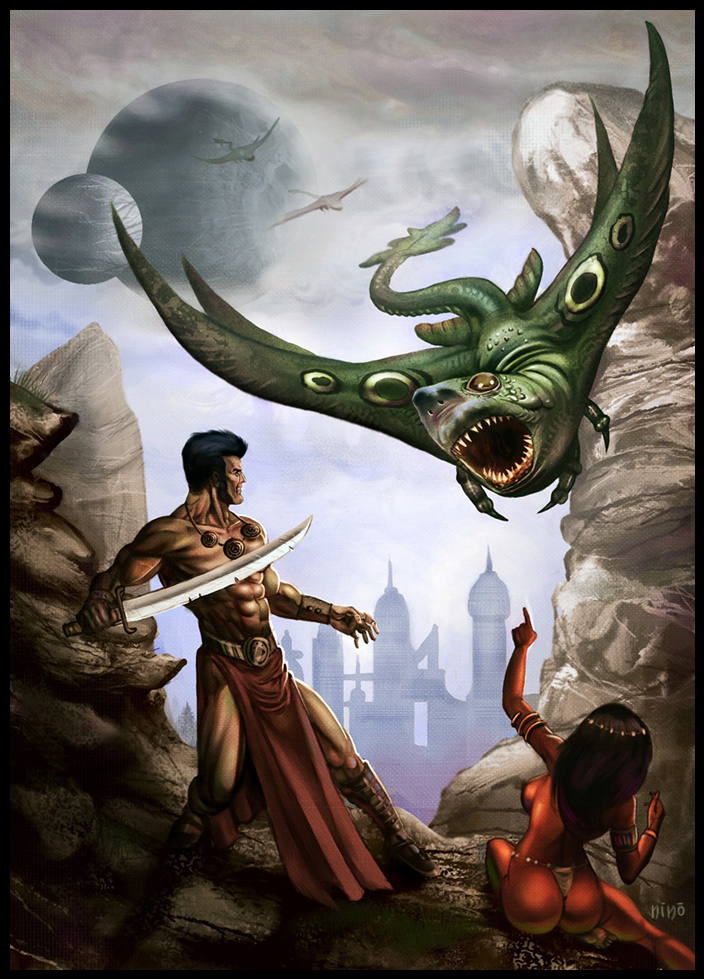
    'John Carter of Mars' by artmessiah on DeviantArt

    'John Carter of Mars' (c) artmessiah on DeviantArt

    Our game was a Flash Gordon-style story, set in a garden party on Venus. The cast was as follows:

    • An arrogant spaceship captain (think Zap Branigan)
    • An ace reporter
    • A Robby the Robot-style robot
    • A slightly mad professor
    • A spunky female hover-limo driver
    • A femme fetale

    We had an excellent group; people were throwing ideas out and actively playing. Unfortunately, though we raced after the mad Moon Men, we were unable to complete the story in time.

    Risus is a flexible and straightforward system that struck me as easy to play and easy to GM. Opposed actions are against other characters’ clichés. At most, you’re rolling a couple of dice and adding the result. Boom.

    Download Risus

    Categories: 50 Games in 50 Weeks | Leave a comment

    RPG Rx: Helping Your Players Role-Play

    'Hero Game' by 8one6 on Flickr

    'Hero Game' by 8one6 on Flickr

    From a thread on RPG.net, Evongelo asks:

    I have run a few games over the years, and a few were successful and a few more weren’t. I play with the same five people every time, who I have been friends with for years, and this makes it difficult sometimes because we’re all too comfortable with each other. We don’t really get into the characters, we don’t do voices, they don’t really try to interact with the NPCs, and above all else they don’t interact with each other.

    How can I turn this around? How can I get my friends to really fall into my world, without telling them to, which of course doesn’t work?

    Great question. There are a bunch of things to unpack here.

    First, your players may not want to dive deep into role-playing. They may want a social, fun experience. Perhaps they just want to unwind.

    So, secondly, I would talk to your players. Find out what they want. Would they like to get more involved in the story, and to really get into their characters?

    However, don’t take their replies too seriously. You’re asking them to change a fun, long-standing tradition. The result may be more fun, but they don’t know that. They’ll probably say that they’re fine with things as they are. Don’t take this to mean you can’t change.

    The key is to get a sense of how resistant they are to the idea of a roleplaying-intense experience.

    Let’s assume that your players are at least ambivalent, and you decide to move forward.

    Make role-playing explicit. Next session, tell players that there will be a couple of intense, dramatic sequences in this session. Tell them that you’ll note this by announcing “Drama Time.” Explain that during Drama Time, they’ll need to concentrate and really think things through. Moreover, you will interpret their actions during Drama Time as their characters’ actions.

    At the end of the session, ask them about it. How’d they like Drama Time?

    Once they become used to Drama Time, it will continue for longer periods. Your players will find themselves drifting into it.

    Hope this helps!

    Categories: Prescriptions | 2 Comments

    Let’s Play an Interesting RPG: The Beginning

    'Dice' by jamesrbowe on Flickr

    'Dice' by jamesrbowe on Flickr

    Update on 19 Oct 11: Time change! We will start at 9:00pm EDT on Friday, 21 October 2011. 4 players are confirmed; still open to others.

    I suggested on #4eDnD that we organize an online group to play different, interesting games every week. We’d focus on trying out new things, but could certainly play the same system a couple weeks in a row if we felt that was worthwhile.

    I’m pleased to announce the first session:

    When: Friday, 21 October 2011, starting at 7:00pm Eastern Time

    Where: Google+ Hangout. Make sure to circle me.

    System: Dresden Files. You will not need to own a copy of the rules to play. We’ll create characters and define the setting during the session.

    Signing up: Either leave a comment on this blog post, or join the Yahoo! group and add a record to the database table for this game.

    Categories: Let's Play an Interesting RPG | 2 Comments

    50 Games in 50 Weeks: Do: Pilgrims of the Flying Temple

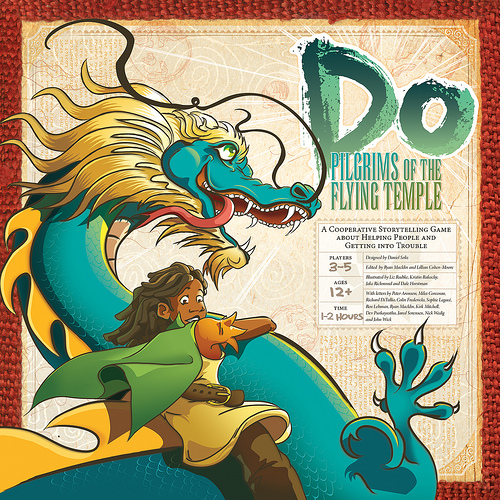
    Do: Pilgrims of the Flying Temple

    Do: Pilgrims of the Flying Temple

    Do simulates a specific fantasy trope: adolescent temple iplgrims who travel the world, helping people and getting into trouble. As limiting as this may appear, it’s easy for folks to grasp and use to tell stories.

    The system is much more simple than the length of this review implies, and highly story-focused. Your character is represented by two words: an adjective or verb “banner” and a noun “avatar.” The banner represents how your character gets into trouble, and the avatar represents how she helps people.

    That’s it for character creation. There’s no GM, and no combat system. Intrigued yet?

    Each story begins with the pilgrims’ receipt of a letter from some community outside their temple. The letter describes some big problem that the community faces (though the letter writer may not be telling the whole truth). From that letter, a set of key words called “goal words” (10 for an easy adventure; 20 for a normal one) have been extracted. The book provides a bunch of sample letters, with goal words pre-extracted.

    The system uses no dice; instead, several dozen stones are placed inside a pouch. Black and white go stones are ideal; we simulated them using coin tosses.

    Once the pilgrims fly off towards the source of the letter, play begins with the oldest player, then continues to the left in a circle. The current player is the “storyteller,” while the other players are “troublemakers.”

    The storyteller removes three stones from the pouch, and decides whether to take the white or the black stones. Taking the larger number lets you help people and get out of trouble while fewer stones get you into trouble, but once any player collects 8 or more stones, the story is over and the group fails.

    Practically speaking, if you take as many stones as possible each turn, you’ll collect too many stones. So, there’s a built-in incentive to get in trouble.

    The only part of the system that can’t be quickly memorized is the table that tells you what you do depending on how many stones you take.

    That table determines what the storyteller or the troublemakers do next, and it’s determined by how many stones you take and whether you are or aren’t in trouble (a total of 8 scenarios). The storyteller may be able to help someone–perhaps another pilgrim who’s in trouble, or perhaps someone in the world they’re visiting–or the troublemakers may be directed to get the storyteller into trouble. Either (or both) may involve crossing off goal words.

    Crossing off goal words is how you get a happy ending: if you cross off all the goal words before any pilgrim gets 8 stones, the pilgrims succeed.

    After a few rounds, it becomes clear that the pilgrims are regularly getting into trouble, and each player must, while storyteller, balance helping her friends and moving the story along towards its goal.

    There’s a bit more complexity involving the stones you take and how your character changes at the end of the story, which appears lovely but I wasn’t able to test.

    The book’s cover claims that it’s aimed at players 12 or older, but I think it’s ideal for kids as young as 8. It’s basically Avatar: The Last Airbender, without the heavy long-term story arc.

    Moreover, the system is supported by beautiful artwork that evokes child-like wonder and fantasy awesomeness. This is a book worth owning just for the art; combined with the system it was well worth every penny.

    Categories: 50 Games in 50 Weeks | Leave a comment

    Upcoming Project: Voidjumpers of Space

    I’m careful to avoid announcing new products until they’re evolved enough that I’m sure I’ll be able to release them.

    I have 38 pages and over 10,000 words in this one, so I’m confident now.

    "Flying Imp, Elven Spelljammer" by juanosarg on Flickr

    Flying Imp, Elven Spelljammer by juanosarg on Flickr

    I’m working on a SpelljammerTM adaptation for Dungeons & DragonsTM 4th Edition. Its working title: Voidjumpers of Space.

    First, a few definitions:

    Spelljammer was a D&D 2nd Edition supplement for running D&D adventures in outer space. Wooden sailing ships flitted through the spaces between worlds.

    This will not be Spelljammer with the serial numbers filed off. This is not a one-for-one conversion. My goal is to accomplish the same basic goals as Spelljammer with new, original content.

    Here’s what I’ve got so far:

    • Complete ship combat rules
    • 10 types of ships
    • 18 ship-based weapons
    • 7 new monsters
    • 2 new class themes (I’m particularly excited about these)
    • 10 major space-faring societies, including significant individuals and relationships
    • 8 famous locations in space
    • The Starfire Cluster, a group of 6 worlds intimately connected by major leaders and resources, and ready for adventure
    • 5 campaign ideas

    I’ve also statted out several dozen specific monsters and potential enemies. I want this to give you plenty of material to work with, which you can either drop in directly or easily modify to suit your tastes.

    When will it be released? When it’s ready. I’ve got a lot of playtesting and massaging of the text remaining.

    I’ll post more as I firm up the content. Meanwhile, I’m open to suggestions. Let me know what you’d like to see in the final product!

    Categories: Uncategorized | 3 Comments

    50 Games in 50 Weeks: Searchers of the Unknown

    \"Books,As part of RyvenCon, I decided to stretch myself a little and run a game in a system I\’d never tried before: Searchers of the Unknown.

    Some background is in order: No edition of Dungeons & Dragons has ever been released for free. Moreover, copies of early versions of the game are increasingly impossible to find, except at sky-high prices.

    Searchers of the Unknown is one of several projects aimed at releasing a free version of the mechanics of early D&D, in this case 1st Edition. While other systems aim at completeness, SotU aims for brevity: the entire system fits on one side of one page of paper.

    Many things are missing from that system, of course, including spell lists and monster lists. But it contains all the basics, and you can easily create spells and monsters with a little imagination. Indeed, there are several free supplements, including Spellcasters of the Unknown, which follow the same format and provide options for wizards and such.

    Why would you want to play 1st Edition D&D? Simplicity. Your character sheet consists of 5 numbers, total. And one of those numbers is derived from another.

    How does it work, in practice? Surprisingly well.

    For one thing, the minimal mechanics practically forcerole-playing. When you always use the same attack roll, and each weapon is differentiated at most by the die you roll, a slugfest becomes boring within 5 minutes. You have to leap and parry and swing from the rafters or you\’ll die of boredom.

    Moreover, the system is easy to teach and learn. I and my 2 merry players were playing within 15 minutes, and that\’s including a full explanation of all the rules.

    The players did point out that the various weapons are differentiated only by die size, meaning there\’s no reason to carry a d8 weapon when you could carry a d12 one. We agreed that a rock-paper-scissorsmechanic would alleviate this: medium weapons get a +1 on attacks against enemies wielding small weapons, large weapons get a +1 against medium, and small ones get a +1 against large (representing the ability to dodge in and around a big, heavy weapon). But that\’s a quibble.

    Contrasted to later editions of D&D, in which the rules focus on combat, SotU isn\’t about combat. It\’s about exploration and adventure. It felt much easier to focus on the larger story, and let the mechanics step in only when needed to resolve a question.

    (That may also have been caused by my awesome players.)

    SotU is not for everyone, obviously; it requires more imagination from the players and the GM than more mechanics-heavy editions like D&D 4E. That\’s nothing against those systems; it\’s just a different approach, one well worth exploring.

    Download Searchers of the Unknown and Spellcasters of the Unknown for free.

    Categories: 50 Games in 50 Weeks | 4 Comments

    50 Games in 50 Weeks: Hollowpoint

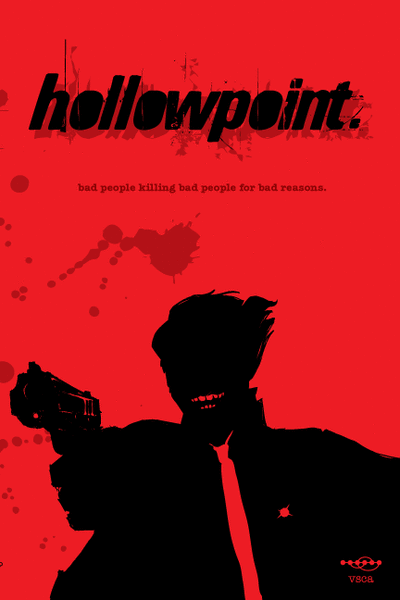
    Hollowpoint coverWhen my first game of Hollowpoint ended, one player burst out, “That was awesome!” and the others agreed that they’d like to run Hollowpoint again a bunch of times, trying different setups every time.

    So, yes, this is a fun system.

    Hollowpoint is built to tell stories about Agents on a Mission. These are the kinds of stories where everyone wears a black suit and a narrow tie, and carries a gun. Quentin Tarantino movies are perfect examples, though the system’s flexible enough to handle cop stories, hard sci-fi, etc.

    The System, In Brief

    Each character has a name, six skills, and five traits. The six skills are KILL, CON (conniving/tricking others), DIG (research), TAKE (stealing), TERROR, and COOL. Each player ranks these skills from 0 to 5 for their character, 5 being best. Each trait is a freeform description of some special ability, focus, or talent that a character can “burn” for extra dice.

    Quick basics of conflict resolution: Each player chooses a skill, and rolls that many dice. The ref (GM) gets 8 dice in the first conflict, and more in later ones. Dice are pulled into sets by matching number, so if you roll a 1, 3, 3, 5, 5, you have two sets: two 3’s and two 5’s. At this point, you can burn as many traits as you want to roll 2 more dice and slide them into sets as appropriate.

    Whoever has the longest set (and within that, the highest-numbered set) goes first, and can knock a die out of someone else’s sets. Remove one die in a set of two, and that set is completely knocked out. Attack someone with no sets left, and they take a first-stage effect. Attack with the same skill again, and they take a second-stage effect and are out of the fight.

    There’s more to it–particularly regarding teamwork and introducing new characters–but that’s the basic flow. Characters are easily built and described, and the system encourages a more abstract ebb-and-flow to conflicts, rather than the “trading blows” mechanics of a system like D&D or Pathfinder. More significantly, it allows characters who suck at combat to be useful within it, as long as they can justify the use of their skills.

    How We Set Up

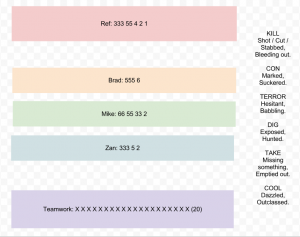
    I ran this game online via Skype, with every player’s video cameras on. I made two Google documents: one text document with blank character sheets, and one drawing to represent the dice on the table. In the drawing, I created five text boxes: one for my die rolls, three for the players’, and one for the teamwork pool (though we ended up ignoring the teamwork rules):
    Hollowpoint table

    Hollowpoint table

    When we rolled dice, we’d group like-numbered dice together as shown in the screenshot, so we could easily see each others’ sets.

    It took us about 45 minutes to decide on the era, the agency, and to create the player-characters.

    How It Went Down

    "Suit Day" by JuditK on Flickr

    “Suit Day” by JuditK on Flickr

    We decided to set our game in the future, but with a 1960’s heist vibe. The characters were all mercenaries working for a crime syndicate, who were hired by The Dragon (a heavy-drinking little person in a white suit) to steal an unnamed object being kept in the central vault of the Night Shadow, a casino/hotel ship orbiting Ganymede.

    The player-characters were Lord Trap V, a mysterious masked man; Face, a social manipulator who was owed a lot of favors, and Mike, a squirrely hacker.

    The players boarded under false identities and, upon casing the casino, discovered that the grown daughter of Ganymede’s President was hanging off the arm of the most dangerous-looking man in the place. Said man was an enormously obese man throwing vast sums of money away at the craps tables. The players used one PC’s poison needles to stun the girl, then in their first conflict, talked their way past security (“These are friends of mine; she’s just feeling a little faint”) to get her to her room.

    Her room had been completely ransacked. A quick check of her computer terminal revealed that her system had also been compromised, and it was an inside job. Security burst in, led by the fearsome Security Chief Garibaldi, and the PCs again managed to talk their way out of it in conflict 2. They went to the Fat Man’s suite, where he managed to get security uniforms for them and swapped out their records for an incoming group of security personnel. They made their way to Security HQ, where they were led to an interrogation room. The door slammed shut behind them. They had been betrayed by The Fat Man!

    Their third conflict was against an interrogation team, which the players lost. They revealed most everything. They were left in the interrogation room, at which point they used various mobile hacking skills to create a distraction (Face called in a favor), get out of the room, and sneak their way to the central vault. They used some ingenious tricks to unlock the vault, at which point they heard ironic clapping. The Fat Man stood in the doorway, flanked by two security guards!

    The final conflict began. As the ref, I had a lot of dice, and while the PCs did well, The Fat Man eventually managed to shoot one PC until he was bleeding out, hit another, and rattle the third before the hacker was able to jack into The Fat Man’s cyber-brain and burn him out. Security backed off, and the player-characters made away with their goods.

    What I Learned

    Hollowpoint perfectly modeled complex, intense conflicts with a variety of different character types, and can be easily extended or changed to handle others (for a Mage-like game, one might swap out the TAKE skill for MAGIC).

    It also models those stories well. The book provides a structure for the overall story, with certain conflicts involving the big bad guy, and retaliation scenes. The ref also gets extra dice in future conflicts, ratcheting up the tension and making later battles tougher.

    One player made the point that the game really felt like an “Us versus the world” story; the characters were backed into corners constantly.

    I also love the rule (and, yes, it’s a rule) that everyone must narrate every use of the mechanics. It got my players thinking about how to role-play, and how the numbers on the sheet corresponded to their actual actions.

    To sweeten the deal, the paperback of Hollowpoint is currently available at Lulu for US $19.99. A PDF is coming soon, at a significantly lower price.

    Hollowpoint was developed by the always-helpful Brad Murray and the other folks at VSCA, developers of Diaspora.

    Categories: 50 Games in 50 Weeks, Role-playing | 1 Comment