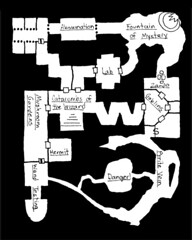
The Perfect Light RPG? Dread.


Role-playing games exist in a problematic black hole. Existing role-players play RPGs, but the hobby isn’t attracting a lot of new players (though D&D 4th Edition appears to be changing that somewhat).

So how to attract new players to the hobby?

Well, last Sunday, I had the chance to run a game of Dread, and it was a revelatory experience. It might be the answer, or at least point the way towards the answer.

Dread contains a very simple system: each player gets a sheet filled with about 9 probing questions about the person they’re going to play in that evening’s entertainment. These questions are usually intrusive, like “Who forgave you just before he died?” and “What childhood toy do you still carry with you, and why?”

While the players are answering their questionnaires, the host (who runs the game) explains the situation in which the characters will be involved, and sets up a JengaTM tower. (For those unfamiliar, Jenga is a tower of wooden blocks, three blocks per level.) In our case, the characters were college students in the middle of a wilderness adventure in the Grand Canyon.

Once the players have filled out their questionnaires, they should have a good feel for the character they’re going to play, and the game begins. The host reveals the initial scene. In our case, the characters woke up in the middle of the night to the screams of their guide, and found him hauled several yards from his shredded tent, badly wounded and delirious.

The players then act out their characters. And here’s where the incredibly simple but remarkably effective system comes in. Whenever a character attempts something difficult–anything from leaping across joists in a burning building to staying calm in the face of a serial killer—the character must make a “pull,” by removing a block from the Jenga tower and placing it on the top of the tower. If a player knocks over the tower, then that player’s character dies.

As you can imagine, characters die a lot in this game.

After a character’s death, the tower is set back up, and three blocks are immediately pulled for every dead character. And the game continues.

So, it’s a game of psychological stress and horror. The three sample stories included in the book cover a werewolf attack during a camping trip (the one we played on Sunday), space marines exploring an alien-infested starship hulk, and a horny-teen slasher film, all perfect for this system.

The Jenga mechanic provides several interesting advantages:

  • You can explain the mechanic in about a minute, to anyone. Those who’ve never played an RPG in their life can get into it immediately.
  • It creates a literary-style wave of rising tension, release, then more tension. Because blocks are pulled after each death, the tension increases on every iteration.
  • The central tower, standing in the middle of the table, is a potent reminder of the deep trouble the players face. When a player makes a pull, conversation dies. Players hold their breath. There’s actual palpable tension.
  • Because there are no numbers, the host has fewer distractions and can focus on the story.

I’ve never had as much fun as I did hosting that game. Everyone enjoyed themselves.

Categories: Uncategorized | 3 Comments

50 Games in 50 Weeks: Fudged Mouse Guard


Image from 'Mosue Guard,' copyright David Petersen

Image from 'Mosue Guard,' copyright David Petersen

My game group played Fudged Mouse Guard a few weeks ago. It takes the excellent Mouse Guard RPG–a game of intelligent mice with medieval-level technology–and converts the system to Fudge (every stat is a score from -4 to +4, and you roll dice that modify your score up or down for a final result, which is compared to a target difficulty).

The original Mouse Guard system is a simplified and heavily modified version of the odd Burning Wheel system. The conversion to Fudge can’t be exact.

It isn’t, but Fudged Mouse Guard fits the world well, and converts all the important statistics. We were able to play in the Mouse Guard world effectively, using skills and abilities, and combat involved simply trading blows. It works.

I did encounter one problem: The Fudged Mouse Guard document lists no example enemies, and provides no guidelines for enemies’ power level. I guessed at the stats for enemies, which turned out to be low. The PCs defeated all their enemies within three rounds. The original RPG’s unique combat system doesn’t translate directly to a traditional RPG’s mechanic of trading blows, so more direction there would be helpful.

Overall, though, the game went smoothly and we had fun. You can view our character sheets to see the stats used in the system.

Categories: 50 Games in 50 Weeks | 3 Comments

A Better Adventure: Scenarios

In my previous article, I argued that traditional published adventures inevitably tend towards a linear story. It’s fundamental to their nature.

I’d like to propose an alternative: the scenario.

A scenario describes a problematic situation that the PCs can solve. The concept can best be explained by an example.

Let’s say that a small town is being terrorized by the undead. The PCs are sent to investigate. They pick up a clue which leads them to the graveyard. A fight against zombies erupts, leading to a crypt. In the crypt is a necromancer, who teleports away near the end of the battle. The heroes return to town and learn that the necromancer matches the description of a strange man who bought a haunted house in the nearby hills a few weeks ago. They then attack the haunted house, killing the necromancer.

Instead, imagine a document with the following:

  • A map of the town
  • A list of major inhabitants, including:
    • Personality
    • Role-playing tips
    • What they know and will talk about
    • Secrets they’ll keep unless forced
  • A description of the necromancer, with all of the above including:
    • What he’s trying to accomplish
    • The resources at his disposal
    • What he’ll do if left undisturbed, and what he’ll do if he is disturbed
  • Battle maps of the graveyard, crypt, and haunted house, but without linear paths
  • Monster stat blocks

Sounds like the first description, but note that there’s no order here. The players can interact with this scenario in any way they’d like. They might learn of the mysterious stranger and go to the haunted house directly, and that wouldn’t break anything.

More importantly, the town itself can be fleshed out. It’s not just the jumping-off-point for the adventure. It can have its own secrets, plots, and adventure potential.

Categories: Role-playing | 1 Comment

50 Games in 50 Weeks: Dungeon World

'CatacombsOfTheWizard' by orkboi on Flickr

'CatacombsOfTheWizard' by orkboi on Flickr

Dungeon World is another sword-and-sorcery tabletop RPG system aiming to recapture the purity of classic Dungeons & Dragons. The surface looks the same, including the four classes of Cleric, Fighter, Thief, and Wizard. The mechanics and approach, however, are quite different.

Player-character attributes mirror D&D, except for the addition of Bond, which is used to indicate how well each character knows each other character. Moreover, at the beginning of each session, two attributes are “highlighted” by other players and the GM. If a player uses those attributes during the session, the PC gets extra XP.

The basic die mechanic is 2d6, added together, plus any modifiers. 10 or higher is a full success; 7-9 is a success with a complication; 6 or lower is a failure.

The “move,” which is the core procedure of the system, is a rule that lists a trigger (the thing in the game that activates the move), possibly a roll, and a set of possible results.

Interestingly, moves are not optional. If any character action satisfies the trigger condition for a move, the character must immediately use that move.

Moreover, moves are always responses to character actions. A player can’t say “I use the Defy Danger move;” the player must narrate a character action which triggers the Defy Danger move.

This is central to the system. Players must narrate. The mechanics must flow from that narration.

There are also mechanics that allow for results to be held for the next turn, for the next use of a move, until a condition is met, or using a currency called “hold.” The move specifies the uses of “hold.” For example, if you stand in defense of a person, item, or location under attack and succeed fully, you get 3 hold. You can later spend that hold to redirect an attack from the defended item to yourself, or halve the damage of an attack against the defended item, or deal extra damage to anything attacking the defended item.

In a reversal from traditional D&D, most weapons deal no damage themselves. Damage is dealt by rolling a certain sized die for your class, and in some cases adding +1 for a particularly powerful weapon. The system justifies this by pointing out that your class’s training determines your ability to hurt people. Thieves are not build to deal damage; they have moves that make them useful in many other ways.

Unfortunately, the rules are written with often-tortured grammar, making many sentences hard to parse. Here’s an example, and I’ve even corrected two typos: “When the doom you show signs of is an onslaught of goblin arrows, if the players don’t do something to get out of the way, you can follow through with damage as a hard move.” This is frequent enough that I needed to re-read many passages to fully understand them.

I wouldn’t mind this in a supplement, but these are the core rules.

The term “move” compounds the issue. It’s such a generic word that I often felt confused by a particular turn of phrase. When a rule tells you to “make your move,” is that meant colloquially or mechanically?

When we sat down to play it, the game progressed smoothly. I spent much of the time prompting players with “What do you do?”, as the rules demanded, which non-plussed a few players. Dungeon World expects focus, an admirable quality.

much as I’m complaining about it, I found Dungeon World‘s rules and approach refreshing and effective. We had a classic hack-and-slash adventure. It did exactly what it claimed it would do.

Categories: 50 Games in 50 Weeks | Leave a comment

Adventures Are Stories

A while ago, I posted an article on the Gamer Assembly titled Adventures Should Die. I argued that traditional published adventures, with their mostly linear adventure paths, are decreasingly useful as RPGs evolve from dungeon crawls to player-driven, open-ended stories.

Let me be clear: adventures have uses. They’re great for new GMs, and for experienced GMs who don’t have the time to prepare for a session (and lack improv skill).

But published adventures tend towards linearity. This is not just an accident of fate; this is fundamental to published adventures. The more specific an adventure, the more linear. (Yes, exceptions exist.)

Why? Because an adventure is a story. Most published adventures introduce a problem, then throw obstacles at the PCs until they reach a climactic confrontation that solves the problem. That’s a story.

How can an author balance encounters and ensure a narrative progression without specifically ordering those encounters to make a narrative?

More detail tends towards linearity, as well. As soon as you draw a map, you restrict player choice about their positions on that map, and which locations they can visit in which order. As soon as you place specific enemies at specific locations on a map, you open up questions. Why is that enemy in that room? Can she escape if the battle goes poorly? Why can’t the PCs just avoid this room that contains twelve goblins and no treasure?

An open-ended adventure is one that’s hard to pick up and run with no prep. An open-ended adventure will necessarily require some interpretation from the GM, and the GM will probably need to understand the implications of those open ends. An open-ended adventure becomes what I call a scenario.

What’s a scenario? I’ll talk about that in my next post.

Adventures are the prefab housing of the RPG world; useful, yes, but not something to which architects should aspire.

Categories: Role-playing | 2 Comments

Chatting with the Stars (of Role-Playing)

"Exchanging life experience" by pedrosimoes7 on Flickr

So, @gamefiend opened up an IRC channel: #4eDnD at 4eatwill.net (since defunct).

Background: I love IRC in my bones. Perhaps my first major online experience (certainly major; not sure if it was first) was my involvement in the Sci-FiChannel’s IRC servers, where I spent most of my time. Literally. Those were my friends back then.

Anyvay. I left, years passed, and @gamefiend started up #4eDnD. I love gamefiend, love the games he ran for me, and jumped into the IRC channel as soon as I could.

I was stunned to find lots of smart people, who were staying and talking in the channel. This is a gang of some of the smartest people in role-playing games today, at least on the amateur/semi-pro side.

There are very few ways to have useful, helpful conversations online. Forums, Twitter, and Facebook just aren’t built for long-formconversations that dive deep into a topic. IRC and Skype are about the only way to do it, and IRC’s usually full of 14-year-olds, warez kiddies, and idlers in some combination.

This place is different. If you’re interested, head over to at-will.omnivangelist.net/at-will-webchatto join the conversation.

Categories: Role-playing | Leave a comment

50 Games in 50 Weeks: Fiasco

'Brother' by linuz90 on Flickr

'Brother' by linuz90 on Flickr

Man, I loved Fiasco.

Fiasco is a tabletop RPG that approaches die rolls from a radically unorthodox angle. The players roll the dice at the beginning of the game, and those rolls tie into various elements of the setting (the book comes with several starter settings). Once those dice are rolled, they’re never rolled again.

The first half of the game involves describing and explaining the elements rolled, as well as their relations to each other. If the dice connect a child’s chemistry set to a protagonist’s law offices, someone will get a chance to explain that connection at some point before the game’s mid-point.

Halfway into the game comes the Tilt, a major plot point that disrupts the ongoing story and rolls it towards disaster. The rest of the game involves narrating the characters’ reactions and fates.

As a result, Fiasco is a story-driven game, to the point of being story-obsessed. The game hinges on players collaborating to narrate whole scenes without a single die roll, skill, or attribute to fall back on.

Only one in our group of four had played Fiasco before, so he guided us through the dice-rolling and story-telling process. Most of us found the system awkward at first, but we warmed to it, especially in the second half. Our story of a small Southern town and its corrupt cop, his innocent niece, and the drug-dealing lawyer and his daughter quickly spiraled out of the character’s control, into dark places. We felt gripped by the power of our story.

What better praise can I give to a role-playing game?

Categories: 50 Games in 50 Weeks | 1 Comment

Let’s Play an Interesting RPG: F%&!ed Mouse Guard

In our 17 December 2011 session, we played Fudged Mouse Guard, which uses the Fudge system toolkit to create a free system similar to that of the official Mouse Guard RPG.

Unfortunately, my recording lost audio, so you can only hear me in the recording, and none of the players. As such, I’m not releasing this episode as a recording. Sorry about that.

I’ll post my thoughts on the system in a separate post.

Categories: Let's Play an Interesting RPG | Leave a comment

3 Dice Dungeon, A Solitaire Dungeon Crawl Game

'P1050124' by indiepants on Flickr

'P1050124' by indiepants on Flickr

Nearly a year ago, Greywulf posted RPG Solitaire Challenge: 3 Dice, a simple solitaire game of dungeon exploration. In his game, you roll 3 dice for your adventurer’s stats, then for each room in the dungeon, roll 1 die to determine the room’s type, 1 die for a monster, and 1 die for a treasure.

I played the game a couple of times, and while I had fun, I found two major issues:

  1. The game is very swingy. I played several games where I died within two encounters, and others where I could’ve continued playing forever.
  2. There’s nothing to do except trade blows with monsters.

There’s a tantalizing possibility resting in the rooms, though. So, let’s add some design and map the dungeon as you go!

3 Dice Dungeon

3 Dice Dungeon is an expansion of the rules in  RPG Solitaire Challenge: 3 Dice.

You create a character by rolling three six-sided dice (re-rolling if your total is 10 or lower). One die roll represents your BODY, another your MIND, and a third your SPIRIT (or magic). These represent both your current and maximum points in these attributes. You’re now ready to adventure!

Create each location by rolling 3 dice (one for each column) and consulting the table below.

Result Location Monster Treasure
1 Corridor (straight or curved) Goblins None
2 Small room (1d2 exits) Orcs Healing potion
3 Large room (1d3 exits) Ogres Magic sword
4 Vault (1d3 exits) Giants Tome of Enlightenment
5 Temple (1d3 exits) Dragon Spell scroll
6 Great Hall (1d3+1 exits) None Map fragment

Mapping: Draw this location on a piece of paper. Each location takes up about the same space on the overall map, and can have exits to the north, east, south, and west. You must mark the exits logically (an exit cannot lead to a room with no entrance on that side), but otherwise exits can be wherever you want.

How Many Exits Is That? The number of exits in each room includes the one that you entered from, so each room may be a dead end.

Combat

Attacking: If the room contains a monster, you must attack it! Pick an attribute and roll a die. If you roll less than the attribute, you hit! Turn the monster’s die so that it shows one point lower. When you hit a monster that’s at 1, it is defeated. If you roll equal to or greater than the attribute, the monster hits you; decrease the attribute chosen for this attack by 1.

Bleeding Out: If an attribute is reduced to 0, you take -1 on all attack rolls. If all three attributes are reduced to 0, you’re dead.

Crits: When attacking, a 1 always hits and a 6 always misses.

Training Wheels: In your first location, if you roll 4 or 5 for the monster, re-roll (multiple times if necessary). In your second location, re-roll any 5’s for the monster.

Treasure

Once a location’s monster is defeated, you get the location’s treasure.

  • Map fragment — When you’re in a vault, you may use up a map fragment to unearth a powerful ancient artifact (see below).
  • Healing Potion — Increase one attribute by 2 points, or two attributes by 1 point each, up to their respective maximums.
  • Magic Sword — +1 on all BODY rolls. This is cumulative, so if you have two Magic Swords, you add +2 on all BODY rolls.
  • Tome of Enlightenment — +1 on all MIND rolls. This is also cumulative.
  • Spell Scroll — Use this scroll for a +3 on one SPIRIT roll. The scroll disappears once used.

XP

When you defeat a monster (or if there is no monster in the room), total the value of all three dice rolled for the location (room, monster, and treasure). Add this to your XP total.

Leveling Up: For every 50 XP you earn, increase the maximum of one attribute, and return all your attributes to their maximum values.

Moving Around The Map

Returning to Danger: When you return to a room you’ve already visited, you run the risk of encountering a low-level monster who’s sneaked into the room. Roll a die for a roving monster. If you roll 3–6, there’s no monster.

Temple Teleportation: From a temple, you can teleport to any other temple already on the map. When you do, roll for a roving monster. You may only teleport after defeating any monsters in the room.

Descending To The Next Level: You may only descend to the next level of the dungeon from a Great Hall, and only after you have collected one artifact on this level.

Artifacts

Roll a die to find an artifact:

Result Artifact
1 Jade Idol (+2 on an attack roll)
2 Crystal Pendant (+3 on one MIND roll)
3 Boots of Swiftness (run from one fight per player level into a random adjacent room, with no penalty)
4 Scroll of Teleportation (after clearing a room, teleport to any other explored room; use once)
5 Sleeping Salts (cause one monster to sleep; no XP for the monster, and when this room is next visited, it is awake again)
6 Shielding Charm (ignore one hit against you)

Multiple Players

To play with others, each player rolls their own stats. In each location, roll one monster die per player. The highest monster die determines the type of the monsters in the room; sum all the monster dice rolled for the monster’s hit points.

Each player earns the XP total for each location (so, if a location provides 10 XP, each player gets 10 XP).

Note that playing with multiple players is harder, because you’ll have to share the rewards.

The Undead Level

Finally, just for the fun of it, here’s an undead-themed level:

Result Location Monster Reward
1 Corridor (straight or curved) Skeletons Map fragment
2 Small room (1d2 exits) Zombies Healing potion
3 Large room (1d3 exits) Mummy Magic sword
4 Crypt (1d3 exits) Vampire Tome of Enlightenment
5 Temple (1d3 exits) Lich Spell scroll
6 Great Hall (1d3+1 exits) None None

Crypts? A crypt acts just like a vault.

The Undead Are Weak Against Magic: A SPIRIT attack against undead does not automatically fail on a 6.

That’s it. If you play 3 Dice Dungeon, please let me know in the comments!

Categories: Uncategorized | 60 Comments

50 Games in 50 Weeks: InSpectres

'Ghost Exit' by rbrwr on Flickr

'Ghost Exit' by rbrwr on Flickr

InSpectres is a lot of fun.

It’s a tabletop role-playinggame that’s basically Ghostbusters. The lightweight system includes only four attributes per PC–Academics, Athletics, Technology, and Contact–with a focus on one of them. A total of 9 points are distributed among these attributes.

The core mechanic involves rollingsix-sideddice–as many dice as you have points in the attribute that applies to the attempted action–and looking up the highest die rolled in a results table. Higher numbers provide extra Job Dice (each job requires the players to collect a certain number of job dice), while lower numbers mean that bad things happen.

Similarly, when faced with something scary or otherwise stressful–which happens a lot to paranormal investigators–the player rolls a number of dice equal to the force of the stress, and lower numbers provide bad results, including the loss of dice from attributes. Once all of a character’s attribute dice are gone, the character freaks out and retires from that particular job (and possibly from the ghostbusting franchise).

That’s most of the system. The franchise itself has a couple of attributes that can be called upon in dire circumstances, and there’s also a “confessional” mechanic, that lets players add facts to the world by narrating an aside,noir-style(“But what we didn’t know was that the tool shed contained an old stick of incense that the ghosts hated!”). And that’s about it, mechanically.

In play, we had a great time. We decided to play a small franchise in New Orleans, that was invited to investigate strange nightly noises in an old government building that once served as the governor’s mansion. The PCs faced down various ghosts wandering the cubicled building before discovering that the top office doubled as a seance chamber. Further paranormal hijinks ensued.

The rules describe a 10-die job as “easy” and a 30-die job as “hard.” We started with a 10-die goal, but within an hour upped the goal to 20, as the players quickly gathered job dice with few ill effects. Indeed, we finished the 20-die mission after losing only a couple of attribute points per player. A 10-die job seems trivial, though perhaps the players were rolling well.

The system’s simplicity let us get to the action quickly, which is critical for a light-heartedgame like this. Moreover, the high-levelmechanics prevented us from bogging down in blow-by-blowcombat.

InSpectres fits its genre almost perfectly. The only downside is that it fits this genre only. However, if bustin’ makes you feel good, I’ve found no system better than InSpectres.

Categories: 50 Games in 50 Weeks | 1 Comment