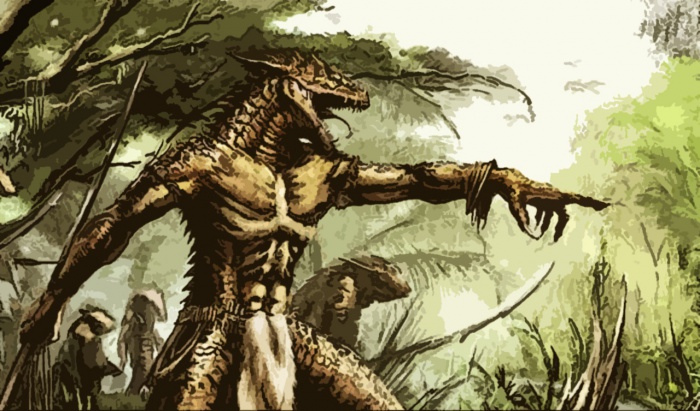
The Kala, Draconic Warriors of the Plains

As part of the draconic Tarakona setting I’m building on this blog, today I introduce in detail the Kala, fierce humanoid lizards who live in the plains of the world.

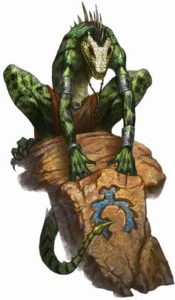
Found online without attribution

Created as laborers, Kala are, as a whole, strong but not bright. They have capitalized on these traits by developing a strong warrior culture of hunters and soldiers. For their first few generations, they established small clans of 20 to 50, each led by a chief, living off the bounty of the western grasslands.

Then came Dak One-Eye, who carried the magic hammer Thundermaker. This hammer was given to him by the god Ahm, who instructed Dak to unite the Kala as one empire under his name. The other clans quickly fell under Dak’s banner, forming the Empire of Ahm. Dak received many other visions and teachings of Ahm, which evolved into a complex religion.

Quickly conquering the western plains, the Kala established a thriving, spirited civilization now divided between industrious city-dwelling Kala and their wilder nomadic cousins, though it is not without its own internal squabbles.

Kala Culture

The empire is led by the Charl—currently Charl Torren of the Piercing Gaze. According to the Fourth Scroll of Ahm, the Charl must be “warrior in spirit, noble in bearing, fierce in war, decisive in home, and dedicated entirely to preserving the worship of Ahm.” This is generally interpreted to mean a strong warrior with a level head and respect for religion. Torren certainly combines these attributes, though he’s a better administrator than a fighter. This reputation has earned him some enemies among the war-chiefs.

Just below the Charl in rank are the priests and priestesses of the Eight Orders of Ahm. Each gender has its own religious role. Males (korani) serve as lay counselors and perform basic rites like the Seventh-Day Naming of the Child. Only females (dessen) may dance the holy dances and participate in the holiest of rites directly to Ahm. The high council of dessen also choose the next Charl when the current Charl dies.

Charls rarely die of old age. This remains an open secret.

Just below the priesthood sits the warrior class. Organized into battalions named according to their originating clan, battalions are led by war-chiefs. Each battalion votes for its war chief, though these elections are usually far from fair.

At the moment, the most powerful clans include Piercing Gaze, Everstride, Deep Shadow, and the Thousand Spears.

The rest of the Kala population is made up of the common class, including all the usual suspects: potters, weavers, ranchers, etc. Kala are omnivores, but favor meat. Since so much of the continent has been domesticated, most of their food comes from ranching and herding of slurn, a large, cattle-like lizard. Farming is looked down upon as an occupation too tied to one place, though some vegetable and fruit gardening occurs, particularly in the cities.

Every clan specializes in a particular craft, though several clans may practice the same craft.

Kala love rocks and stones, attaching great significance to the shape of stones, and often carrying one with them as a sort of totem. They will often set up standing stones to absorb evil or as sites of worship, believing that powerful spirits are attracted to them.

Kala Clan Life

Kala live in clans. Adolescents are encouraged to explore strong relationships but remain sexually celibate. Upon maturation, males and females are “bonded,” which is roughly equivalent to a marriage ceremony. Kala bond deeply to their mates, to an extent that may be physiological. Infidelity is a capital crime for both involved. Kala reproduce ovipariously (by laying eggs), and both parents watch over the eggs.

However, Kala young are raised by the clan. Mothers are expected to care for their infants themselves, but after weaning, parentage is mostly ignored. Adults self-organize into disciplinarians, care-givers, trainers, and so forth.

Kala Civilization

Kala live in either large, sprawling cities miles wide, with buildings rarely more than 2 stories high, or in nomadic camps. Predictably, nomadic Kala look down on city-dwellers as soft and living lives unfit to traditional values, while city-dwelling Kala see themselves as modern and much more economically powerful than their scattered nomadic cousins.

Kala cities are usually built of adobe or simple brick. What was once a clan on the plains is now a group of several dozen Kala who live in a complex of squat buildings surrounded by a low stake wall. Each clan works a particular trade, from weaving to weapon-making.

Kala Personality

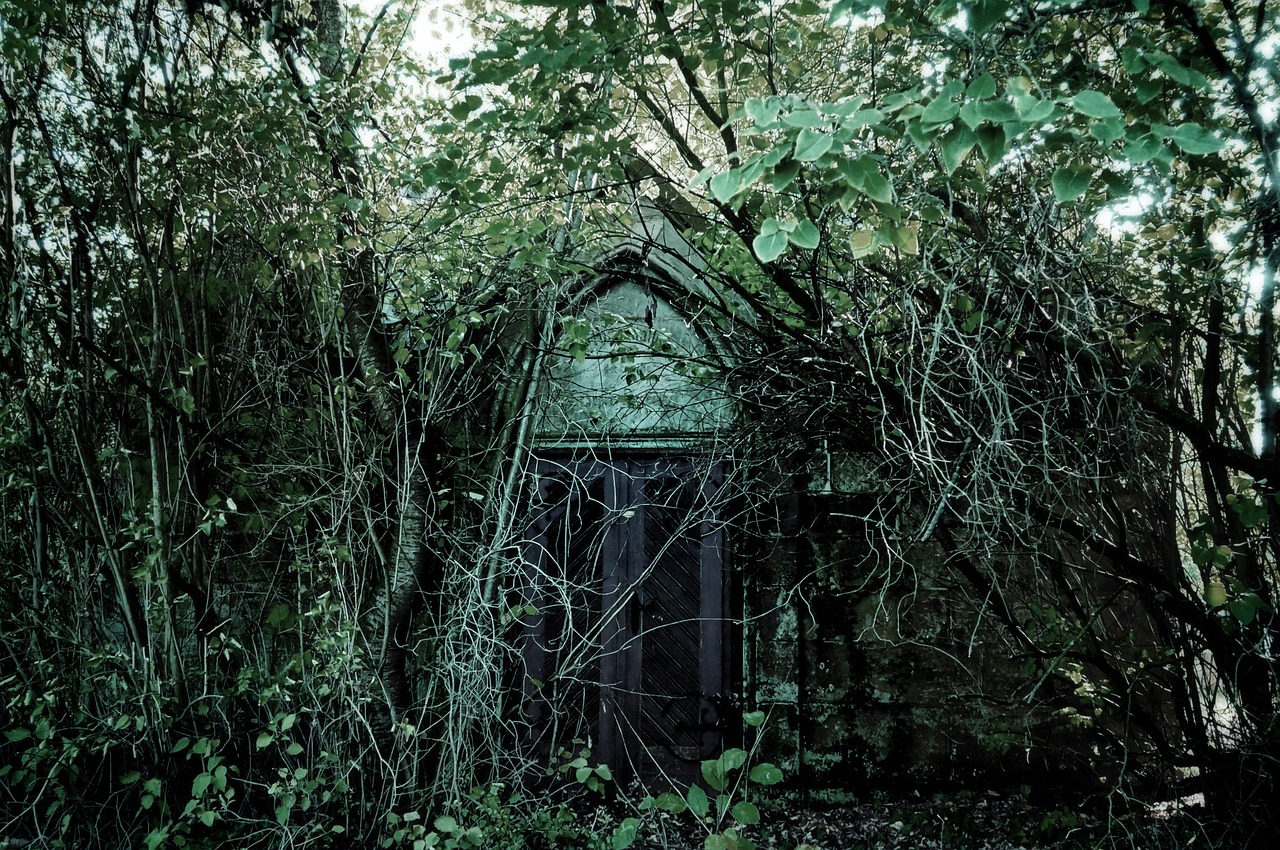
Found online without attribution

The average Kala has a spirited personality, given to strong emotions. They are not the savage brutes often painted by other cultures. Instead, they lust for life and vibrant experiences.

This helps to explain their many festivals and generally loud culture. As the Kala saying goes, “It’s not a proper festival unless a dish has been broken.”

Because companionship enhances emotion, Kala make excellent friends, and indeed they often jump into friendships without much judgment.

Most Kala are highly religious, though most outsiders have a difficult time deciphering Ahm rituals and festivals, which operate according to a highly complex schedule.

The Teachings of Ahm

According to the only two historical records we have of his early life, Dak One-Eye was just another energetic clan chief until receiving Thundermaker. His early revelations about Ahm concentrate on the importance of uniting the Kala race under one banner for Ahm’s glory. Later teachings take a much more pacifistic tone, particularly in the Eighteenth Revelation.

At the time, Dak’s teachings about pacifism were revolutionary, and caused much debate within the Kala wash-tents. However, Dak carefully phrased pacifism not as a lack of conflict, but as necessary for the survival of the race. As is explained in lines fifty-three through sixty-one and seventy-six through eighty-one of the Eighteenth Revelation:

In war there is fighting, yes
But is there not also death, not only of lives but also of nations?
Are the lives of all to be risked, year after year, generation after generation, without end?
No warrior wins every battle.
No feeling surpasses that of proof of arms
Of feeling victory over your foe with the might of claw and arm and leg
And can we feel this only in war?
We are warriors, yes
And we are more, far more, infinitely more.

We must survive,
To survive we must stand firm,*
To stand firm we must build,
To build we must not step onto the battlefield.
We will preserve our warrior’s spirit
In a thousand other ways.

* There is no direct translation for the term here translated as “stand firm.” The closest equivalent means to remain successful over a long period, despite drawbacks and enemies.

Ahm’s teachings can be usefully analyzed along the same gender division of the korani and dessen. The korani lay teachings emphasize self-discipline, self-reliance, self-control, and zest for raw emotion. These are taught during daily lessons given by the korani, who also typically teach in the informal neighborhood schools of the Kala (though these are gradually being supplanted by tutors and “professional” teachers, which has caused much concern). The dessen oversee the three-hour weekly rites attended by all Kala at temples or shrines, and dessen lectures emphasize pacifism and the importance of preserving Kala race and culture.

Kala Religion

The major festivals of the Kala include (but are by no means limited to):

  • The Feast of the High Sun
  • The Fast of Thek
  • The Festival of the Waxing Moon
  • The Three-Day Festival
  • The Five-Day Festival
  • The Feast of Forgiveness
  • The Coming of Age
  • The Gift of the Dead

Encountering the Kala

Combat

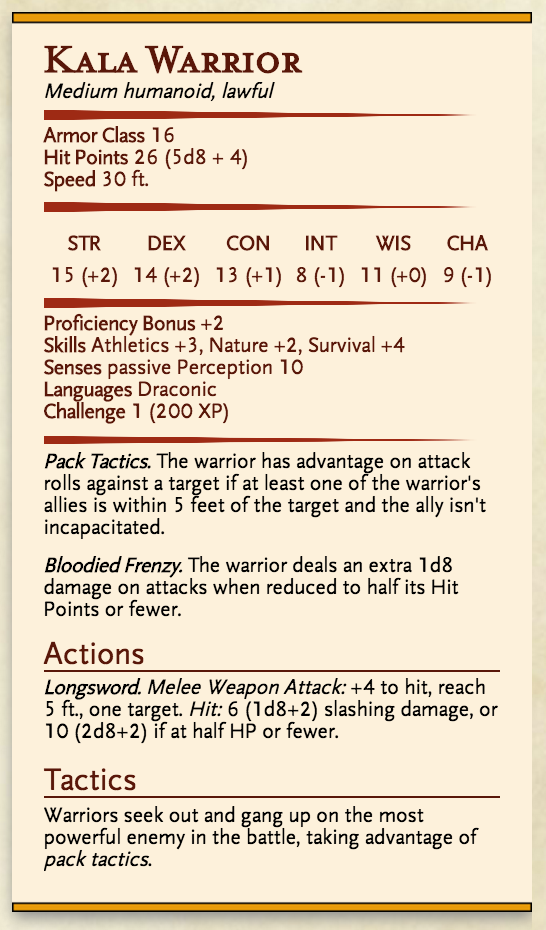
If you encounter a Kala raiding party, it will generally consist of a handful of warriors, archers, and warcasters, led by an elite warrior. The warriors will swarm the most physically powerfully enemy, directing their archers to do the same, while the warcasters keep other enemies at bay. Once the first enemy dies, the warriors leap to the next most powerful enemy in turn.

Plot Hooks

Nomadic clans often want information on rival clans nearby; this can be as simple as a scouting mission or as complex as infiltrating and “helping” the other clan.

Whenever you visit a Kala city, you’re likely to find it in the middle of a religious celebration. There are many opportunities for conflict here, such as the theft of a religious item or a mysterious death during a feast.

Categories: Tarakona | Leave a comment

Run an entire D&D 5E encounter on one sheet of paper

D&D Encounter Sheet

D&D Encounter Sheet

I’ve put everything I need to run a Dungeons & Dragons 5th Edition encounter on one page, with enough space for 40 monsters (4 different monster types, and 10 individual monsters for each type).

This doesn’t include every stat for every monster; just the stats that I need for 90% of my encounters: Hit Points, Armor Class, speed, initiative, attacks (attack bonus, average damage, damage roll, and damage type/special options), and special abilities.

There’s also an initiative tracker on the side, numbered from -5 to 25. Just write down where each creature is, and you can just glance down to see who’s where. There’s even a round tracker.

Download the PDF here.

Categories: Cool Utilities | 1 Comment

What created Tarakona, the Land of Dragons?

I’m building a setting on this blog: Tarakona, a continent filled with draconic races.

Today I’m going to flesh out the continent’s history. To understand any world, it helps to understand where it came from. If you know which elements forged it into its present shape, you can grasp it that much better.

However, a world intended for a tabletop RPG has specific requirements, different than what you need for a novel.

First, the world has to provide plot hooks. All the “fluff” in a game should provide plot hooks, in my opinion: material that can provide the backstory or motivation for an adventure.

Second, the setting has to provide dungeons. I don’t mean that literally, nor is it just because of the legacy of D&D. The PCs will need iconic areas to explore and have their adventures in. Even games that don’t involve heroic fantasy or dungeon crawling need iconic environments: dusty libraries and long-forgotten crypts in a Cthulhu investigation game, for example. The setting has to provide for the presence of those environments.

I’ve already established that dragons ruled the continent some centuries ago, and created the races that currently dominate it. But every epic fantasy world needs ruins and dungeons of past empires, and it’ll be difficult for GMs to run a game in a world where all the ruins are scaled for dragons.

So, let’s add some races that came before: humans who grew too powerful. What destroyed them? Let’s echo the downfall of the dragons by having them destroy the humans who came before.

On to our history:

The Age of Monsters

Savage Jungle by Private Islands Magazine

Savage Jungle by Private Islands Magazine

Tarakona was a primitive, untamed wilderness. Huge monsters roamed the jungle-covered land. Eventually, humans arrived and killed off most of those monsters, though many were driven underground or to remote areas. Few records of this era survive.

Plot hooks=: A newly-discovered record hints at an ancient monster driven underground, now living in caves like Morlocks, their internal organs valuable for spell components.

The Golden Age of Man

Great empires grew during this time. Men built massive cities and fortresses. Armies fought until they were united under Grand Emperor Koss. Under Koss and his descendants, lords squabbled and fought, but never put the entire nation at risk.

Most people viewed magic with suspicion, and the state increasingly disfavored it. This eventually led to the Sorcerer’s Rebellion. In their search for freedom and vengeance, wizards unleashed massive powers, leveling whole nations and throwing Tarakona into chaos. Great cities fell into ruin and sank into the jungle.

Plot hooks: Koss and his descendants ruled with a famous scepter, long thought lost; a recently-discovered map shows its location. Five artifacts were used to destroy whole cities during the Sorcerer’s Rebellion; someone has found an old, heavily trapped ruin that contains one of them.

The Days of Magic

After the dust settled, the surviving wizards set themselves up in power. Frankly horrified at the vast destruction they and their peers had wrought, they pledged never to use spells of mass destruction again.

For the next few centuries, the High Wizards retreated into their towers, devoting themselves to magical research. Their minions built fantastic palaces, impregnable fortresses, and secret underground laboratories.

Then one High Wizard grew powerful and distrustful. He allied with a few other spellcasters and summoned the dragons in an attempt to wipe out the other High Wizards.

Plot hooks: An old, fallen tower from the Days of Magic has been discovered; it’s full of valuable artifacts…and magically-animated guardians.

The Age of Dragons

The Dragon's Lair by jeffchendesigns on DeviantArt

The Dragon’s Lair by jeffchendesigns on DeviantArt

The dragons fought for the wizards in a long war. The remaining humans and humanoids either died or emigrated to other continents of the world. Eventually, the dragons turned on their masters and killed them all, leaving Tarakona solely to its dragon masters. The dragons settled in their former masters’ homes, and used the wizards’ abandoned laboratories to create many lizard-like and draconic servant races.

Dragons and dragonkind spread throughout Tarakona, settling every corner of the continent. The dragons ruled with absolute power, sending Kala into vast battles purely for the dragons’ amusement, toying with craven lizardlings, and driving komodos deep into the dangerous old ruins for forgotten magical lore.

Then, mysteriously, a few centuries ago, the dragons began to weaken. Some died; some left. Nobody knows why; the dragons murmured of a dozen different reasons, few of them compatible.

Once the dragons grew sufficiently weak, the many servant races seized the opportunity, rose up, and killed their masters.

Fifty years of civil war followed, and the races eventually settled into stable clans and empires. The wars died, and over the next century, things slowly settled. Occasional battles marred a period of general peace and construction. Today, each of the three primary civilizations of Tarakona is sufficiently mature to attempt true mastery of their entire continent.

Now, each kingdom needs adventurers.

Plot hooks: An oracle prophesies that the dragons will return in one year unless certain conditions are met. A dragon’s lair has been unearthed.

Categories: Tarakona | Leave a comment

How to Tell a Big Story

"Heart of Ice" by jdhancock on Flickr

“Heart of Ice” by jdhancock on Flickr

Lots of GMs want their campaigns to tell an epic, inter-connected story with plot threads woven over dozens of sessions. But as soon as they plan one, their players take a left turn two sessions in and never actually interact with 90% of the material the GM planned.

Here’s the secret: don’t write out what happens. Instead, develop big problems and big antagonists.

In other words, create an antagonist who has big plans, like raising an undead army, leading a military coup, or killing a god. Make it something that will upend the world. You can even create several antagonists like this.

Then place your antagonist most of the way towards his or her goal. Give him or her resources. The army is half-built, the country is destabilized, or the antagonist is only a few pieces away from assembling the Staff of God Killing.

You’re now ready to start the game, during which, you must make these situations visible and evident in the PCs’ every-day lives. Every town is attacked by undead, everybody’s talking about the weak leader, or every powerful mentor is scrambling to find adventurers who will find other pieces of the Staff.

As the PCs continue in their story, ensure that every major decision the PCs make for or against these antagonists has an impact. If they find a piece of the Staff, they’re attacked by the antagonist’s agents. If they ignore the undead attacks, those attacks intensify and the shops they rely on for supplies are destroyed.

Create a problem that the PCs ignore at their own peril, so that the game is defined by their actions relative to that problem.

Categories: Role-playing | Leave a comment

First Time DM Essentials

"Lighthouse in Stavern" by lattefarsan on Flickr

“Lighthouse in Stavern” by lattefarsan on Flickr

You want to run Dungeons & Dragons for the first time. Awesome! You’ll have a great time. Here’s some advice for the absolute minimum you need to do for your first session to make it run as smoothly as possible.

Ahead of Time

Find a first level adventure. While this will take some work, it’s a lot easier for a first-time DM than building your own scenario. The “Lost Mine of Phandelver” adventure in the D&D 5th Edition Starter Set is a great start, and there are quite a few more on dmsguild.com.

Read this adventure thoroughly, multiple times, before you play.

Read the Player’s Handbook or other core rules thoroughly. Don’t worry about memorizing every rule, but the more familiar you are with the rules, the better.

Find an encounter sheet (like this one), which has space for several monsters, plus an initiative tracker. Print out a bunch of copies and fill in several for the encounters you think you’ll have in the first session. That way, you’ll have all your monster stats and initiative on one sheet of paper.

Setup at the Table

In your notes, have a sheet of paper or text file for the players’ characters. Write down each PCs’ player name, character name, race, class, and passive Perception score on this sheet. This will be very useful to glance at as you play, so you can address people as their characters and handle passive Perception checks.

During Play

If somebody has a question about a rule and you don’t know the answer, make a quick “ruling.” This is a temporary decision about how that aspect of the game works. Don’t worry about looking it up unless somebody already has the Player’s Handbook open near that rule. If anybody’s concerned about that, choose a player who will write down the rules questions you all have as you play. Somebody can look those up afterwards.

Related to that: If a player doesn’t understand some aspect of their character, encourage the player to look it up in their spare time. In other words, if they chose the “Light” spell, but only wrote down “Light” on their character sheet, then in-game asks you how “Light” works, make a ruling, then tell them roughly where it is in the Player’s Handbook and have them look it up later. It’s not your job to know how the PCs’ spells and special abilities work.

When you’ve finished describing a scene, ask the players some variation on, “What do you do?” Maintain the focus on them and their actions. Keep encouraging them to make decisions and move the story forward.

Good luck! If there’s anything I missed, please post in the comments.

Categories: Role-playing | Leave a comment

A New World: Tarakona

Far off in the distant sea, a lost continent sits and broods. Cut off from the rest of the world for centuries, its draconic races killed their dragon masters and developed unique histories and culture over the past century and a half. But now they face a new threat: the dragons have returned. And now these strange creatures need adventurers.

Found online without attribution

Tarakona can be dropped into any fantasy world, and I’m developing it here, in the open. I’ll build it according to the following principles:

  1. Multi-level design. RPGers are imaginative, so each major element will start with a high-level version of a race, creature, artifact, or location. This high-level version will be all you need if you’re full of imagination and want to make it your own for your game. But I’ll also include detailed information that will let you plunk the element down directly in your game.
  2. Enough detail to whet your appetite. I won’t list every ruler in Tarakona’s history. That’s boring and not useful. But I will tell you about the major names, and give you a couple of juicy details that can hook into other plots. Each major fact will be memorable and directly useful.
  3. Multiple system support. I’ll include stats for D&D 5th Edition, Pathfinder/D&D 3E, and OSR systems (though not all at once!). I definitely won’t be able to playtest them all, though, so I’ll beg your indulgence there.

Tarakona map

So, what is Tarakona? Let’s give you a high-level history to get you started.

Tarakona is a continent dominated by draconic races: versions of kobolds, lizardfolk, and similar creatures magically created by powerful dragons to serve them. There are no humans, elves, dwarves, or other humanoids (until the PCs arrive). These draconic races spent generations toiling for the dragons as slaves and pawns.

The powerfully-built kala were built for battle, their masters breeding whole armies that they would send against other dragons in battles over trifling bets, but which cost untold kala lives. The strange komodos spread throughout the continent, gathering rare spell components and braving dangerous creatures to research magic (and learning a few secrets themselves). The servile lizardlings served the dragons directly, fetching food and providing innumerable forms of entertainment for their masters.

Then, a few centuries ago, the dragons weakened. Some wasted away and died; others flew away; some simply disappeared. Nobody knows why. Dragons murmured of a dozen different reasons, none of them matching each other.

Eventually, the dragons weakened enough that their slave races rose up and slew their masters. Civil war inevitably followed, until finally the races stabilized into three great empires. Despite occasional skirmishes, they have spent the past century and a half developing their civilizations.

The kala seek out new experiences and vibrant emotional experiences, and they evolved into a nomadic people, dozens of tribes swarming across the plains and lightly-forested foothills in the northwest of the continent. Komodos established a secretive empire built around magic and blood sacrifice, their stone ziggurats sprouting out of the jungles and swamps in the center of the continent. The lizardlings, meanwhile, built sprawling, highly developed cities in the south, where you can find any entertainment you can imagine…for the right price.

But now a new war looms, and the draconic races cannot face it alone. They need outside help.

They need adventurers.

To use this now: use your system’s stats for lizardfolk (kala), kobolds (lizardlings), and yuan-ti (komodos), and set up the lizardfolk as a Mongolian-style civilization, the kobolds as a sprawling, Indo-Chinese civilization, and the yuan-ti as an Aztecy civilization. That’s not going to be quite as interesting as what I’ll develop here, but it’ll get you started.

Much more to come!

Categories: Tarakona | Leave a comment

Minimum Viable World: How much of your world to build

"Construction Site Safety" by peronimo on Flickr

“Construction Site Safety” by peronimo on Flickr

How much of your world do you need to prepare ahead of time to make the world appear fresh to your players?

Let’s avoid the obvious extremes of zero preparation on the one hand, and a binder full of notes on the other. Some people run successfully with one extreme or the other; this post is not for them. This post assumes that, if you personally invent a secret society during your game session, it’ll work, but it’ll feel made-up to the players, so you want to avoid that.

We’ll start with a principle: The most important elements of a world relate to people and geography, and how they conflict.

The Geography

You don’t need to define every country in your world ahead of time. You only need the current country and its neighbors.

For each country, you need to define each country’s conflicts with each other. So, what do countries conflict get into conflict over? Two main things: boundary disputes (usually resulting from previous invasions) and trade.

Boundary disputes imply prior military conflicts between these countries. You just need to write down what land is in dispute and a reason for now. The reason usually has to do with an imbalance of trade or resources; a strip of land that’s particularly fertile, or defensible, or indefensible. It could even be religious. This will help to define each country’s geography, too.

Defining the trade differences is a big help to your world-building, because that defines a few of each country’s major exports and imports. This will also tell you what professions will pop up most commonly in these countries.

One helpful way to think of conflicts between countries is answering the question: Why aren’t these countries at war yet? Pretend that war is inevitable between any two given countries, and ask A) why each country would go to war with another, and B) what’s prevented it from breaking out so far.

The People

You’ll want to define representatives of three broad categories of people: governmental, religious, and popular. There may be some overlap, and that’s fine.

For governmental people, I include hereditary rulers, elected officials, and even the military: anyone with major organized power. Who are the big movers and shakers? Who could start a war?

Role-players tend to shy away from religious elements in their games. That’s a shame, because religion provides some of the most interesting story fodder. Who are the major religious leaders in each country (or across multiple countries)? What religions or factions do they lead? Note that many influential religious leaders direct relatively small cults of followers, and they may be known more for their politics or activism than for the number of their followers.

Popular people lead informal groups, from school founders to martial arts masters to philanthropists to investors to major merchants. For this, you need each person’s name, the name of the organization they lead, and a reason why they’re particularly popular.

Define at least two characters in each of these three categories.  To define a character, I mean give them each a name, a simple personality trait, at least one connection to one other character (it can be a character that you haven’t defined yet), and the group(s) to which that character belongs (parliament, court, military, school, guild, religion, etc.).

You’re not quite done with people yet. Also name five other characters, and give each a simple personality trait. These will remain available to you for improvisation.

The Rest

Fantasy adventure requires one more significant detail:

What monsters commonly inhabit each country? For each monster, rough out a single prototypical enclave or encounter. You just need a rough map, location of creatures, and pointers to stats. The key here is to define a prototypical encounter, the kind that frightened townsfolk gossip about in the tavern. Stat that out and have it available in your notes.

Anything I’ve missed? Let me know in the comments.

Categories: Role-playing | Leave a comment

RPG Rx: “I Won’t Play X Because of Mechanic Y”

Different “Different Directions” by Matthias Ripp on Flickr

From an old thread on RPG.net, shockvalue asked:

Are the people who absolute[ly] won\’t abide a game with some mechanic and/or prop a tiny, tiny minority? Or are they more common? Are there a lot of people who just flat out refuse to use cards in a game? Or would refuse to play an rpg with a group of people they liked just because they were playing a game with classes?

I’m going to turn that around a bit and answer the question, “Why do some people refuse to play games with certain mechanics?”

Mechanics, like most things, are complicated. Let’s look at a few common randomization tools:

  • Dice have a triple connotation in modern society: board games, gambling, and role-playing games. Nobody feels shame at rolling dice in a board game or gambling game, and in fact, that very action can create a thrill.
  • Cards imply gambling or Uno.
  • Flipping a coin implies an old-time gangster or maybe Two-Face from Batman.

Meanwhile, mechanics can have all sorts of specific associations with people, places, or events. Your uncle used to roll a coin across his fingers, and you can’t stop thinking about that when you see a large coin. You won $500 your first time at a Blackjack table on your one trip to Las Vegas. You only ever played card games during the annual family ski trip.

What associations do RPGers have with certain mechanics? Well, some folks don’t like percentile dice rolls, because they were so often used for lookup tables in early RPGs. Some don’t like cards, because they’re larger than dice and they’re an extra thing to bring to the table.

I think many shy away from non-dice mechanics because they’re often gimmicks. Die rolling is tried-and-true within tabletop RPGs, so cards or coins or tokens or what-have-you feel like an unnecessary layer. Why install a second engine in your car when you already have a perfectly good one?

The solution, I think, has to come from outside RPGs. If you have a player who “hates cards” in tabletop RPGs, play a few card games. Play a few board games that use cards. Get him or her used to the concept in well-built games, games where the utility of cards shines with blinding obviousness.

Exposure, as is so often the case, breaks down barriers.

Categories: Prescriptions | Leave a comment

Generate an Island Map

The Polygon Map Generation demo (requires Flash) will generate a random, colored map of an island. You can even save the random seed for re-generation later. It offers several generation methods and a number of different views, including biomes, elevation, moisture, and even a rotating 3D view.

It’ll export a 2,048 x 2,048 PNG file, which is pretty darned big.

Categories: Cool Utilities | 2 Comments

Which lasts longer: the PCs or the world?

Cole

Do you create campaigns to suit the player-characters? When the PCs reach a stopping point, do you move on from that world and create a new campaign?

Or do you create worlds that your PCs happen to adventure in?

Obviously, our games are never as cut-and-dried as this, but think about your general approach. In practice, does your campaign world exist separate from the PCs?

This difference in approach highlights a key distinction between old-school and modern play approaches.

Modern games create heroic characters who are the focus of big stories. The game is all about the characters.

Old-school games were set in a big world where characters lived and died. Blackmoor and Greyhawk existed regardless of who was playing it. The characters accomplished great deeds within those worlds, and gameplay focused on their heroics. But the world continued on.

Both approaches are useful. Just beware of getting stuck in one.

Categories: Role-playing | Leave a comment