Game Design Hour: How to Find Play Testers

'Talking on the offshore' by ePi.Longo

‘Talking on the offshore’ by ePi.Longo

This is part of a series of blog posts where I confront issues relating to tabletop RPG game design.

First off, you may be asking: Do I need play testers? Can’t I play my game with a few friends, then just post it online?

Of course, yes, you can just publish it. And if you’ve got a simple, quick game, that might be appropriate.

But the game won’t be as good as it can be. You’re not everyone. Your friends probably have similar interests to you. You need other perspectives to find holes in your design that you can’t even see.

So how do you find play testers?

There’s no magic bullet. But one way is to run games online for strangers.

Post on your favorite social media network, offering to run games. If you have a lot of followers, you might be able to ask for players for your in-development games. If not, offer to run popular games like D&D.

Then, once you’ve run a couple of sessions with these players, ask them if they’d be willing to play a session of a game you’re writing. Run a game with them.

Now, ideally, you can find a group that will run your game without you even being there. Unfortunately, very few people are willing to run a game that’s still in development. Try asking your players if one of them is willing to do so, but if they’re not, that’s just the reality of indie tabletop RPG development.

At least you’ve found playtesters and received their feedback!

How do you run a playtest and gather that feedback? I’ll be covering those topics in future posts.

Categories: Game Design Hour | Leave a comment

How Ryon Got Kicked Out of Our Group

Play tabletop RPGs long enough, and you’ll run into him: the player who you no longer want to be part of your group. He’s not just annoying; he makes the game less fun for everyone.

Again, to be clear: this post is about a player who decreases everybody’s enjoyment of the game.

That was Ryon. He was rude, he’d elbow people when making jokes, he wouldn’t pay attention, and he’d show up an hour late for sessions then expect everyone to catch him up.

How did we kick him out? We didn’t. At least, not right away.

First, I sat down and defined the specific behavior that was causing the friction. The problematic behavior isn’t a problem for the player, so if you just tell a player “You’re being annoying,” he or she won’t know what you’re talking about.

I remembered specific things that Ryon said or did, like repeatedly shouting “No!” when another player suggested a reasonable course of action, or rolling his eyes repeatedly when another player talked, or pulling out his phone, or elbowing another player. You don’t have to remember it word-for-word, but the more specific, the better.

But I wasn’t done. If you just outline a problematic behavior, it’s easy for the player to discount its impact on the group. Again, it’s not a problem for the player. But if you explain the results of that behavior, you’ve changed the conversation from a personal complaint to a discussion about the entire group.

So I thought about the specific results of his behavior. This is hard to define, because it’s not necessarily external. It can be hurt feelings, or it can be about other people’s changed opinions of the player in question.

Besides, if I couldn’t think of specific negative results from Ryon’s behavior, something else isn’t right. Maybe I’m over-reacting, or maybe I’m identifying the wrong problem. But that’s another post.

Once I identified the behavior and how it was frustrating for our group, I talked to him one-on-one. I was able to do it face-to-face, which is best, since you can modulate your tone or body language. If you can’t do it that way, by voice is next best. I made sure to do it as privately as possible; confronting somebody in front of other people dramatically increases the tension (and the player’s behavior in the group is likely driven partly because it is in front of an audience). In this instance, I just took Ryon into another room as folks were arriving for the next session. While the conversation might technically have been audible if others got close enough, it was reasonably private.

What I told Ryon can be basically broken down into four parts:

  1. Some variation on, “Hey, can I give you some feedback?” You need to give the player a heads-up about the topic you’re about to address, and phrasing it as feedback makes it sound more neutral. It also gives the player a chance to say “Yes.”
  2. Describe the problematic behavior.
  3. Describe the results of that behavior on the group.
  4. Ask the player to try something different from now on. Simply leaving it with a description of the problem focuses on the problem instead of on solutions. By asking the player do try something different later, you shift focus to the future, and the fact that the player can change.

That’s it.

Two important “don’t”s at this point:

Don’t tell the player specifically what to do. Leave it up to the player to figure out a different way of acting. He or she may not do so, but that’s okay; that’ll get taken care of, too.

Don’t argue. The player may want to debate with you about how big the problem is. The player may even do this out of a genuine desire to understand the situation. While you can answer the player’s specific questions, move on from this conversation as quickly as possible. You are not the player’s therapist.

This may surprise you, but most of the time, this will solve the problem. The player will come up with a different behavior, and the problem won’t happen again.

Unfortunately, Ryon wasn’t one of those players. He was a little better that session, but he went right back to the same behavior next session.

So I talked to the player again, this time adding a firm condition between parts 3 and 4: either he changes his behavior, or he’s not going to be welcome at this group any more.

Now again, if you’ve made it this far, most people will change their behavior. You’ve clearly laid out this problem twice now, and that’s enough for most people to realize they’ve been wrong.

But Ryon wasn’t one of those people either. He still had basically the same behaviors; he just wasn’t quite as bad about them as before (instead of showing up an hour late, he showed up 30 minutes late, among other things).

If this happens, it’s time to cut the cord. It’s best to do this face-to-face, but it’s also okay to send them a private message telling them they’re no longer welcome in the group. That’s what I did.

It sucks, but it happens.

Now if you’ve read this post this far, I’ll share a secret with you: I’ve never had a Ryon. I’ve given players feedback along these lines, but it’s never escalated to kicking a player out of the group. Why? I followed this pattern, so each player had plenty of chances to learn.

Categories: Player Advice | Leave a comment

Game Design Hour: What You Need for a First Draft

'Writing Pencil' by home thods

‘Writing Pencil’ by home thods

This is an ongoing series of posts where I look at tabletop RPG design pretty darned exhaustively.

Let’s say you’ve got an idea for an RPG, and you’ve written down some notes and rules. Let’s further say that you want to release this to the public.

Before you do, you’ll want to show it to at least somebody else to know what makes sense. You should playtest it, too, but let’s say you know one or two people to whom you can show an RPG, and can read it and get back to you with reasonably useful feedback.

We’ve now helpfully established the goal of the first draft: This is the version that you will show to other people.

So, what is the minimum content needed for a first draft of an RPG?

I think you need three things:

You need your core mechanics. This is further composed of four things:

  1. What do players do in the game?
  2. What do player-characters do in the game?
  3. When do you break from the fiction and use a randomizer (like dice or cards)?
  4. How do you interpret the randomizer’s results back into the fiction?

You also need to explain character creation. Assuming players play characters, they need to know how to build one.

You also need decent spelling and grammar. I’m not trying to be your grammar teacher here; this grows naturally out of your goal. Other people will be reading your work. If you know you’re poor at spelling and grammar, you know they’ll have a tough time even understanding your sentences, much less the game you’re trying to explain to them. If this is a problem for you, find a friend who can fix this before you pass your first draft off to other people.

That’s it. Note what I’m not including:

  • Setting
  • Sample of play
  • Introductory adventure
  • Optional rules
  • How to level up

Those are all useful things to include, but they’re not necessary for your first readers to grasp the essentials of your game. Focus on the basics.

Categories: Game Design Hour | 1 Comment

Monster Monday: Komodo Investigator of Tarakona

The savage continent of Tarakona, where draconic races battle for supremacy!

The studious Komodos explore the ancient ruins that cover Tarakona in groups of 5 to 10, typically made up of rangers, investigators, and tamed hunting drakes, who then report back to a team of researchers in a Komodo stone city.

Once the rangers get a team safely to a ruin, the investigator specializes in delving into it and uncovering its secrets. Part archaeologist, part sage, part adventurer, investigators are smart and careful.

They also each carry an orb of takala, which they use to electrify their staff and arrows.

Investigators typically keep to the back of a fight, using their illusion of falsehood to appear like rangers until they are engaged in melee. If a fight goes poorly, investigators retreat and escape rather than fight to the death.

Text version of stat block, suitable for use in Homebrewery:

___
> ## Komodo Investigator
>*medium humanoid, evil*
> ___
> – **Armor Class** 17
> – **Hit Points** 80 (12d8 + 34)
> – **Speed** 30 ft.
>___
>|STR|DEX|CON|INT|WIS|CHA|
>|:—:|:—:|:—:|:—:|:—:|:—:|
>|12 (+1)|14 (+2)|12 (+1)|17 (+3)|14 (+2)|9 (-1)|
>___
> – **Proficiency Bonus** +2
> – **Skills** Arcana +4, History +3, Perception +4, Stealth +3
> – **Senses** darkvision 60 ft., passive Perception 14
> – **Languages** Draconic
> – **Challenge** 3 (700 XP)
> ___
> ***Innate Spellcasting.*** The investigator’s innate spellcasting ability is Intelligence (spell attack bonus +5, spell save DC 15). It can innately cast the following spells, requiring no material components: At will: *light, mage hand, minor illusion*
>
> ### Actions
> ***Quarterstaff of Lightning.*** *Melee Weapon Attack:* +3 to hit, reach 5 ft., one target. *Hit:* 6 (1d6 + 3) bludgeoning damage plus 7 (1d8 + 3) lightning damage.
>
> ***Shortbow of Lightning.*** *Ranged Weapon Attack:* +4 to hit, range 80/320 ft., one target. *Hit:* 7 (1d6 + 4) piercing damage plus 8 (1d8 + 4) lightning damage.

> ***Illusion of Falsehood.*** The investigator can make itself (and anything it wears and carries) look like any other creature or humanoid its same general size and shape. This will not hold up to physical examination, it does not change the investigator’s voice, and a DC 20 Intelligence (Investigation) check will reveal the illusion.

Categories: Monsters | Leave a comment

Faction Friday: Elydain’s Caravan, The Dragon Egg Smugglers

'The Caravan' by dungeonmiester

‘The Caravan’ by dungeonmiester

Elydain’s Caravan can be used either as a friendly faction that sends the PCs out on a mission, or as a foe that the PCs must overcome. This small caravan of about two dozen tightly-knit, mostly elven merchants, guards, and family members, led by an old elven lady named Elydain Cirelthion, trades mostly in metal merchandise from pans to daggers. Their ten-wagon caravan has plied the trade routes in this area for over two centuries.

As a friendly faction, Elydain contacts the PCs with a delicate problem. They were asked by a client to transport a dragon’s egg to a wizard’s tower. The client is part of an adventuring party that defeated a dragon and found the egg in its lair. Dragon’s eggs are dangerous enough that most city guards wouldn’t look kindly if they found anyone possessing one, but the client paid handsomely, so Elydain agreed. Unfortunately, the caravan arrived at the wizard’s tower to find it destroyed. She now has a dragon’s egg to fence, and asks the PCs to find a buyer. Any number of spellcasters would jump at the chance to study a dragon’s egg; Elydain just wants to ensure that the buyer doesn’t connect the egg to the caravan.

As a foe faction, the PCs are hired by a wizard, Carvorax the Splendid (so he calls himself), who has heard that the caravan recently acquired a dragon’s egg in secret. He wants the PCs to waylay the caravan and take the egg, which they shouldn’t be transporting anyway. They’re unwilling to sell the egg (they already have a buyer in the form of a sorcerer, Tristram the Invincible, who happens to be Carvorax’s rival).

Combat Encounter

If the PCs attack the caravan, its wagons will be pulled into a circle, and guards will approach the PCs outside the circle. If engaged, the PCs will have to defeat the guards, some of whom will remain with the wagons and fire crossbows at range. Once the guards are dealt with, half the merchants will muster and attack with short bows and swords. If at least two of the attacking merchants die, Elydain will approach the PCs, asking them what they want (if they haven’t made it clear), and give them the dragon’s egg. She doesn’t want to see the caravan slaughtered.

As such, make sure that the guards and the merchants are a very tough fight, since the PCs won’t have to kill most of the merchants.

Categories: Faction | Leave a comment

Game Design Hour: Helpful Sites for the Designer

'service-design-39' by Tobias Toft on Flickr

‘service-design-39’ by Tobias Toft on Flickr

This post covers public websites with features useful for the game designer during design. In other words, this isn’t about publishing your game (that’s another post).

Often, you’ll need to share game materials with other players, or you want to work on your rules from multiple places. Some folks forget the utility of Google Drive. You can create a shared folder on Google Drive for your game, then drag-and-drop your rules PDF into there and share the folder with playtesters. Or you can write your draft rules in a Google Doc, which you can access from any PC.

If you’re creating a game with components, like a board game or card game, or an RPG that uses special counters, The Game Crafter is invaluable. You can not only buy components (tokens, pawns, miniatures, etc.) in any amount you choose, you can actually build a game: upload art for custom cards or a game board, list the components, and order a copy. Prices are reasonable, and you can buy just one copy of anything (in other words, you never commit to a 10,000-copy print run). Particularly useful for RPG designers who use custom cards.

If you’re writing a tabletop RPG and want to self-publish the rule book, Lulu is one of the go-to self-publishing companies out there. Just upload your book as a Word document (or similar), and they’ll create a book out of it, which folks can buy straight off Lulu; you get the money dropped into a PayPal account once a month. They offer a reasonably wide selection of book types (softcover and hardcover at various sizes), and reasonable prices. Just as with The Game Crafter, you can buy as many copies as you want; you’re not ordering a big print run.

If you know of any others, please let me know in the comments.

Categories: Game Design Hour | Leave a comment

Campaign Concept: Savage, Dangerous Nature

Imagine a D&D fantasy world where you don’t screw with animals. If you enter a cave and you run across a growling wolf, you back down and find another way in (or tempt the creature away, or make peace with it, or whatever).

Now, you could make exceptions for some vermin, like sewer rats and spiders, as well as trained guardians. But otherwise, you only fight people.

Obviously, you’d need to establish this with your players. You could mechanically support it by, saying, tripling the damage and HP of each animal.

It would make a game where you explore the wilderness; you don’t dominate it.

Worth thinking about.

Categories: Random Idea | Leave a comment

Game Design Hour: The Three Phases of Prototyping

by Kars Alfrink

by Kars Alfrink

This post continues a series of blog posts in which I provide recommendations about tabletop game design. This won’t necessarily teach you how to design a game, but it will help you along as you build it.

In this post, I’m going to talk about the prototyping.

The Crappy First Prototype

When I get an idea for a game, I rush to a Word document, a pack of index cards, or a physical notebook, and I write down everything that’s pouring out of my head. I document abstract ideas, specific mechanics, materials, and anything else that comes to mind.

Then I need to see what it looks like on the table, and I build my Crappy First Prototype.

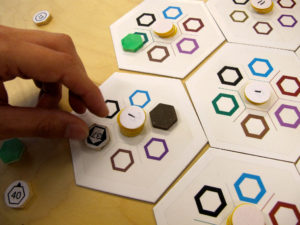
I intentionally use scrap for the first prototype. I use torn-off bits of paper for counters, printer paper for boards, binder clips for pawns; anything that’s nearby.

I do this for a couple of reasons:

  1. Your game will change so much that any time or expense you put into any item probably won’t be worth it. You won’t use that item in the final product anyway.
  2. If you invest time and thought in “perfect” materials, your unconscious mind will favor the mechanics using them. It’ll be harder to change something that’s a poor fit for the game.
  3. Cheap materials will spur you to create a cooler game. Your mind will spawn all sorts of cool ideas for materials as you struggle with paper chits.

For an RPG, you may not need any materials. For a card game, I recommend blank (that is, unlined) index cards, which you can buy in huge, inexpensive quantities at any office supply store. For board games, use 8.5×11″ paper taped together for boards. I take a highlighter to a paper and tear off bits to create tokens, markers, and pawns. Coins and binder clips are great pawns.

The Early Play Test Prototype

Eventually, you’ll need to show the game to other people.

At this point, I replace the low-quality materials with something better, but still simple. For tokens, I’ll use plastic poker chips, for example. The point is to move away from scrap, but still avoid investing serious cost. Your game is still going to go through a lot of changes.

I’ll also format my rules into a form that’s easier to read, with headers and some form of organization. This isn’t anywhere near the final version with cool fonts and fancy art, but it’s at least formatted in a way that other people will understand, and I fill out any “(NEED TO FILL THIS OUT LATER)” sections.

Remember, you’re not showing this to everyone in the world; just a few friends who can give you an idea of whether the basic mechanics work.

The Reasonably Nice “Public” Prototype

Once you’ve run your game with a few friends, you can turn this into something closer to a final game.

Find materials closer to the final version. For a board game, The Game Crafter sells spare tokens, player pieces, etc. For a card game, you can also use The Game Crafter to order a cheap version of your cards. You’ll be showing your game to people who are less familiar with your aesthetics and expectations, so it’s important that the components suggest the game.

Now’s the time to really think about how to format your rules and make them look interesting and inviting. If we had large budgets, we’d plan for art ahead of time, but indie developers rarely have that luxury. Now you can look for art to slot into your rules and the actual presentation of your game.

Once you’ve gone through a few playtests with your “public” prototype, you can look into actually publishing your game. But that’s another post.

Categories: Game Design Hour | 1 Comment

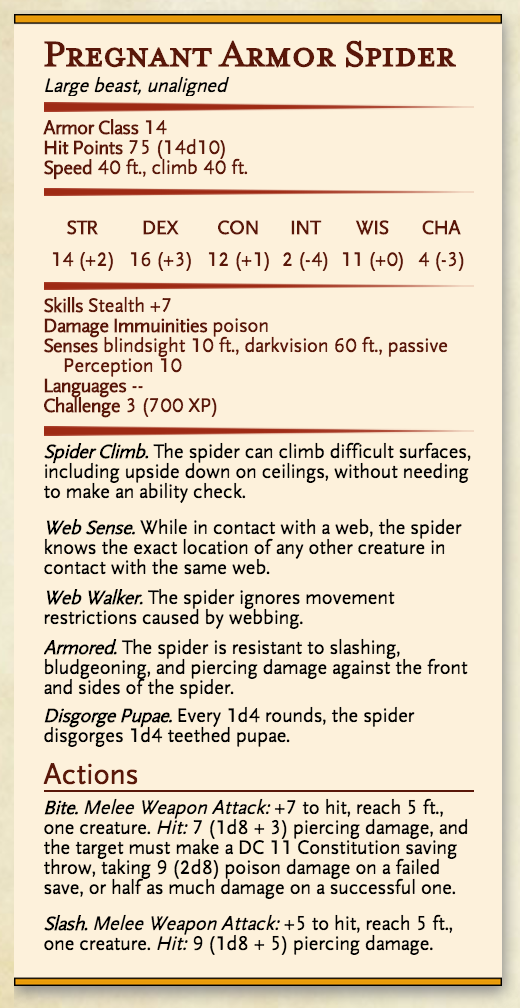
Monster Monday: Pupae-Disgorging Pregnant Armor Spider

How metal is that, huh?

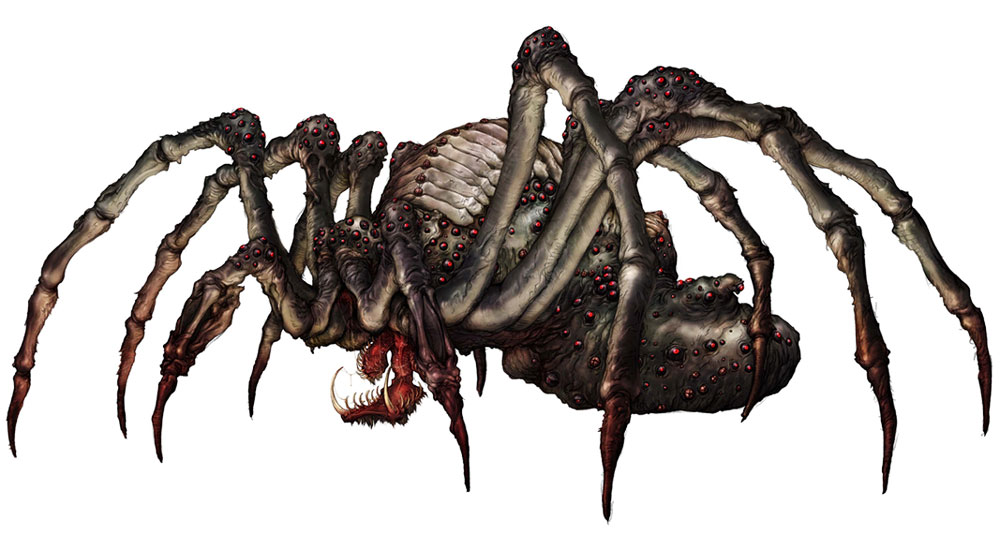
Inspired by the Egg Hunt encounter designed by Drunkens & Dragons, this giant armored spider has two particularly interesting elements:

Every 1d4 rounds, the spider spits out 1d4 teethed pupae, who quickly join the fray. The pupae are low on Armor Class and Hit Points but high on damage, which means PCs are likely to ignore them and focus on the spiders until the pupae get in one or two good hits. By that point there may be an overwhelming number of pupae, depending on how many spiders you include.

This monster introduces a facing mechanic. Due to its chitinous armor and steel-like blades of its forearms, normal weapon damage is halved if the attacks are made against the spider’s side and front. Its bulbous, pupae-filled, pregnant abdomen, however, will take damage like normal.

I ran two of these spiders against a 6th-level party and it was a pretty tough encounter; two of six PCs dropped below 0 Hit Points.

And here are the stat blocks:

___
> ## Pregnant Armor Spider
>*Large beast, unaligned*
> ___
> – **Armor Class** 14
> – **Hit Points** 75 (14d10)
> – **Speed** 40 ft., climb 40 ft.
>___
>|STR|DEX|CON|INT|WIS|CHA|
>|:—:|:—:|:—:|:—:|:—:|:—:|
>|14 (+2)|16 (+3)|12 (+1)|2 (-4)|11 (+0)|4 (-3)|
>___
> – **Skills** Stealth +7
> – **Damage Immuinities** poison
> – **Senses** blindsight 10 ft., darkvision 60 ft., passive Perception 10
> – **Languages** —
> – **Challenge** 3 (700 XP)
> ___
> ***Spider Climb.*** The spider can climb difficult surfaces, including upside down on ceilings, without needing to make an ability check.
>
> ***Web Sense.*** While in contact with a web, the spider knows the exact location of any other creature in contact with the same web.
>
> ***Web Walker.*** The spider ignores movement restrictions caused by webbing.
>
> ***Armored.*** The spider is resistant to slashing, bludgeoning, and piercing damage against the front and sides of the spider.
>
> ***Disgorge Pupae.*** Every 1d4 rounds, the spider disgorges 1d4 teethed pupae.
> ### Actions
> ***Bite.*** *Melee Weapon Attack:* +7 to hit, reach 5 ft., one creature. *Hit:* 7 (1d8 + 3) piercing damage, and the target must make a DC 11 Constitution saving throw, taking 9 (2d8) poison damage on a failed save, or half as much damage on a successful one.
>
> ***Slash.*** *Melee Weapon Attack:* +5 to hit, reach 5 ft., one creature. *Hit:* 9 (1d8 + 5) piercing damage.

___
> ## Teethed Pupae
>*Small beast, unaligned*
> ___
> – **Armor Class** 10
> – **Hit Points** 10 (1d10 + 5)
> – **Speed** 20 ft.
>___
>|STR|DEX|CON|INT|WIS|CHA|
>|:—:|:—:|:—:|:—:|:—:|:—:|
>|14 (+2)|10 (+0)|12 (+1)|2 (-4)|6 (-2)|4 (-3)|
>___
> – **Senses** blindsight 10 ft., darkvision 60 ft., passive Perception 10
> – **Damage Immuinities** poison
> – **Languages** —
> – **Challenge** 1/4 (50 XP)
> ___
> ### Actions
> ***Bite.*** *Melee Weapon Attack:* +7 to hit, reach 5 ft., one creature. *Hit:* 8 (2d6 + 2) piercing damage.

Categories: Monsters | Leave a comment

Faction Friday: The Necromancer’s Pits

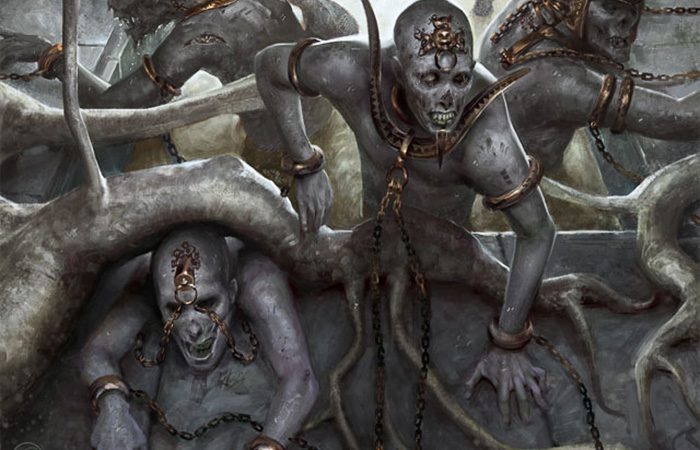
Magic: The Gathering art by Ryan Alexander Lee

Magic: The Gathering art by Ryan Alexander Lee

The Necromancer can be used either as a friendly faction that sends the PCs out on a mission, or as a foe that the PCs must overcome. Scarloth Vonidar studies necromancy in an old, haunted cave complex. He normally keeps to himself, but now he needs spell components to further his research.

As a friendly faction, Scarloth is a necromancer in name only; he’s a former druid who studies the arts of undeath to better understand the undead’s weaknesses, and maybe even find more powerful defenses against them. He found an out-of-the-way cave deep in the forest, not far from an old battleground that contains a mass grave, where he can raise and experiment on zombies in peace. The caves are further guarded by the ghosts of several dryads whom Scarloth befriended.

Plot hook: Scarloth needs poison sacs from gas spores as components in a spell that might weaken the undead. He’s located a cavern filled with fungi (and, unfortunately, a colony of ettercaps), travels in disguise to a nearby city, and hires the PCs to retrieve the sacs.

As a foe faction, Scarloth is no ordinary necromancer. Instead of just raising zombies to do his will, he seeks to understand the inner workings of undeath. To that end, he’s created a laboratory in a remote cave complex, where he raises and experiments on zombies. To guard the caves, he destroyed several nearby trees, and when dryads came to defend them, he killed them and turned them into ghosts that have no choice but to attack any except Scarloth who enter the caves.


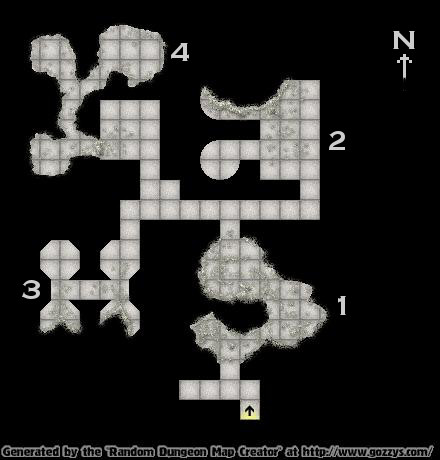
  1. The entrance leads to a natural cave haunted by 3 ghostly dryads. They have the stats of regular dryads, without spells but with the addition of a ghost’s ethereal sight, incorporeal movement, and etherealness abilities, and an AC of 12.
  2. Scarloth uses this chamber as his laboratory; it contains several tables filled with bubbling potions, and a zombie chained in the small holding area to the west. He’s currently enlarging it as he has time, but the new room to the north is unfinished.
  3. Pits in each of these rooms contain noxious liquids, into which Scarloth dips bodies, testing their effects when he raises them as zombies.
  4. Scarloth stores his supplies in the square chamber, and has left the rest of the caves untouched. Most of the supplies are mundane items, like food and tools, but the various magical reagants stored here would be very valuable to a spellcaster. If this adventure isn’t challenging enough for the party, these caves could be home to any number of predators, and could connect to a larger cave system.
Categories: Faction | Leave a comment