The Scheduling Post

"Calendar*" by dafnecholet on Flickr

“Calendar*” by dafnecholet on Flickr

Feel free to steal/modify this for your group:


Hi there! I know it can be hard to find time for gaming. But I need to establish a few ground rules.

From now on, at the end of each session, we’re going to agree on a date and time for the next session. By that I mean, before we leave, we’re going to spend just a few moments working out a date/time for next session. We don’t have to all agree, but we’ll come to a majority vote.

If you don’t verbally commit to attending, I’ll assume you’re not coming.

I need you to let me know by phone/email/text/Discord/Facebook at least 24 hours before a session if you can’t make it. I have to plan encounters, which I can’t do effectively if your fighting force is sudden reduced by one or two characters. I just won’t have enough time to plan. If I don’t receive enough warning ahead of time, another player will play your character.

If you show up without having committed, that’s great, and I’ll do my best to fit you in. I’d always rather have more players. Just be aware that I’ll have optimized the game for a smaller number of players, so the experience might be a little rougher than it would otherwise have been.

Categories: Uncategorized | Leave a comment

How to Get Minis 3D Printed

Deco Diselbot by Arian Croft

You’ve probably heard about 3D printing, and you’ve probably thought about 3D printed miniatures or terrain, but you probably don’t own a 3D printer. What to do?

You’ve got roughly four options, which I’ll describe here from the easiest (and most expensive) to the cheapest.

If you have no files and nothing to start with, just an idea, head over to HeroForge. Their site includes an incredibly customizable mini creation tool that works right in your browser. Choose from a huge variety of body types and measurements, clothes, items, helmets, boots, and so forth. They’ll then 3D print it in materials ranging from nylon plastic (USD $15) to steel ($35) and ship it directly to you. They can’t do terrain or anything beyond the minis you can build there, but what a great resource!

If you’re looking for a bit more flexibility, Shapeways has a section of pre-generated character models (and many, many other models, too). You choose a model on the site, and they’ll 3D print and ship it to you. They have a relatively limited range of models, unfortunately, and you can’t customize them, but you can find minis or terrain that you just can’t build with HeroForge.

But Shapeways is far from the only site offering mini files. You can search online for a 3D model of your character, using sites like Thingiverse and Yeggi. You can then upload that to Shapeways for printing, or try one of the options below.

3D Hubs will connect you with someone near you who owns a 3D printer. You can treat this in basically one of two ways: You can just upload a file you’ve found online, use the service to match you with a local 3D printer owner, and treat the rest of the transaction like it’s any other commercial site: order your file and have it sent to you. Or, you can treat it as more like a local social network that connects 3D printer owners with folks who want things printed. You can communicate with the owner about the file you want printed, explain exactly what you want, and even meet up with him or her at a public place to pick up your printed object. You can build a longer-term relationship with that owner and have a bunch of things printed, with a lot more flexibility and options than you’d get if you’re just making an order on Shapeways.

But the ultimate flexibility comes from a local makerspace or hackerspace. You might have one very close to you (search for a local makerspace here), and most of them have 3D printers. Members will almost certainly be willing to help you 3D print your object, and teach you how to operate their 3D printers yourself, so you can print as many objects as you want. Some makerspaces even sponsor 3D printer build clubs, so you can build your own 3D printer.

Categories: Uncategorized | Leave a comment

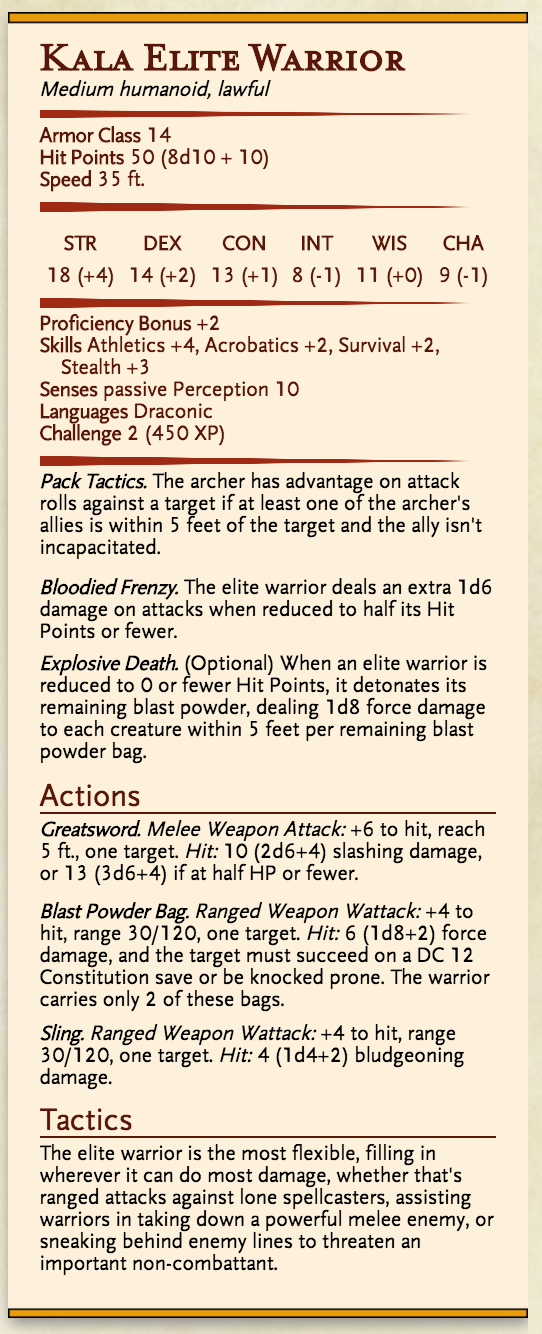
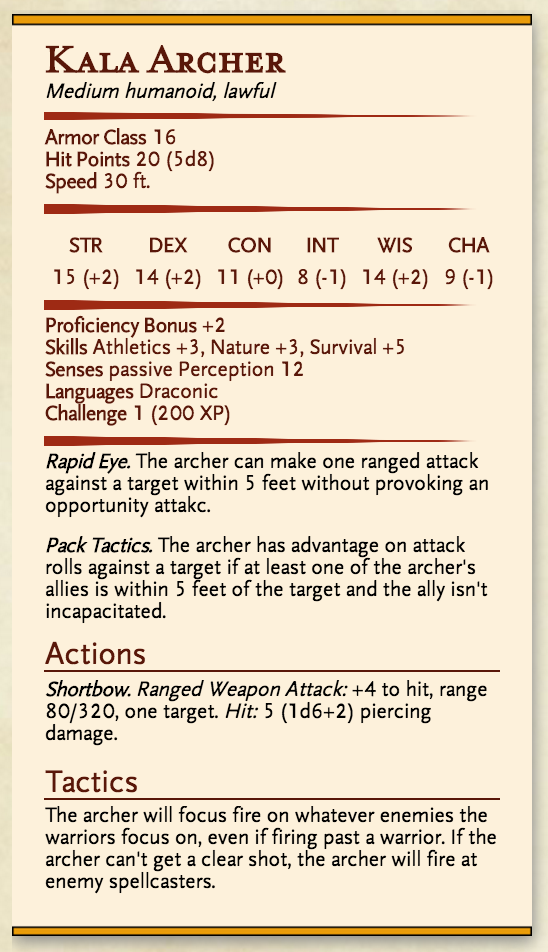
Monster Monday: Kala Warrior of Tarakona

Credit: Anonymous

The savage continent of Tarakona, where draconic races battle for supremacy!

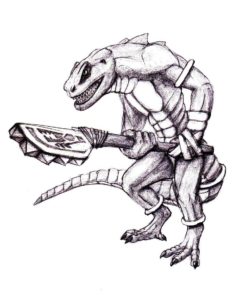
The fearsome, combative, plains-dwelling Kala people (think lizardfolk) pride themselves on their fierce warriors, who wade into battle and gang up on the most powerful enemy.

It’s easy for melee combat in D&D and other fantasy RPGs to get predictable. Melee monsters spread out amongst the front-line PCs, while ranged monsters stick to the back and look for where they can do most damage.

Kala Warriors are different. They will all coordinate to take down the biggest enemy, regardless of other powerful melee fighters in the battle. While this may cost them one or two warriors, their pack tactics can brutalize even a high-HP barbarian or paladin that the party counts on to hold the line, quickly shifting the tide of battle. Combine this with kala archers and warcasters for a tough battle.

As such, if you’re dropping the kala warrior alone into your campaign, beware that it can do a lot of damage in groups. Use slightly fewer than you normally would until you’re sure of how the PCs will deal with them.


Text version of stat block:


Kala Warrior

Medium humanoid, lawful


  • Armor Class 16
  • Hit Points 26 (5d8 + 4)
  • Speed 30 ft.

|STR|DEX|CON|INT|WIS|CHA|
|:—:|:—:|:—:|:—:|:—:|:—:|
|15 (+2)|14 (+2)|13 (+1)|8 (-1)|11 (+0)|9 (-1)|


  • Proficiency Bonus +2
  • Skills Athletics +3, Nature +2, Survival +4
  • Senses passive Perception 10
  • Languages Draconic
  • Challenge 1 (200 XP)

Pack Tactics. The warrior has advantage on attack rolls against a target if at least one of the warrior’s allies is within 5 feet of the target and the ally isn’t incapacitated.

Bloodied Frenzy. The warrior deals an extra 1d8 damage on attacks when reduced to half its Hit Points or fewer.

Actions

Longsword. Melee Weapon Attack: +4 to hit, reach 5 ft., one target. Hit: 6 (1d8+2) slashing damage, or 10 (2d8+2) if at half HP or fewer.

Tactics

Warriors seek out and gang up on the most powerful enemy in the battle, taking advantage of pack tactics.

Categories: Monsters, Tarakona | Leave a comment

Faction Friday: The Eyetooth Cult

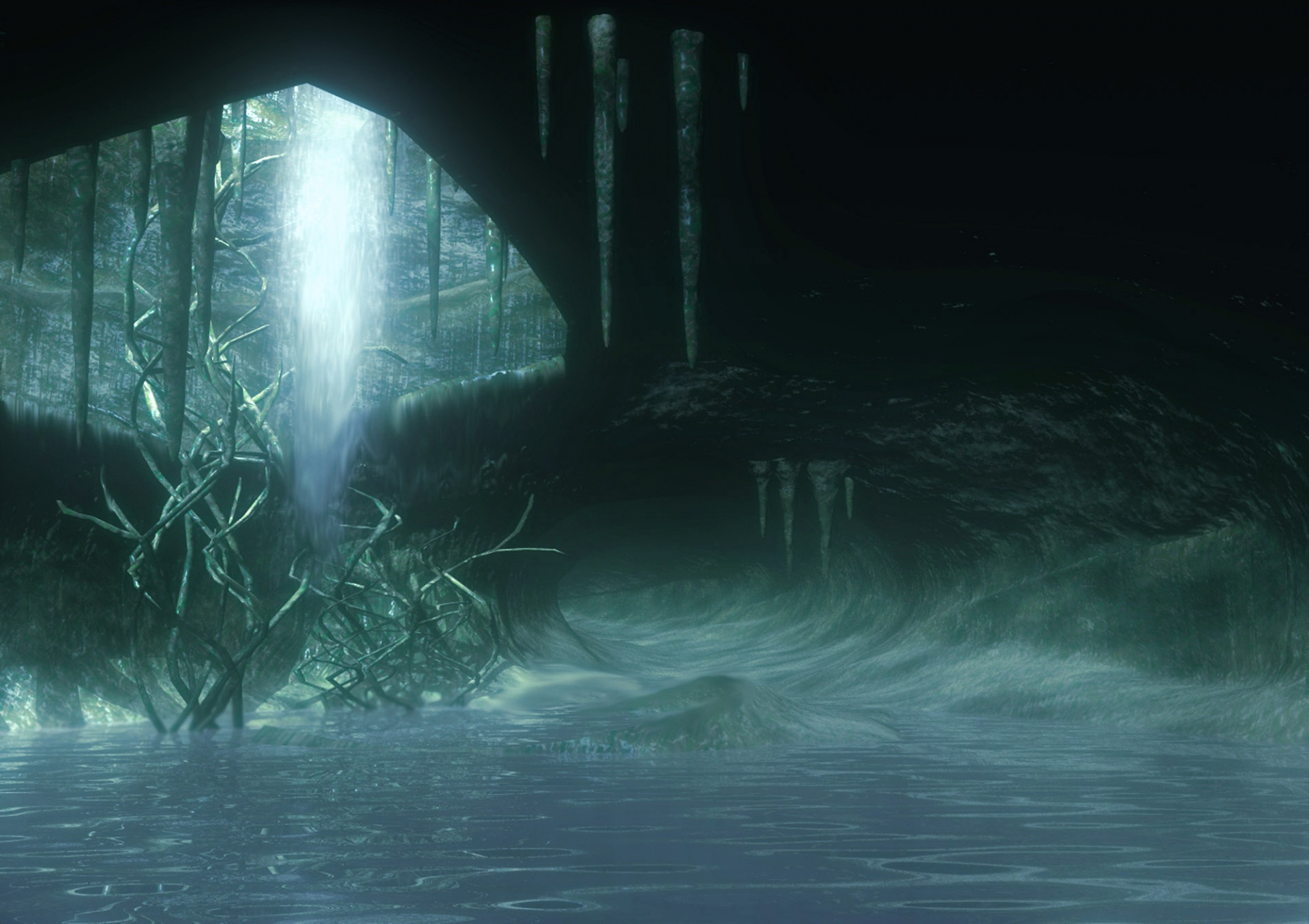
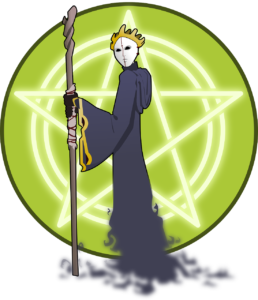
The Eyetooth Cult can be used either as a friendly faction that sends the PCs out on a mission, or as a foe that the PCs must overcome. It is led by Bariam Incisor, an old human man who wears a black, hooded cloak and carries a gnarled staff. The cult bases itself in an abandoned crypt where a werewolf is interred.

As a friendly faction, the Eyetooth Cult is a small cult to Cala, a canine god. Their leader has set himself up in an abandoned crypt to a powerful werewolf, where he’s careful not to desecrate anything, and his followers meet here once a week to perform simple rituals.

Plot hook: An enemy group has stolen Bariam’s staff of dreaming, which is a symbol of his authority within the cult. He pays handsomely for its return. The enemy group wants it to invade the dreams of a foe.

As a foe faction, the Eyetooth Cult is a pack of gnolls led by a werewolf who controls them with a staff of domination. He has secreted the gnolls in an abandoned crypt to a powerful werewolf, who he wants to raise as an undead servant.

Plot hook: The cult has been raiding nearby settlements (even dominated gnolls need food). During a recent raid, the village’s healer saw the staff and realized its purpose, and the village elders will pay the PCs to bring back the staff, broken, as proof that Bariam’s power is no longer.

The Crypt of Callahan
Room 1: Entrance Room 2 Room 3
Friendly: Two acolytes sit at a small, book-covered table in this small stone entrance chamber, studying their books.

Foe: Two gnolls keep watch in this small stone entrance chamber.

This otherwise empty chamber contains three sarcophagi (one along each side wall and a large one at the end) and four gargoyles. Stepping on any of the floor tiles in a 10’x10′ square at the room’s entrance causes darts to fire at the triggering creature (1d8 damage; DC 12 Dexterity saving throw for half damage). A DC 15 Wisdom (Perception) check will identify the trap. Moving past the trap causes the gargoyles to animate if the intruders are unknown to them.

The cult usually performs its rituals in this chamber. Three copper ritual bowls lay on top of the large sarcophagus.

Each sarcophagus is carved with the image of a half-man, half-wolf. Each contains the skeleton of a human; the main sarcophagus also contains a small gold ring.

Bariam spends much of his time in this chamber off the main crypt. It contains a simple bed, chair, and table, on top of which are stacks of books about lycanthropy.

If attacked, this room will contain a force of cultists or gnolls guarding Bariam. A creature within 5 feet of Bariam can make a DC 15 Strength check to wrest the staff away from him and break it. Doing so ends his control of the gnolls, and they will attack anyone they please.


Categories: Faction | Leave a comment

Your villain should be like your PCs except in one way

VillainYour villain should be industrious and productive, just like the heroes.

Your villain should be committed to her or his cause, just like the heroes. Your villain should be convinced that she or he is right, and have reasonable justifications for her or his behavior.

Your villain should inspire others to follow the same cause, just like the heroes.

However…

Your villain should be willing to do anything to accomplish her or his goals. Murder, theft, bribery, kidnapping; all of it is defensible in pursuit of a goal. The villain may not relish taking those actions, but the villain must be willing to take those actions.

Categories: Role-playing | 1 Comment

Do you like isometric dungeon maps?

Would you have any interest in seeing more maps like this?

It’s a bad photo of a line drawing, so if I did this more often, I’d make it much cleaner (and I’d add a symbol pointing north).

I enjoyed drawing it, but I don’t know if anyone would find it useful. Please comment if you’d like me to draw more of them, a la Dyson Logos.

Isometric map

Categories: Maps | Leave a comment

Have you ever had a die break?

Check this out:

Broken die

Found it in my big bag of spare dice.

I like to think that the dice gods said, “Nope, rolled poorly too many times.”

Categories: Uncategorized | 1 Comment

Monster Monday: Kala Warcaster of Tarakona

Kala Warcaster

Art for Pathfinder “Hell or High Water” book; artist uncredited

The savage continent of Tarakona, where draconic races battle for supremacy!

The fearsome, combative, plains-dwelling Kala people (think lizardfolk) send spellcasters into battle along with their warriors and archers. The kala warcaster is a ranged support fighter, corralling enemies with walls of force, churning up ground into difficult terrain, and blasting enemies that get too near.

Because Tarakona is designed as a foreign, unexplored continent, the warcaster uses unique spells, outlined in its stat block.

If you’re dropping the warcaster alone into your campaign, it livens up a battle with its unusual tactics.

Text version of stat block:

Kala Warcaster

Medium humanoid, lawful


  • Armor Class 11
  • Hit Points 25 (5d8 + 3)
  • Speed 30 ft.

|STR|DEX|CON|INT|WIS|CHA|
|:—:|:—:|:—:|:—:|:—:|:—:|
|10 (+0)|12 (+1)|13 (+1)|12 (+1)|15 (+2)|11 (+0)|


  • Proficiency Bonus +2
  • Skills Perception +4, Nature +3, Medicine +4
  • Senses passive Perception 14
  • Languages Draconic
  • Challenge 2 (450 XP)

Spellcasting. The warcaster is a 4th-level spellcaster. Its spellcasting ability is Wisdom (spell save DC 12, +4 to hit with spell attacks). It casts from a non-standard spell list, so its standard combat spells are listed below.

Actions

Blast of Overwhelming Force. Melee Spell Attack: +4 to hit, reach 10 ft., one target. Hit: 6 (1d8+2) force damage, and the target must make a DC 12 Consitution save or be pushed back 10 feet.

Prayer of Blessed Healing. Up to 3 creatures the warcaster can see within 50 feet gain 2d4 temporary Hit Points.

Perimeter of Total Defense. Concentration, up to 1 minute. The warcaster creates an invisible wall of force 10 feet high, 1 foot thick, and up to 30 feet long, which can turn 90 degrees every 5 feet as desired. The wall can be enclosed on itself. The wall has Armor Class 10 and 20 Hit Points.

Corruption of Firm Ground. An area 30 feet wide shakes and crumbles, becoming difficult terrain. All creatures within the area are knocked prone and must make a DC 12 Dexterity saving throw or take 1d8 thunder damage.

Tactics

The warcaster uses corruption of firm ground on enemies as they approach, then perimeter to keep them away from allies (especially archers), switching to prayer if enough allies are damaged. If an enemy gets within melee range of the warcaster, it uses blast then moves 30 feet away.

Categories: Monsters, Tarakona | Leave a comment

How to Prepare a One-Shot RPG Session

"OC-2013-8143" by mattlephotography.com

By mattlephotography.com

Let’s say you’re going to run a game at a convention, or you want to introduce a new system to your regular players who may not continue beyond one session. That’s what I’m calling a one-shot for this article: a self-contained tabletop RPG session, where you don’t expect to return to the characters or world.

Since this is such a different experience than so many games, you’ll want to approach it differently:

Create interesting characters. Make sure the characters are vibrant, with stronger personalities than you’d normally make. Remember, the players will only have a few opportunities over the course of a few hours to really act out with that character, so the character needs to be strong, memorable, and easy to grasp.

Make sure the player characters’ goals relate to each other. With so little time, it’s easy for each PC to just act in his or her own self-interest. Each PC should have a specific bond to at least one other PC (“Sara saved Melanie’s life last week,” “Carroll is Johann’s best friend,” “Fred is so amazed by Tara’s mystical abilities that he trusts them implicitly”). This will make it easier for the players to include each other and back each other up.

Set the session at an interesting location. Again, since you have so little time, make sure it’s a place that the players can latch onto easily and won’t soon forget. Make a little more bizarre or off-kilter than your typical place. For a crime investigation game, place the murders at a carnival. Set an epic fantasy RPG in a crystal tower or an Aztec-style jungle city.

Also give the characters a strong reason to be at that location. Since you’ll only be playing this once, you can tie the characters closer to the backstory. Maybe the crime scene investigators are all employees of the carnival. Maybe the fantasy explorers were captured and will be sacrificed to the sun god at dawn by the Aztec-style civilization.

Now that you have characters and location, you’ll have a good idea of the basic building blocks of the scenario: the big problem that the PCs have to solve, the obstacles in their way, and the various ways they can solve the problem.

This gets to one of the toughest things about one-shots: time. Some players will breeze through a scene that you thought would take an hour, while others will draw out a scene you thought would pass quikcly. Make sure you create more content than you think you’ll need, but modularized. In other words, if you can think of the session as a series of scenes, set up more scenes than you’ll probably need. Just make sure that you can drop a few scenes to make the session shorter than you think you’ll need.

Now that you have a good idea of all the elements of your session, you can think about props. A physical prop or two pulls players into the fictional world (which can be particularly helpful in a noisy, distracting convention environment). This can be as “simple” as a map or letter printed onto a piece of paper that you stain in a tea bath to jewelry representing magical artifacts or talismans (craft stores often sell inexpensive, fantastical jewelry in their make-your-own-jewelry aisle) to 3D printed objects like skulls. Of course, this is completely optional, but it’s worth looking over the adventure for items that you could easily fabricate or cheaply buy.

As you finalize the game and prepare character sheets, look for (or write) rules summaries that you can print and hand out to players. Keep these to one side of one piece of paper; just the core rules that the players are most likely to encounter. It can be terse, too. If you’re playing with a simple enough system, you might be able to include that on the character sheet itself!

And there you have it! That should ensure a fun session that fills its time nicely, where the players can dive deep into their characters and the setting.

Categories: Role-playing | Leave a comment

Why you should playtest

"service-design-41" by tobiastoft on Flickr

“service-design-41” by tobiastoft on Flickr

I’ve run across a surprising number of people who will design a tabletop RPG, then publish it without doing any playtesting. I’ll admit it: I was one of them.

To be clear, I’m not talking about folks who throw together a simple RPG, then publish it on their blog as an early draft for feedback. And I’m not talking about people working against a contest deadline.

I’m talking about designers who never playtest. This post is for you.

Why should you playtest your games?

1) Your words aren’t clear to other people

It’s clear to you, and it looks like it will be clear to other people. But folks have all sorts of different experiences and exposures to games. You may use terminology they’ve never come across.

Even beyond that, writing clear rules is hard. It’s very easy for players to find loopholes, or interpretations that let them break the game.

2) Math gets out-of-whack quickly and in surprising ways

That dice mechanic that seems so elegant in your head will work great in the scenarios you’ve thought of, but what happens when someone pushes it? What happens with a group of jokesters, or serious RPers, or GMs who like to throw very hard challenges at the players?

How many bonuses can someone add to that die roll? Can a PC overwhelm the odds?

3) You can’t know what parts won’t work together

So far, I’ve been talking just about atomic pieces of the game. All the pieces of your game have to work together. Those interactions can cause all sorts of havoc in the actual game.

Here’s an example: the rules say you can apply bonuses from “relevant skills” to a die roll. What happens when a PC builds all of her skills around a certain task, then applies all of them to the same roll?

Or let’s say you’re making a traditional epic fantasy, dungeon crawling game that includes healing potions. Have you looked at the price of healing potions, and made sure that PCs aren’t making enough in treasure to just load up on 10 healing potions each before every encounter?

4) Why spend a lot of time on mechanics that you’ll likely change?

This may sound counter-intuitive, but bear with me. Let’s say you have a reasonable idea for a mechanic in your game. Write it down, then move on to another part of your game. Don’t spend lots of time fiddling with the math. Write down a reasonable mechanic, then playtest it. Playtest it as much as possible. The playtest will tell you how the math should work, and any weaknesses in the rules themselves.

Adjust based on player feedback, not based on the voices in your head telling you how it should be.


Categories: Game Design Hour | Leave a comment